
Close Menu
    Facebook X (Twitter) Instagram
    SciTechDaily
    • Biology
    • Chemistry
    • Earth
    • Health
    • Physics
    • Science
    • Space
    • Technology
    Facebook X (Twitter) Pinterest YouTube RSS
    SciTechDaily
    Home»Earth»Severe Drought in the Czech Republic Visible From Space
    Earth

    Severe Drought in the Czech Republic Visible From Space

    By European Space Agency (ESA)May 18, 2020No Comments4 Mins Read
    Facebook Twitter Pinterest Telegram LinkedIn WhatsApp Email Reddit
    Share
    Facebook Twitter LinkedIn Pinterest Telegram Email Reddit
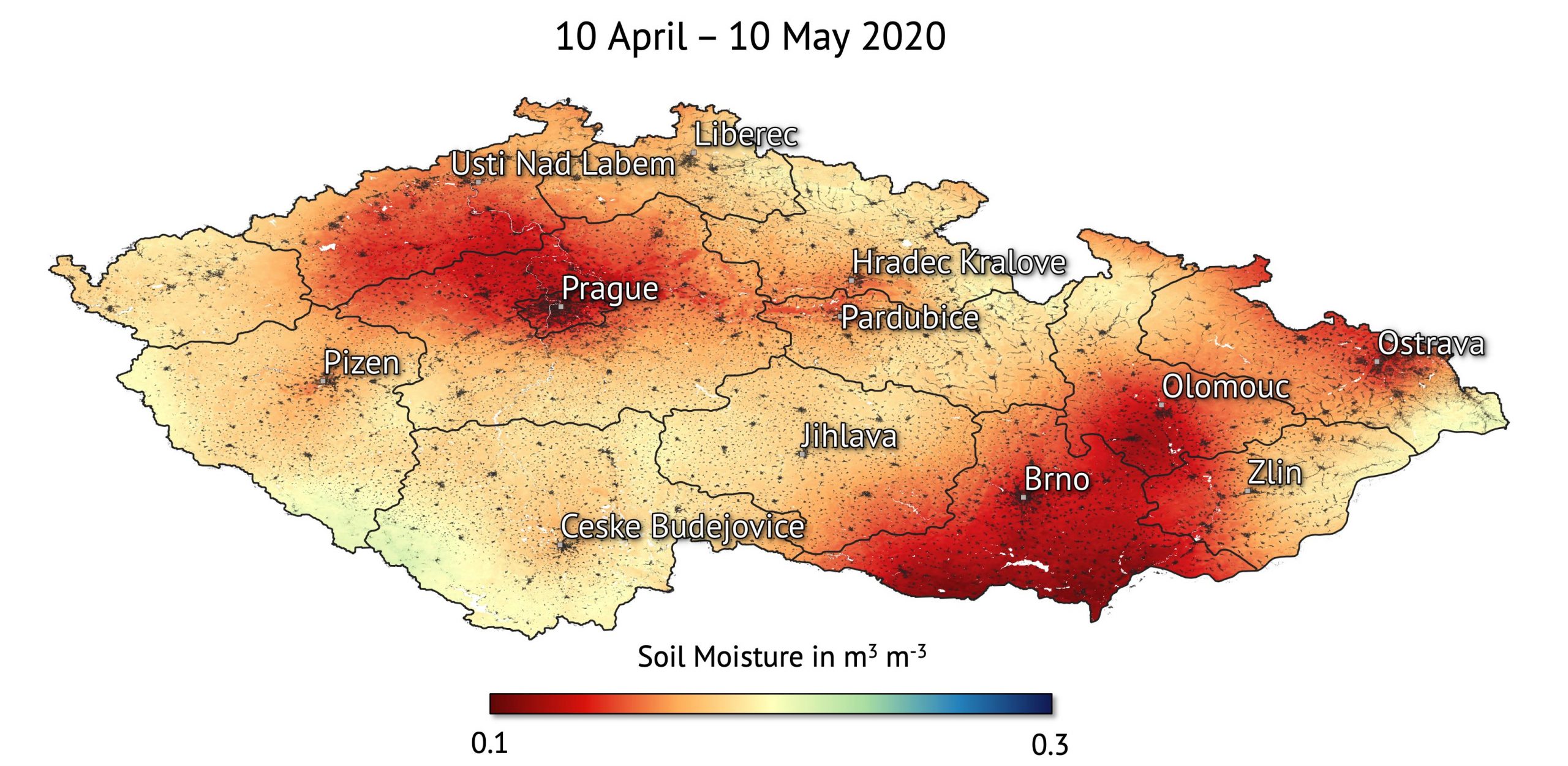
    Czech Republic Soil Moisture 2020

    This map shows the average soil moisture conditions from April 10 to May 10, 2020. The map uses data from ESA’s SMOS satellite, the EU’s Copernicus Sentinel missions, along with data from NASA and the Japanese space agency JAXA missions. Credit: VanderSat

    The prolonged period of dry weather in the Czech Republic has resulted in what experts are calling the ‘worst drought in 500 years.’ Scientists are using ESA satellite data to monitor the drought that’s gripped the country.

    Recent maps, produced by the Dutch company VanderSat, show the extent of the recent drought in the Czech Republic. The maps show drier-than-usual soil moisture conditions from 10 April to 10 May 2020, compared to the average observations over the same period over the past six years (2015-2020).

    Some areas display a 30% difference compared to the average, with the Olomouc and Ústí regions appearing to be the most affected.
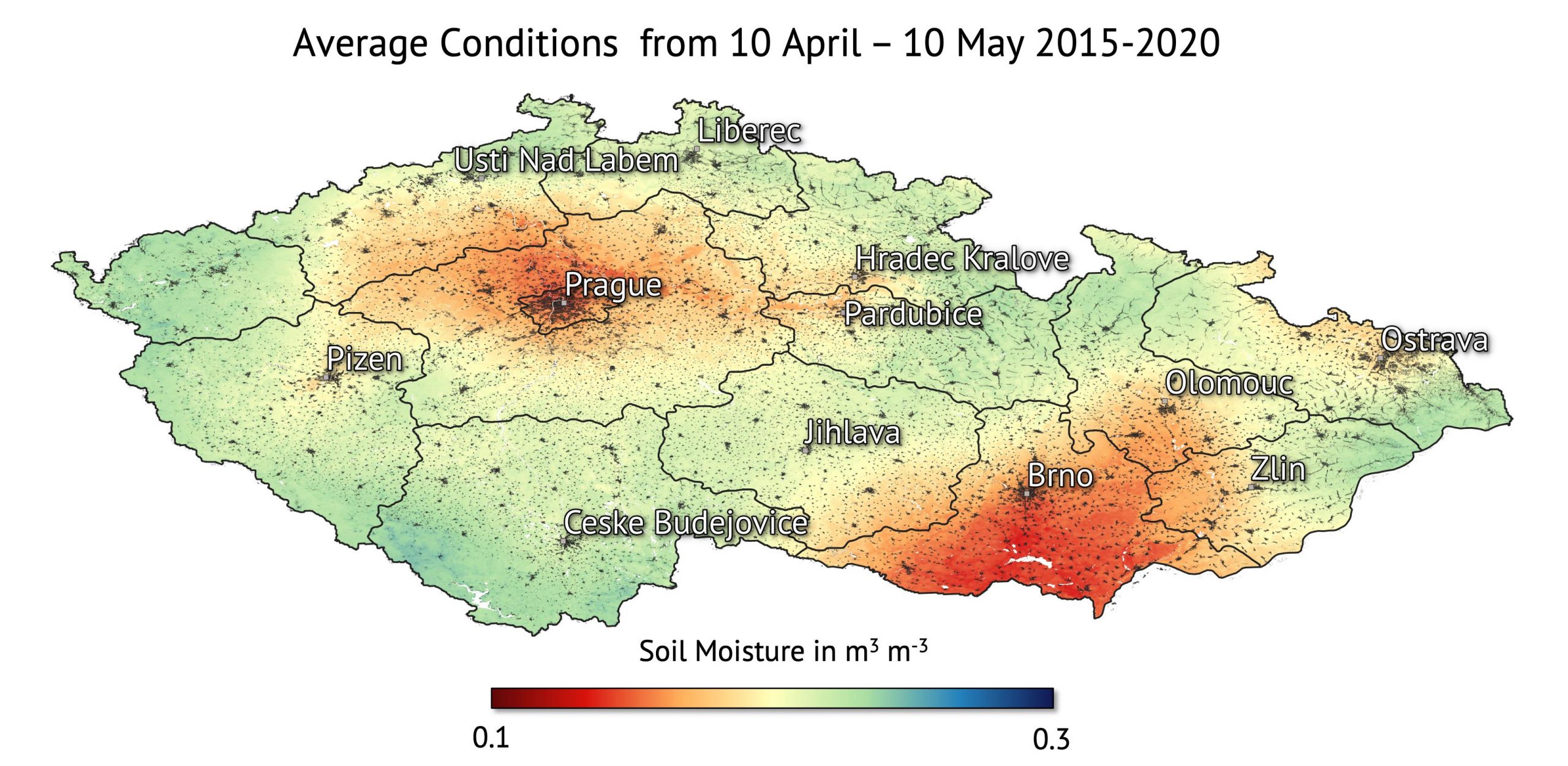
    Czech Republic Soil Moisture Average
    This map shows the average soil moisture conditions from April 10 to May 10, 2015-2020. The map uses data from ESA’s SMOS satellite, the EU’s Copernicus Sentinel missions, along with data from NASA and the Japanese space agency JAXA missions. Credit: VanderSat

    The sequence of images on this page show the extent of the recent drought.

    Richard de Jeu, from VanderSat, comments, “When compared to the average, or what we consider ‘normal’ conditions, a 30% difference in spring can be considered catastrophic for agriculture and nature if this drought persists throughout the summer.”

    Droughts are major natural hazards and have wide-reaching economic, social, and environmental impacts. Globally, severe droughts are considered the number one threat to farmers – regularly endangering crop yield and business for farmers.
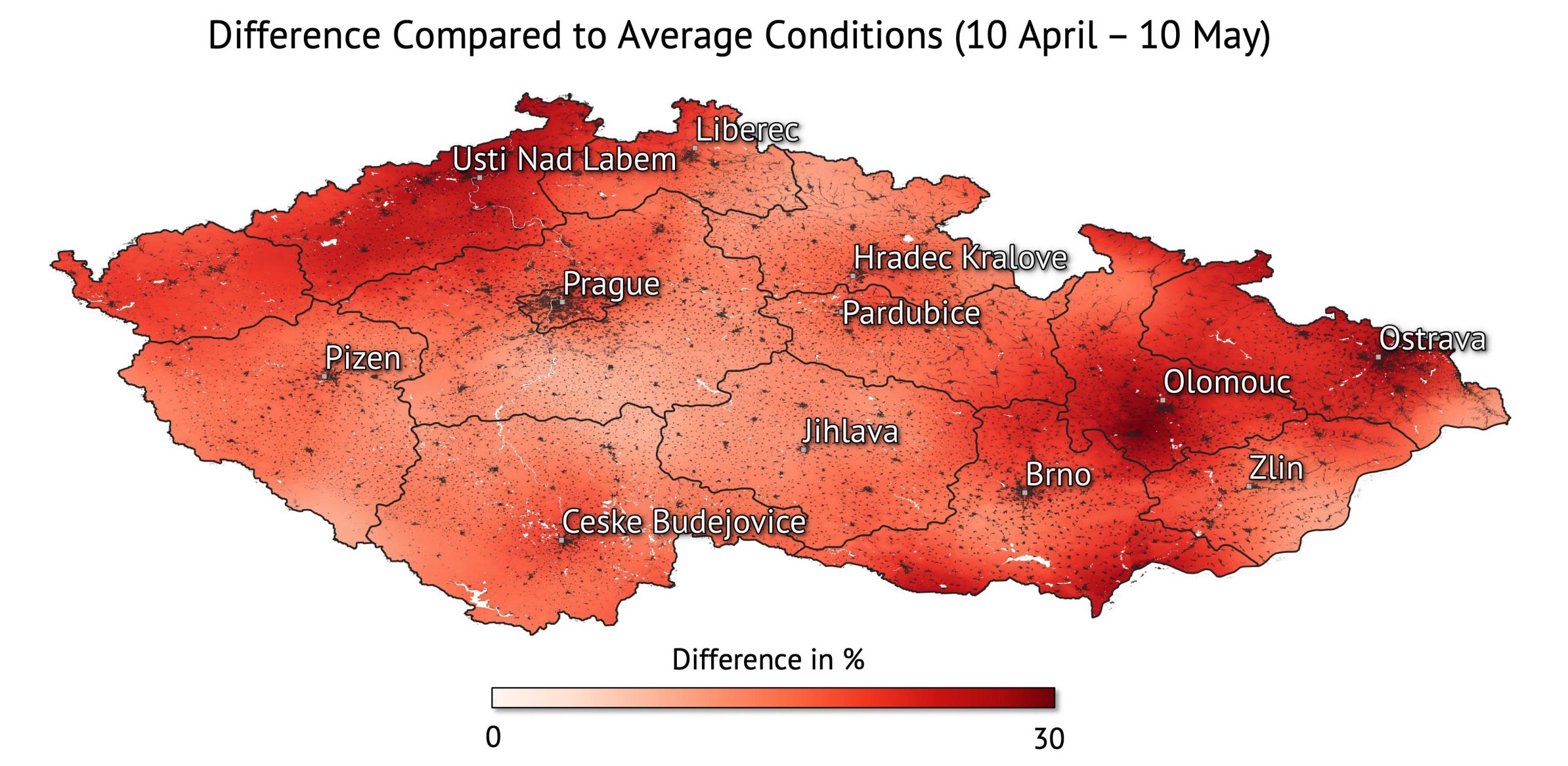
    Czech Republic Soil Moisture Difference
    This map shows the difference of soil moisture conditions in percentages – with some regions showing a difference of up to 30%. The map uses data from ESA’s SMOS satellite, the EU’s Copernicus Sentinel missions, along with data from NASA and the Japanese space agency JAXA missions. Credit: VanderSat

    Climate change is exacerbating drought in many parts of the world – increasing its frequency, severity, and duration. With 2020 expected to be one of the hottest years on record, drought monitoring is crucial.

    VanderSat uses data from ESA’s SMOS satellite and the EU’s Copernicus Sentinel missions, combined with data from NASA and the Japanese space agency JAXA missions, to measure soil moisture across the globe. These data can help farmers to insure and protect themselves against the impact of agricultural drought for specific regions of interest.

    Richard continues, “Satellite soil moisture data serves as a crucial layer for agricultural drought insurance across the globe and is heavily used to support agricultural practices. It is thanks to data from ESA’s SMOS satellite and the Copernicus Sentinels missions that make our soil moisture service possible.”

    SMOS in Orbit

    The Soil Moisture and Ocean Salinity (SMOS) mission makes global observations of soil moisture over Earth’s landmasses and salinity over the oceans. Variations in soil moisture and ocean salinity are a consequence of the continuous exchange of water between the oceans, the atmosphere and the land – Earth’s water cycle. Credit: ESA/AOES Medialab

    Klaus Scipal, ESA’s SMOS Mission Manager, says, “It is impressive to see that even after 10 years of operations, SMOS is still in a very healthy condition and it keeps on delivering high-quality data to support sectors like the agribusiness and many others. SMOS delivers 96% of its data in less than three hours of sensing, which allows companies like Vandersat to make their observations instantly available to the agribusiness sector.”

    Launched in 2009, SMOS is one of ESA’s Earth Explorer missions – which form the science and research element of the Living Planet Programme. The SMOS satellite carries a novel interferometric radiometer that captures ‘brightness temperature’ images. These images are used to derive global maps of soil moisture every three days, achieving an accuracy of 4% at a spatial resolution of about 50 km – comparable to detecting one teaspoon of water mixed into a handful of soil.

    Never miss a breakthrough: Join the SciTechDaily newsletter.
    Follow us on Google and Google News.

    Drought European Space Agency Weather
    Share. Facebook Twitter Pinterest LinkedIn Email Reddit

    Related Articles

    Drought Causes Yangtze – China’s Most Important River – To Dry Up

    Utah’s Great Salt Lake Is Disappearing – Megadrought Persists Across the US Southwest

    Po River – The Longest River in Italy – Dries Up

    Dwindling Water Levels of Lake Powell Seen From Space – Second-Largest Man-Made Reservoir in the US

    ESA’s Earth Explorer Satellite SMOS Monitoring Droughts [Video]

    Amazon Area Twice the Size of California Still Suffering From the Effects of a Megadrought

    Rising Temperatures & Persistent Drought Threaten to Create a Second Dust Bowl

    Effects of Drought in the U.S. are Now Visible from Space

    MSG-3 Weather Satellite Captures Its First Image of Earth

    Leave A Reply Cancel Reply

    • Facebook
    • Twitter
    • Pinterest
    • YouTube

    Don't Miss a Discovery

    Subscribe for the Latest in Science & Tech!

    Trending News

    Scientists May Have Found the Key to Jupiter and Saturn’s Moon Mystery

    Scientists Uncover Brain Changes That Link Pain to Depression

    Saunas May Do More Than Raise Body Temperature – They Activate Your Immune System

    Exercise in a Pill? Metformin Shows Surprising Effects in Cancer Patients

    Hidden Oceans of Magma Could Be Protecting Alien Life

    New Study Challenges Alzheimer’s Theories: It’s Not Just About Plaques

    Artificial Sweeteners May Harm Future Generations, Study Suggests

    Splashdown! NASA Artemis II Returns From Record-Breaking Moon Mission

    Follow SciTechDaily
    • Facebook
    • Twitter
    • YouTube
    • Pinterest
    • Newsletter
    • RSS
    SciTech News
    • Biology News
    • Chemistry News
    • Earth News
    • Health News
    • Physics News
    • Science News
    • Space News
    • Technology News
    Recent Posts
    • Ancient DNA Reveals Irish Goats Have a 3,000-Year-Old Lineage Still Alive Today
    • Historians Reveal Secrets of the Strange Hat Wars That Shook Early Modern England
    • “A Plague Is Upon Us”: The Mass Death That Changed an Ancient City Forever
    • This Strange Material Can Turn Superconductivity on and off Like a Switch
    • Scientists Discover Game-Changing New Way To Treat High Cholesterol
    Copyright © 1998 - 2026 SciTechDaily. All Rights Reserved.
    • Science News
    • About
    • Contact
    • Editorial Board
    • Privacy Policy
    • Terms of Use

    Type above and press Enter to search. Press Esc to cancel.