
Close Menu
    Facebook X (Twitter) Instagram
    SciTechDaily
    • Biology
    • Chemistry
    • Earth
    • Health
    • Physics
    • Science
    • Space
    • Technology
    Facebook X (Twitter) Pinterest YouTube RSS
    SciTechDaily
    Home»Space»The Saturnian Sisters – Cassini Views Tethys and Rhea
    Space

    The Saturnian Sisters – Cassini Views Tethys and Rhea

    By SciTechDailyMarch 8, 2016No Comments2 Mins Read
    Facebook Twitter Pinterest Telegram LinkedIn WhatsApp Email Reddit
    Share
    Facebook Twitter LinkedIn Pinterest Telegram Email Reddit
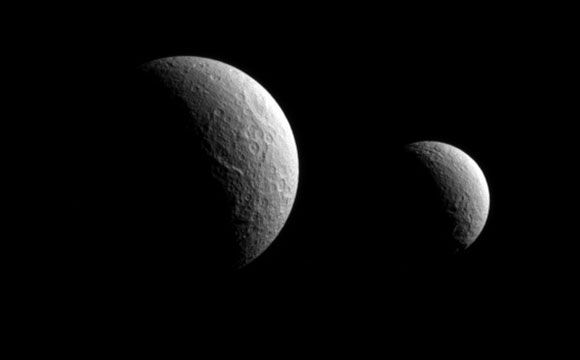
    Cassini Views Tethys and Rhea
    Saturn’s moons Tethys and Rhea (left and right, respectively). Credit: NASA/JPL-Caltech/Space Science Institute

    This newly released image from the Cassini Spacecraft shows Saturn’s moons Tethys and Rhea.

    Similar in many ways, Saturn’s moons Tethys and Rhea (left and right, respectively) even share a discoverer: Giovanni Cassini, namesake of the NASA spacecraft that captured this view.

    The moons are named for sisters — two Titans of Greek mythology. Although somewhat different in size, Rhea (949 miles or 1,527 kilometers across) and Tethys (660 miles or 1,062 kilometers across) are medium-sized moons that are large enough to have pulled themselves into round shapes. They are both composed largely of ices and are generally thought to be geologically inactive today.

    The view looks toward the anti-Saturn sides of Tethys and Rhea. North on both moons is up. The image was taken in visible red light with the Cassini spacecraft narrow-angle camera on October 11, 2015.

    The two moons appear close together here, but Tethys was about 220,000 miles (360,000 kilometers) farther away from Cassini when the image was captured — nearly the distance from Earth to our moon. Thus, the view does not accurately reflect the bodies’ relative sizes.

    The image was obtained at a distance of approximately 708,000 miles (1.14 million kilometers) from Rhea. Image scale on Rhea is 4 miles (7 kilometers) per pixel. Tethys was 930,000 miles (1.5 million kilometers) away during this observation and has a pixel scale of 6 miles (9 kilometers) per pixel.

    Never miss a breakthrough: Join the SciTechDaily newsletter.
    Follow us on Google and Google News.

    Astronomy Planetary Science Popular Rhea Saturn Tethys
    Share. Facebook Twitter Pinterest LinkedIn Email Reddit

    Related Articles

    Cassini Views Saturn’s Icy Moon Tethys

    Ices and Shadows – Cassini Views Saturn’s Moon Tethys

    Cassini Spacecraft Image Shows the Difference between Janus and Tethys

    New Cassini View of Saturn and Tethys

    New Cassini Image Shows Tethys Dwarfed by Saturn and Its Rings

    Scientists Pinpoint the Position of Saturn

    Astronomers Discover Rain Falling From Saturn’s Rings

    Storm Spawns the Largest Tropospheric Vortex Ever Seen on Saturn

    Simulation May Explain Saturnian System

    Leave A Reply Cancel Reply

    • Facebook
    • Twitter
    • Pinterest
    • YouTube

    Don't Miss a Discovery

    Subscribe for the Latest in Science & Tech!

    Trending News

    Scientists Built a Programmable Chip That Can Slow Light on Command

    The Backyard “Silly Sprinkler” That Cracked One of Physics’ Biggest Puzzles

    This Common Sleep Habit Could Be Making You Gain Weight

    Mathematician Offers New Solution to a Fundamental Cosmic Paradox

    Scientists Turn Plastic Waste Into Clean Hydrogen Fuel

    Long COVID Brain Scans Reveal Damage to Dopamine Neurons

    Scientists Warn a Silent Oxygen Crisis Is Spreading Through Earth’s Waters

    James Webb Telescope Discovers Hidden Giant Planet in Famous Star System

    Follow SciTechDaily
    • Facebook
    • Twitter
    • YouTube
    • Pinterest
    • Newsletter
    • RSS
    SciTech News
    • Biology News
    • Chemistry News
    • Earth News
    • Health News
    • Physics News
    • Science News
    • Space News
    • Technology News
    Recent Posts
    • Scientists Discover Two Competing Memories in Matter
    • Quantum Heat Waves Spotted at Room Temperature for the First Time
    • Invisible Black Holes Could Be Triggering Supernovae
    • Scientists Test Natural Compounds Against Sarcoma: Which One Shows the Most Promise?
    • Singapore Has the World’s Longest, Healthiest Lives – but It Comes With a Hidden Cost
    Copyright © 1998 - 2026 SciTechDaily. All Rights Reserved.
    • Science News
    • About
    • Contact
    • Editorial Board
    • Privacy Policy
    • Terms of Use

    Type above and press Enter to search. Press Esc to cancel.