
Close Menu
    Facebook X (Twitter) Instagram
    SciTechDaily
    • Biology
    • Chemistry
    • Earth
    • Health
    • Physics
    • Science
    • Space
    • Technology
    Facebook X (Twitter) Pinterest YouTube RSS
    SciTechDaily
    Home»Space»Cassini Views Saturn’s Moons Enceladus and Tethys
    Space

    Cassini Views Saturn’s Moons Enceladus and Tethys

    By Jia-Rui C. Cook, Jet Propulsion LaboratoryApril 18, 2012No Comments3 Mins Read
    Facebook Twitter Pinterest Telegram LinkedIn WhatsApp Email Reddit
    Share
    Facebook Twitter LinkedIn Pinterest Telegram Email Reddit
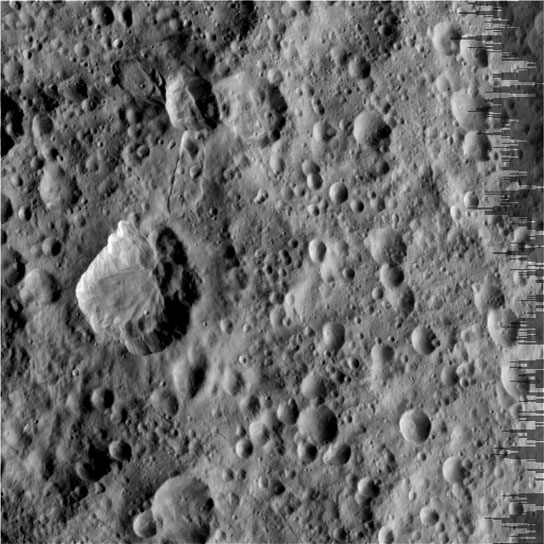
    images of Saturn's moons Enceladus and Tethys
    This image was taken by NASA’s Cassini spacecraft on April 14, 2012. The camera was pointing toward TETHYS at approximately 10,875 miles (17,502 kilometers) away. Credit: NASA/JPL/Space Science Institute

    NASA’s Cassini spacecraft captured surface temperature measurements with its composite infrared spectrometer and several images as it completed its flyby of Saturn’s moons Enceladus and Tethys. Scientists plan on using this new data, combined with previous data, to create digital elevation maps of Tethys.

    These raw, unprocessed images of Saturn’s moons Enceladus and Tethys were taken on April 14, 2012, by NASA’s Cassini spacecraft.

    Cassini flew by Enceladus at an altitude of about 46 miles (74 kilometers). This flyby was designed primarily for the ion and neutral mass spectrometer to analyze, or “taste,” the composition of the moon’s south polar plume as the spacecraft flew through it. Cassini’s path took it along the length of Baghdad Sulcus, one of Enceladus’ “tiger stripe” fractures from which jets of water ice, water vapor and organic compounds spray into space. At this time, Baghdad Sulcus is in darkness, but that was not an obstacle for another instrument, the composite infrared spectrometer, which can see features by their surface temperatures and which also took measurements during this flyby.
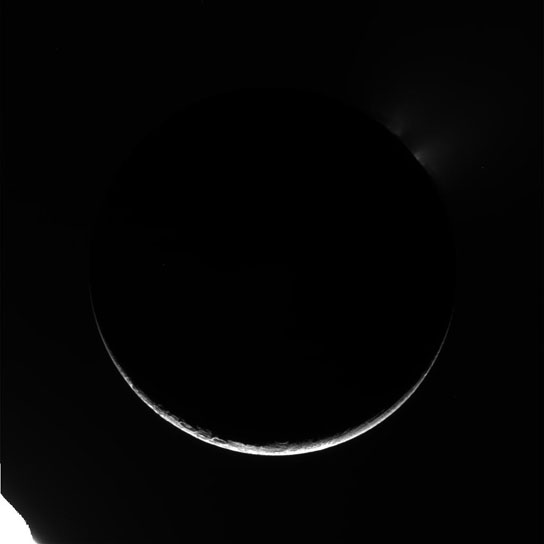
    Arc of Enceladus
    This image was taken by NASA’s Cassini spacecraft on April 14, 2012. The camera was pointing toward Enceladus at approximately 75,067 miles (120,808 kilometers) away. Credit: NASA/JPL/Space Science Institute

    As soon as daylight passed into the spacecraft’s remote sensing instruments’ line of sight, Cassini’s cameras acquired images of the surface. The wide-angle-camera image included in the new batch, taken from around the time of closest approach, has some smearing from the movement of the spacecraft during the exposure, but still shows the surface in vivid detail.

    Cassini’s cameras also imaged Enceladus’ south polar plume at a high phase angle as the satellite appeared as a thin crescent and the plume was backlit.
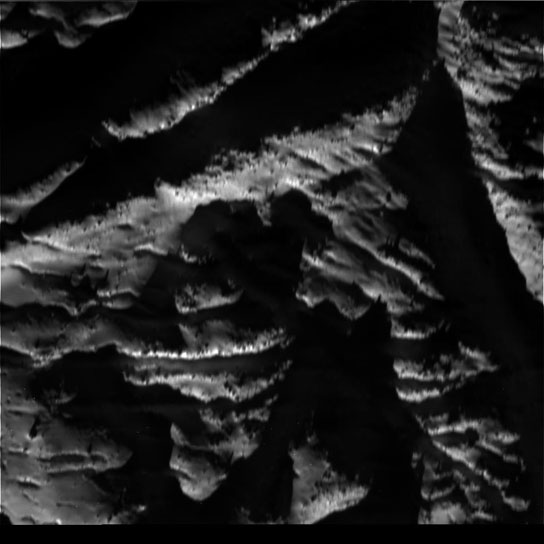
    Enceladus Terrain
    This image was taken by NASA’s Cassini spacecraft on April 14, 2012. The camera was pointing toward Enceladus at approximately 115 miles (185 kilometers) away.  Credit: NASA/JPL/Space Science Institute

    After the Enceladus encounter, Cassini passed the moon Tethys with a closest approach distance of about 5,700 miles (9,100 kilometers). This was Cassini’s best imaging encounter with Tethys since a targeted encounter in September 2005. The 2005 encounter, with a closest approach distance of about 930 miles (1,500 kilometers), provided the images of Tethys with the best resolution and captured views of the side of Tethys that faces Saturn in its orbit. This new encounter examined the opposite side of Tethys, providing some of the highest-resolution images of the side that faces away from Saturn. Cassini acquired a 22-frame mosaic of this side, which features the large impact basin named Odysseus. Scientists will use these new data in conjunction with images from previous encounters to create digital elevation maps of the moon’s surface.
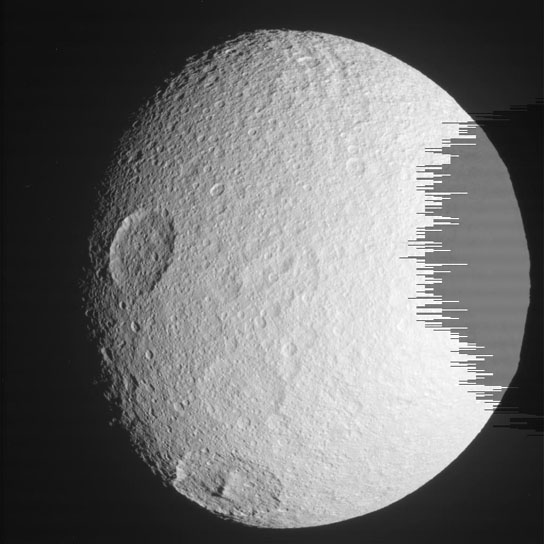
    Tethys Portrait
    This image was taken by NASA’s Cassini spacecraft on April 15, 2012. The camera was pointing toward Tethys at approximately 115,714 miles (186,224 kilometers) away. Credit: NASA/JPL/Space Science Institute

    The Cassini-Huygens mission is a cooperative project of NASA, the European Space Agency and the Italian Space Agency. NASA’s Jet Propulsion Laboratory in Pasadena manages the mission for the agency’s Science Mission Directorate in Washington. The Cassini orbiter and its two onboard cameras were designed, developed and assembled at JPL. The imaging operations team is based at the Space Science Institute in Boulder, Colo. JPL is a division of Caltech.

    Never miss a breakthrough: Join the SciTechDaily newsletter.
    Follow us on Google and Google News.

    Cassini-Huygens Mission Enceladus JPL Moon NASA Saturn Tethys
    Share. Facebook Twitter Pinterest LinkedIn Email Reddit

    Related Articles

    Infrared Eyes on Enceladus: Hints of Fresh Ice in Northern Hemisphere of Saturn’s Moon

    New Kinds of Organic Compounds Found in Plumes Bursting From Saturn’s Moon Enceladus

    Bull’s-Eye Moons – Cassini Views Enceladus and Tethys

    NASA Detects Ocean Inside Saturn’s Moon Enceladus

    New Cassini Images of Saturn and Its Moons

    The Mysterious Dusty Plasma Plumes of Saturn’s Moon Enceladus

    Saturn’s Moon Phoebe Has Planet-Like Qualities

    Cassini Explores Titan’s Lake, Similarities to Etosha Salt Pan

    Cassini Data Helps Explain Saturn’s Stress on Enceladus

    Leave A Reply Cancel Reply

    • Facebook
    • Twitter
    • Pinterest
    • YouTube

    Don't Miss a Discovery

    Subscribe for the Latest in Science & Tech!

    Trending News

    Largest-Ever Study Finds Medicinal Cannabis Ineffective for Anxiety, Depression, PTSD

    250-Million-Year-Old Egg Solves One of Evolution’s Biggest Mysteries

    Living With Roommates Might Be Changing Your Gut Microbiome Without You Knowing

    Century-Old Cleaning Chemical Linked to 500% Increased Risk of Parkinson’s Disease

    What if Your Memories Never Happened? Physicists Take a New Look at the Boltzmann Brain Paradox

    One of the Universe’s Largest Stars May Be Getting Ready To Explode

    Scientists Discover Enzyme That Could Supercharge Ozempic-Like Weight Loss Drugs

    Popular Sweetener Linked to DNA Damage – “It’s Something You Should Not Be Eating”

    Follow SciTechDaily
    • Facebook
    • Twitter
    • YouTube
    • Pinterest
    • Newsletter
    • RSS
    SciTech News
    • Biology News
    • Chemistry News
    • Earth News
    • Health News
    • Physics News
    • Science News
    • Space News
    • Technology News
    Recent Posts
    • Mystery Illness Kills 5 in Burundi As Doctors Scramble for Answers
    • Bone-Strengthening Discovery Could Reverse Osteoporosis
    • The Most Elusive Number in Physics Just Got Even More Mysterious
    • Scientists Uncover Hidden Trigger Behind Stem Cell Aging
    • Scientists Discover Coral Reefs Are Teeming With Previously Unknown Life
    Copyright © 1998 - 2026 SciTechDaily. All Rights Reserved.
    • Science News
    • About
    • Contact
    • Editorial Board
    • Privacy Policy
    • Terms of Use

    Type above and press Enter to search. Press Esc to cancel.