
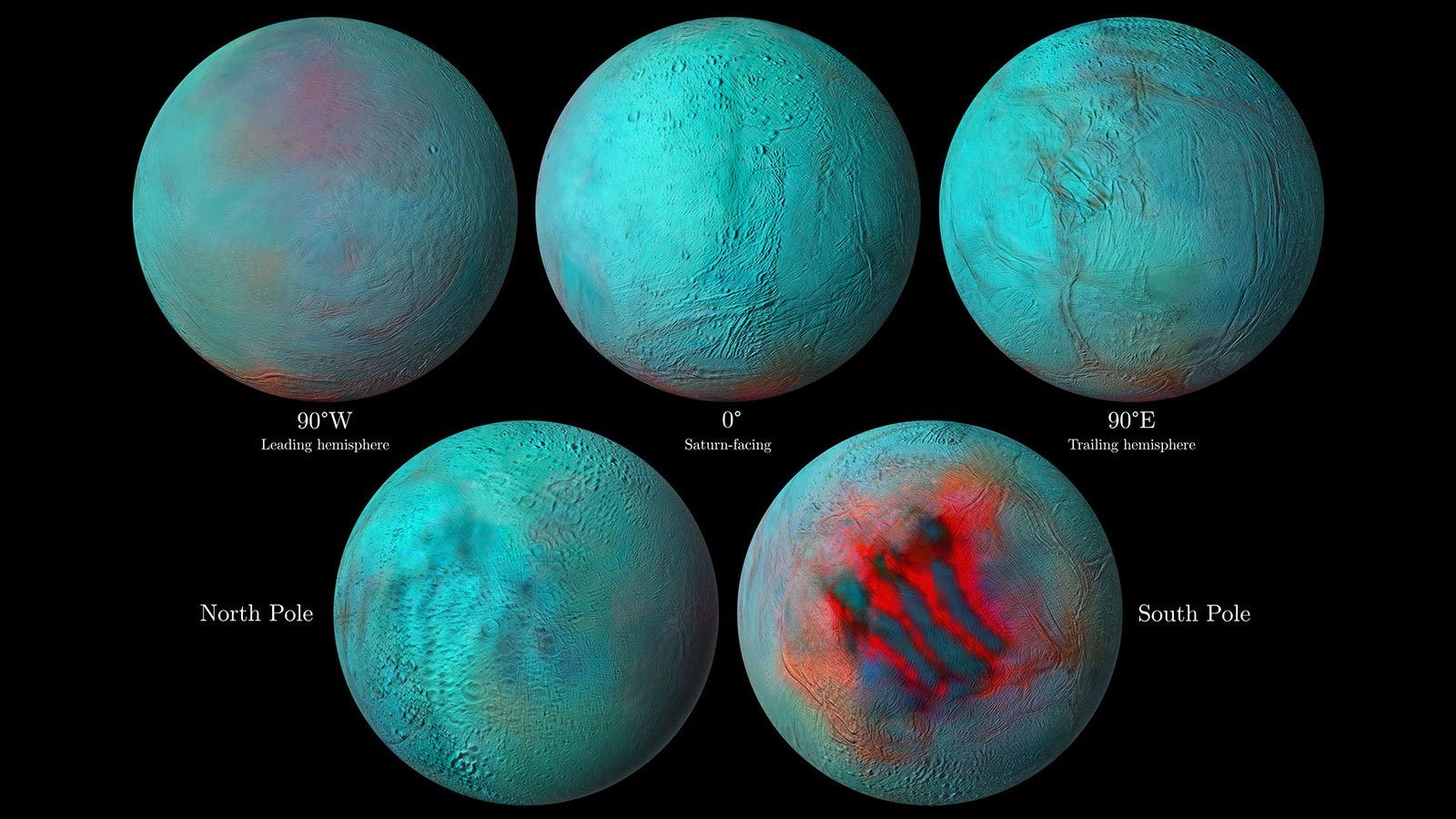
Scientists used data gathered by NASA’s Cassini spacecraft during 13 years of exploring the Saturn system to make detailed images of the icy moon — and to reveal geologic activity.
New composite images made from NASA’s Cassini spacecraft are the most detailed global infrared views ever produced of Saturn’s moon Enceladus. And data used to build those images provides strong evidence that the northern hemisphere of the moon has been resurfaced with ice from its interior.
Cassini’s Visible and Infrared Mapping Spectrometer (VIMS) collected light reflected off Saturn, its rings and its ten major icy moons — light that is visible to humans as well as infrared light. VIMS then separated the light into its various wavelengths, information that tells scientists more about the makeup of the material reflecting it.
The VIMS data, combined with detailed images captured by Cassini’s Imaging Science Subsystem, were used to make the new global spectral map of Enceladus.
Cassini scientists discovered in 2005 that Enceladus — which looks like a highly reflective, bright white snowball to the naked eye — shoots out enormous plumes of ice grains and vapor from an ocean that lies under the icy crust. The new spectral map shows that infrared signals clearly correlate with that geologic activity, which is easily seen at the south pole. That’s where the so-called “tiger stripe” gashes blast ice and vapor from the interior ocean.
Infrared images of Enceladus were used to make this interactive 3D globe. Credit: NASA/JPL-Caltech/University of Arizona/LPG/CNRS/University of Nantes/Space Science Institute
But some of the same infrared features also appear in the northern hemisphere. That tells scientists not only that the northern area is covered with fresh ice but that the same kind of geologic activity — a resurfacing of the landscape — has occurred in both hemispheres. The resurfacing in the north may be due either to icy jets or to a more gradual movement of ice through fractures in the crust, from the subsurface ocean to the surface.
“The infrared shows us that the surface of the south pole is young, which is not a surprise because we knew about the jets that blast icy material there,” said Gabriel Tobie, VIMS scientist with the University of Nantes in France and co-author of the new research published in Icarus.
“Now, thanks to these infrared eyes, you can go back in time and say that one large region in the northern hemisphere appears also young and was probably active not that long ago, in geologic timelines.”
Reference: “Photometrically-corrected global infrared mosaics of Enceladus: New implications for its spectral diversity and geological activity” by R. Robidel, S. Le Mouélic, G. Tobie, M. Massé, B. Seignovert, C. Sotin and S. Rodriguez, 23 May 2020, Icarus.
DOI: 10.1016/j.icarus.2020.113848
Managed by NASA’s Jet Propulsion Laboratory in Southern California, Cassini was an orbiter that observed Saturn for more than 13 years before exhausting its fuel supply. The mission plunged it into the planet’s atmosphere in September 2017, in part to protect Enceladus, which has the potential of holding conditions suitable for life, with its ocean likely heated and churned by hydrothermal vents like those on Earth’s ocean floors.
The Cassini-Huygens mission is a cooperative project of NASA, ESA (the European Space Agency) and the Italian Space Agency. JPL, a division of Caltech in Pasadena, manages the mission for NASA’s Science Mission Directorate in Washington. JPL designed, developed and assembled the Cassini orbiter.
Never miss a breakthrough: Join the SciTechDaily newsletter.
Follow us on Google and Google News.