
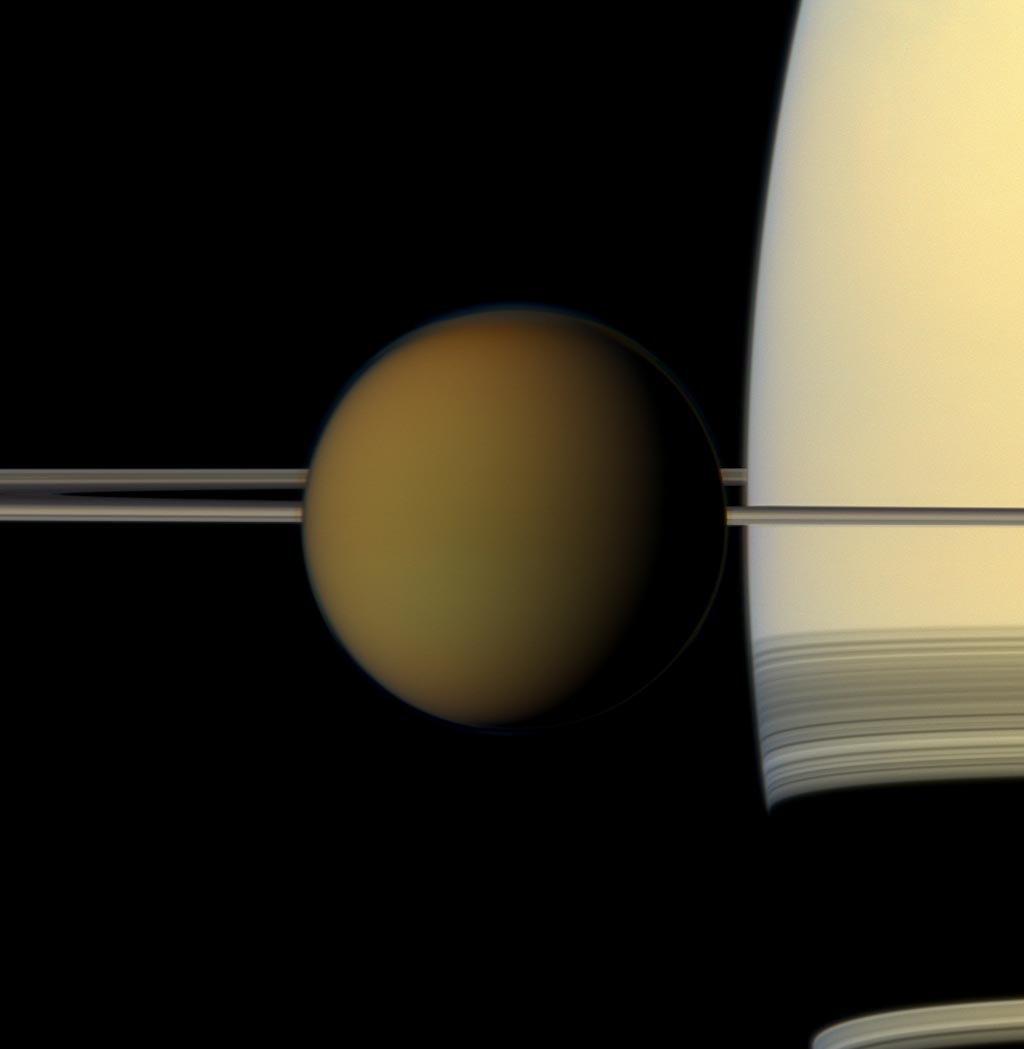
The first map showing the global geology of Saturn’s largest moon, Titan, has been completed and fully reveals a dynamic world of dunes, lakes, plains, craters, and other terrains.
Titan is the only planetary body in our solar system other than Earth known to have stable liquid on its surface. But instead of water raining down from clouds and filling lakes and seas as on Earth, on Titan what rains down is methane and ethane – hydrocarbons that we think of as gases but that behave as liquids in Titan’s frigid climate.
“Titan has an active methane-based hydrologic cycle that has shaped a complex geologic landscape, making its surface one of most geologically diverse in the solar system,” said Rosaly Lopes, a planetary geologist at NASA’s Jet Propulsion Laboratory in Pasadena, California, and lead author of new research used to develop the map.
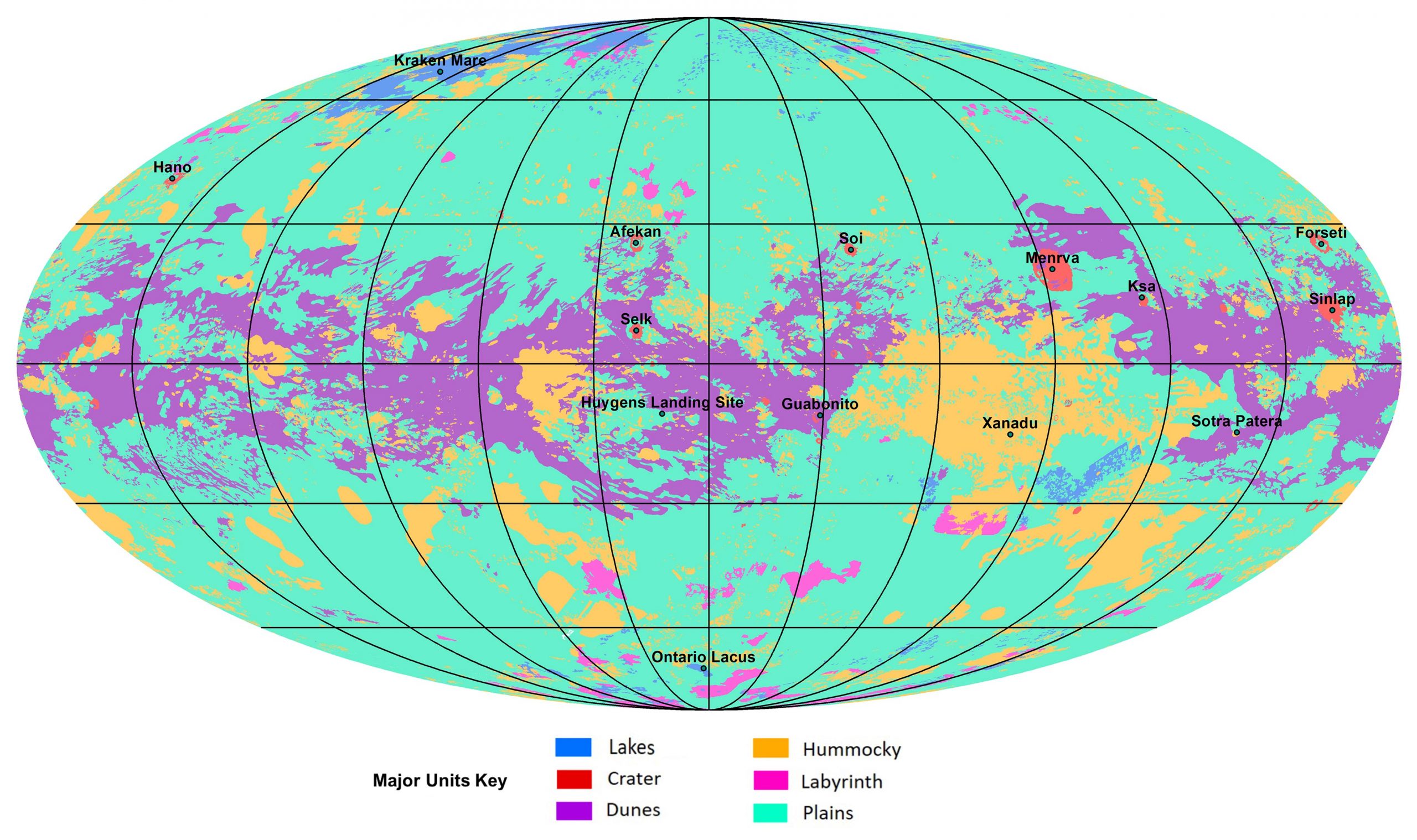
“Despite the different materials, temperatures, and gravity fields between Earth and Titan, many surface features are similar between the two worlds and can be interpreted as being products of the same geologic processes. The map shows that the different geologic terrains have a clear distribution with latitude, globally, and that some terrains cover far more area than others.”
Lopes and her team, including JPL’s Michael Malaska, worked with fellow planetary geologist David Williams of the School of Earth and Space Exploration at Arizona State University in Tempe. Their findings, which include the relative age of Titan’s geologic terrains, were published today (November 18, 2019) in the journal Nature Astronomy.
“The Cassini mission revealed that Titan is a geologically active world, where hydrocarbons like methane and ethane take the role that water has on Earth.” — David Williams
Lopes’ team used data from NASA’s Cassini mission, which operated between 2004 and 2017 and did more than 120 flybys of the Mercury-size moon. Specifically, they used data from Cassini’s radar imager to penetrate Titan’s opaque atmosphere of nitrogen and methane. In addition, the team used data from Cassini’s visible and infrared instruments, which were able to capture some of Titan’s larger geologic features through the methane haze.
“This study is an example of using combined datasets and instruments,” Lopes said. “Although we did not have global coverage with synthetic aperture radar [SAR], we used data from other instruments and other modes from radar to correlate characteristics of the different terrain units so we could infer what the terrains are even in areas where we don’t have SAR coverage.”
Williams worked with the JPL team to identify what geologic units on Titan could be determined using first the radar images and then extrapolating those units to the non-radar-covered regions. To do so, he built on his experience working with radar images on NASA’s Magellan Venus orbiter and from a previous regional geologic map of Titan that he developed.
“The Cassini mission revealed that Titan is a geologically active world, where hydrocarbons like methane and ethane take the role that water has on Earth,” Williams said. “These hydrocarbons rain down on the surface, flow in streams and rivers, accumulate in lakes and seas, and evaporate into the atmosphere. It’s quite an astounding world!”
The Cassini-Huygens mission is a cooperative project of NASA, the European Space Agency (ESA), and the Italian Space Agency. NASA’s JPL, a division of Caltech in Pasadena, manages the mission for NASA’s Science Mission Directorate in Washington. JPL designed, developed, and assembled the Cassini orbiter. The radar instrument was built by JPL and the Italian Space Agency, working with team members from the U.S. and several European countries.
Reference: “A global geomorphologic map of Saturn’s moon Titan” by R. M. C. Lopes, M. J. Malaska, A. M. Schoenfeld, A. Solomonidou, S. P. D. Birch, M. Florence, A. G. Hayes, D. A. Williams, J. Radebaugh, T. Verlander, E. P. Turtle, A. Le Gall and S. D. Wall, 18 November 2019, Nature Astronomy.
DOI: 10.1038/s41550-019-0917-6
Never miss a breakthrough: Join the SciTechDaily newsletter.
Follow us on Google and Google News.