
Close Menu
    Facebook X (Twitter) Instagram
    SciTechDaily
    • Biology
    • Chemistry
    • Earth
    • Health
    • Physics
    • Science
    • Space
    • Technology
    Facebook X (Twitter) Pinterest YouTube RSS
    SciTechDaily
    Home»Space»New Cassini View of Rhea’s Horizon
    Space

    New Cassini View of Rhea’s Horizon

    By NASAMay 27, 2015No Comments2 Mins Read
    Facebook Twitter Pinterest Telegram LinkedIn WhatsApp Email Reddit
    Share
    Facebook Twitter LinkedIn Pinterest Telegram Email Reddit
    New-Image-of-the-Surface-of-Rhea.jpg
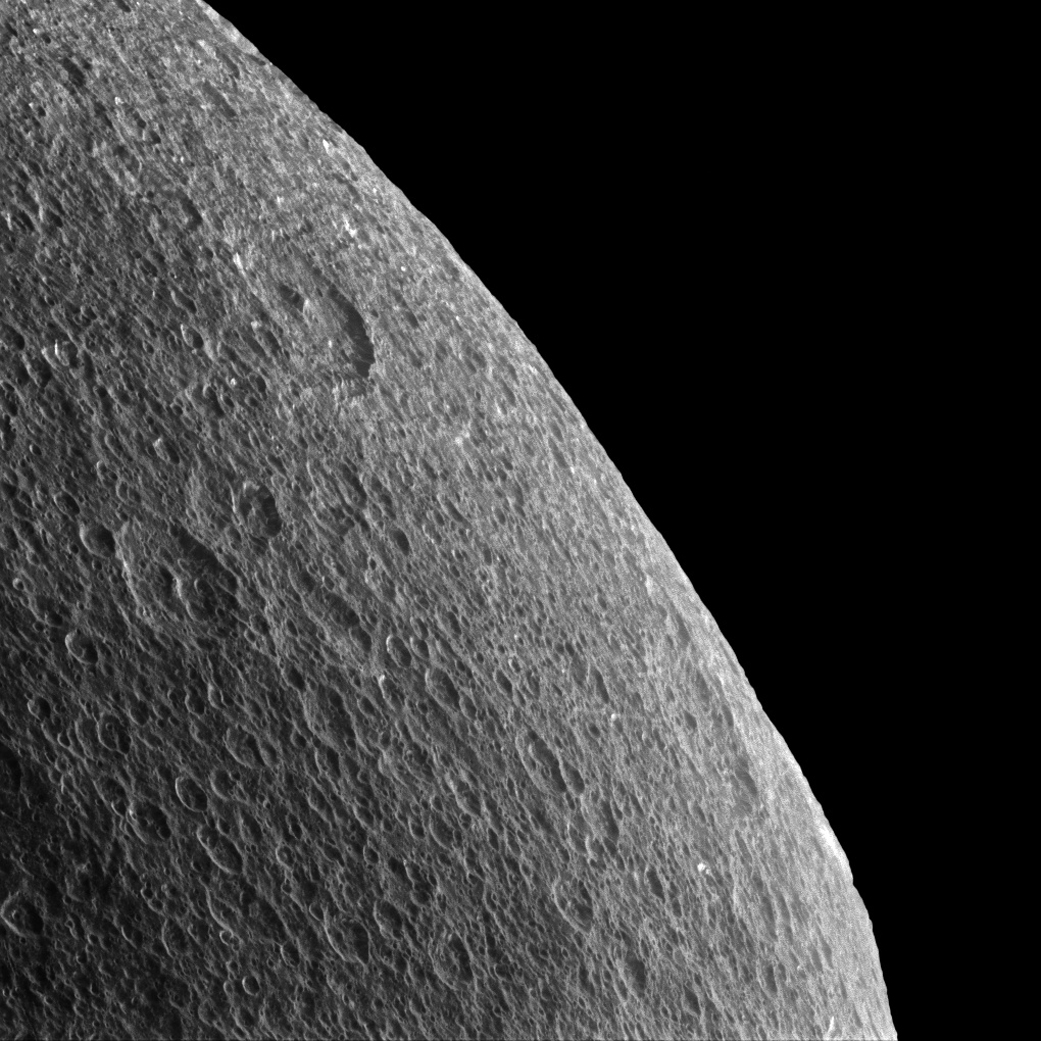
    Saturn’s moon Rhea. Credit: NASA/JPL-Caltech/Space Science Institute

    This newly released Cassini image shows the surface of Saturn’s moon Rhea.

    Gazing off toward the horizon is thought-provoking no matter what body’s horizon it is. Rhea’s horizon is slightly irregular and battered by craters, so thoughts inevitably turn toward the forces that shape these icy worlds.

    The surface of Rhea (949 miles or 1527 kilometers across) has been sculpted largely by impact cratering, each crater a reminder of a collision sometime in the moon’s history. On more geologically active worlds like Earth, the craters would be erased by erosion, volcanoes or tectonics. But on quieter worlds like Rhea, the craters remain until they are disrupted or covered up by the ejecta of a subsequent impact.

    Lit terrain seen here is on the trailing hemisphere of Rhea. North on Rhea is up and rotated 12 degrees to the right. In this view, Cassini was at a subspacecraft latitude of 9 degrees North. The image was taken in visible light with the Cassini spacecraft narrow-angle camera on February 10, 2015.

    The view was obtained at a distance of approximately 35,000 miles (56,000 kilometers) from Rhea and at a Sun-Rhea-spacecraft, or phase, angle of 76 degrees. Image scale is 1,100 feet (330 meters) per pixel.

    The Cassini mission is a cooperative project of NASA, ESA (the European Space Agency), and the Italian Space Agency. The Jet Propulsion Laboratory, a division of the California Institute of Technology in Pasadena, manages the mission for NASA’s Science Mission Directorate, Washington. The Cassini orbiter and its two onboard cameras were designed, developed, and assembled at JPL. The imaging operations center is based at the Space Science Institute in Boulder, Colorado.


    Never miss a breakthrough: Join the SciTechDaily newsletter.
    Follow us on Google and Google News.

    Astronomy Cassini-Huygens Mission Planetary Science Rhea
    Share. Facebook Twitter Pinterest LinkedIn Email Reddit

    Related Articles

    Impressive Cassini Image of Rhea Passing in Front of Titan

    Cassini’s Final Observation of Saturn’s Icy Moon Rhea

    Scientists Use Cassini Data to Create First Global Topographic Map of Titan

    Cassini Views a Spinning Vortex at Saturn’s North Pole

    Cassini Observes Meteors Colliding With Saturn’s Rings

    Titan’s Methane May Run Out

    NASA’s Cassini Catches a Glimpse of Venus From Saturn Orbit

    Storm Spawns the Largest Tropospheric Vortex Ever Seen on Saturn

    Cassini Spots a Nile Like River Valley on Titan

    Leave A Reply Cancel Reply

    • Facebook
    • Twitter
    • Pinterest
    • YouTube

    Don't Miss a Discovery

    Subscribe for the Latest in Science & Tech!

    Trending News

    What if Time Isn’t Fundamental? Physicists Just Tested the Idea in the Lab

    Scientists Say We’ve Been Wrong About the Aging Brain

    68 Quadrillion Miles: Scientists Map Earth’s Vast Hidden Fungal Network for the First Time

    Hidden Damage From Youth May Explode Into Disease Later in Life

    Climate Models May Be Wrong About How Trees Store Carbon

    Scientists Discover Brain-Protecting Peptide That Could Change Parkinson’s Treatment

    This Copper Drug Clears Alzheimer’s Brain Toxins and Boosts Memory

    Adults Over 65 Lost Massive Amounts of Weight With Ozempic

    Follow SciTechDaily
    • Facebook
    • Twitter
    • YouTube
    • Pinterest
    • Newsletter
    • RSS
    SciTech News
    • Biology News
    • Chemistry News
    • Earth News
    • Health News
    • Physics News
    • Science News
    • Space News
    • Technology News
    Recent Posts
    • Scientists Discover a Gene That Boosts Youth – but It Comes With a Cost
    • A Decade-Long Physics Mystery May Finally Be Solved
    • AI Cracks the Secrets of How the Universe’s Heaviest Elements Are Forged
    • After 50 Years, Astronomers Finally Found What the Milky Way’s Black Hole Was Hiding
    • Scientists Discover Immune Cells That Can Fight Both Measles and Nipah
    Copyright © 1998 - 2026 SciTechDaily. All Rights Reserved.
    • Science News
    • About
    • Contact
    • Editorial Board
    • Privacy Policy
    • Terms of Use

    Type above and press Enter to search. Press Esc to cancel.