
Close Menu
    Facebook X (Twitter) Instagram
    SciTechDaily
    • Biology
    • Chemistry
    • Earth
    • Health
    • Physics
    • Science
    • Space
    • Technology
    Facebook X (Twitter) Pinterest YouTube RSS
    SciTechDaily
    Home»Space»Cassini’s Final Observation of Saturn’s Icy Moon Rhea
    Space

    Cassini’s Final Observation of Saturn’s Icy Moon Rhea

    By SciTechDailyNovember 21, 2017No Comments2 Mins Read
    Facebook Twitter Pinterest Telegram LinkedIn WhatsApp Email Reddit
    Share
    Facebook Twitter LinkedIn Pinterest Telegram Email Reddit
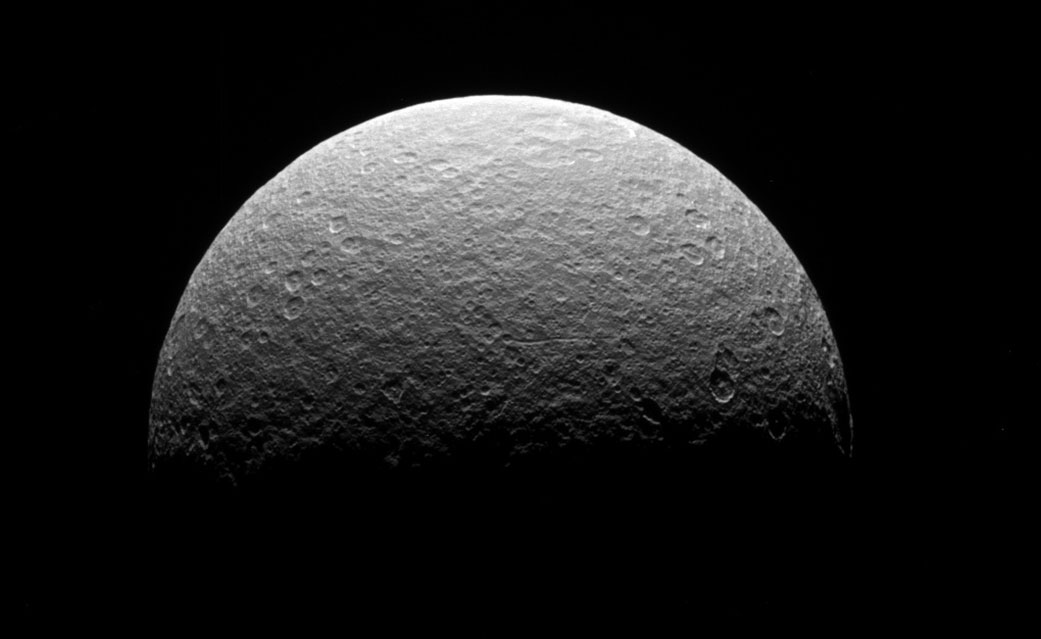
    Cassini's Final Observation of Saturn's Moon Rhea
    Saturn’s icy moon Rhea. Credit: NASA/JPL-Caltech/Space Science Institute

    This image is from Cassini spacecraft’s final observation of Saturn’s icy moon Rhea (949 miles or 1,527 kilometers across) on May 2, 2017. The spacecraft was at the time high above the plane of Saturn’s rings, looking down at Rhea’s northern hemisphere. The northern rim of the giant Tirawa impact basin can be seen along the limb at left. (For a high-resolution view of Rhea, see PIA07763; Tirawa is the large basin at the one o’clock position in that view.)

    The image was taken in visible light with the Cassini spacecraft narrow-angle camera at a distance of approximately 230,000 miles (370,000 kilometers) from Rhea. Image scale is 1.2 miles (2 kilometers) per pixel.

    The Cassini spacecraft ended its mission on September 15, 2017.

    The Cassini mission is a cooperative project of NASA, ESA (the European Space Agency) and the Italian Space Agency. The Jet Propulsion Laboratory, a division of the California Institute of Technology in Pasadena, manages the mission for NASA’s Science Mission Directorate, Washington. The Cassini orbiter and its two onboard cameras were designed, developed and assembled at JPL. The imaging operations center is based at the Space Science Institute in Boulder, Colorado.

    Never miss a breakthrough: Join the SciTechDaily newsletter.
    Follow us on Google and Google News.

    Astronomy Cassini-Huygens Mission Planetary Science Rhea
    Share. Facebook Twitter Pinterest LinkedIn Email Reddit

    Related Articles

    Impressive Cassini Image of Rhea Passing in Front of Titan

    New Cassini View of Rhea’s Horizon

    Scientists Use Cassini Data to Create First Global Topographic Map of Titan

    Cassini Views a Spinning Vortex at Saturn’s North Pole

    Cassini Observes Meteors Colliding With Saturn’s Rings

    Titan’s Methane May Run Out

    NASA’s Cassini Catches a Glimpse of Venus From Saturn Orbit

    Storm Spawns the Largest Tropospheric Vortex Ever Seen on Saturn

    Cassini Spots a Nile Like River Valley on Titan

    Leave A Reply Cancel Reply

    • Facebook
    • Twitter
    • Pinterest
    • YouTube

    Don't Miss a Discovery

    Subscribe for the Latest in Science & Tech!

    Trending News

    Magnetic Fields May Solve a Longstanding Binary Star Mystery

    The Probiotic Breakthrough for Natural Anxiety Relief and Better Mental Health

    Animal vs. Plant Protein: Scientists Found a Surprising Nutritional Difference

    According to Scientists, This Simple Dietary Change Is Linked to Lower Depression Scores

    Researchers Discover a Hidden Vitamin D Problem That Persists Year-Round

    Interstellar Comet 3I/ATLAS Reveals Strange Chemistry Beyond Our Solar System

    A Newly Found Cellular Shift May Explain Why Aging Leads to Disease

    Scientists Discover Gut Signal That Turns Off Sugar Cravings

    Follow SciTechDaily
    • Facebook
    • Twitter
    • YouTube
    • Pinterest
    • Newsletter
    • RSS
    SciTech News
    • Biology News
    • Chemistry News
    • Earth News
    • Health News
    • Physics News
    • Science News
    • Space News
    • Technology News
    Recent Posts
    • Breakthrough for 800 Million Patients? Kidney Disease Drug Shows Powerful New Benefits
    • A Surprising Discovery Suggests Autism Is Not One Condition
    • New Alzheimer’s Discovery Could Change How Scientists Fight the Disease
    • This Quantum Detector Boosts Terahertz Sensitivity by 20 Times
    • A Universe Without Dark Energy? Mathematicians Challenge Standard Cosmology
    Copyright © 1998 - 2026 SciTechDaily. All Rights Reserved.
    • Science News
    • About
    • Contact
    • Editorial Board
    • Privacy Policy
    • Terms of Use

    Type above and press Enter to search. Press Esc to cancel.