
Close Menu
    Facebook X (Twitter) Instagram
    SciTechDaily
    • Biology
    • Chemistry
    • Earth
    • Health
    • Physics
    • Science
    • Space
    • Technology
    Facebook X (Twitter) Pinterest YouTube RSS
    SciTechDaily
    Home»Space»Cassini Image Shows Surface Features on Rhea
    Space

    Cassini Image Shows Surface Features on Rhea

    By NASAApril 21, 2015No Comments2 Mins Read
    Facebook Twitter Pinterest Telegram LinkedIn WhatsApp Email Reddit
    Share
    Facebook Twitter LinkedIn Pinterest Telegram Email Reddit
    New Image of Surface Features on Rhea
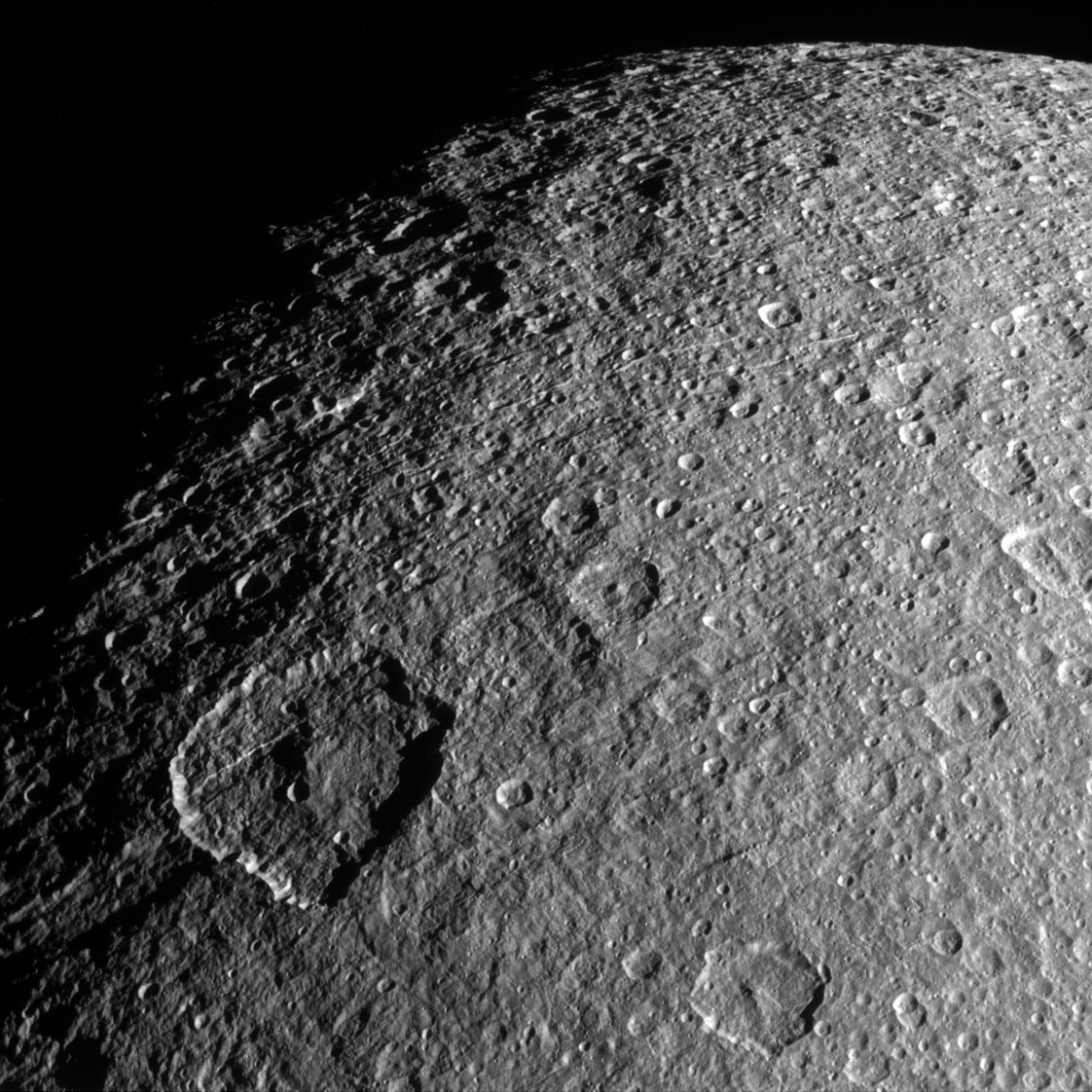
    The image of Rhea shows its surface features, mostly impact craters, reflecting its turbulent geological history over 4.6 billion years of bombardment by small bodies. Credit: NASA/JPL-Caltech/Space Science Institute

    Taken this past February, this Cassini image shows surface features on Saturn’s moon Rhea.

    Surface features on Rhea – mostly impact craters in this image – are thrown into sharp relief thanks to long shadows. Viewing this terrain near the day/night terminator makes it easier to appreciate just how violent Rhea’s geological history has been.

    The craters on Rhea (949 miles, or 1,527 kilometers across) are the result of 4.6 billion years of bombardment by small bodies. With very little erosion, the scars and craters remain unless they are overwritten by other, newer impacts.

    This view looks toward the anti-Saturn hemisphere of Rhea. North on Rhea is up and rotated 11 degrees to the right. The image was taken in visible light with the Cassini spacecraft narrow-angle camera on February 10, 2015.

    The view was acquired at a distance of approximately 47,000 miles (76,000 kilometers) from Rhea. The image scale is 1,500 feet (460 meters) per pixel.

    The Cassini mission is a cooperative project of NASA, ESA (the European Space Agency), and the Italian Space Agency. The Jet Propulsion Laboratory, a division of the California Institute of Technology in Pasadena, manages the mission for NASA’s Science Mission Directorate, Washington. The Cassini orbiter and its two onboard cameras were designed, developed, and assembled at JPL. The imaging operations center is based at the Space Science Institute in Boulder, Colorado.


    Never miss a breakthrough: Join the SciTechDaily newsletter.
    Follow us on Google and Google News.

    Astronomy Cassini-Huygens Mission NASA Rhea Saturn
    Share. Facebook Twitter Pinterest LinkedIn Email Reddit

    Related Articles

    Cassini Views Saturn’s North Polar Hexagon

    Storm Spawns the Largest Tropospheric Vortex Ever Seen on Saturn

    NASA’s Image of the Day Shows Saturnian Moons Prometheus and Pan

    New Cassini Image of Saturn and Its Rings

    Natural Color View of Saturn and Titan

    NASA’s Cassini Spots Lightning in Saturn’s Northern Hemisphere

    Cassini Changes Orbit, Saturn’s Rings Visible Again

    Cassini Data Reveals Likely Subsurface Ocean on Titan

    Heat from Within the Planet Powers Saturn’s Jet Streams

    Leave A Reply Cancel Reply

    • Facebook
    • Twitter
    • Pinterest
    • YouTube

    Don't Miss a Discovery

    Subscribe for the Latest in Science & Tech!

    Trending News

    Massive Study Warns Marijuana Use in Teens Is Linked to Serious Mental Illness

    Scientists Discover a Completely Unexpected Way T Cells Kill Cancer

    Scientists Just Found the Solar System’s Original “Planet Factory”

    Study Warns Widely Used Food Preservatives Linked to High Blood Pressure and Heart Disease

    New Treatment Could Reverse Osteoarthritis Within Weeks

    Physicists Have Measured “Negative Time” in Bizarre Quantum Experiment

    The Deadly Tapeworm Spreading Across America Has Reached the Pacific Northwest

    Could Low Vitamin D Be Making Your Pain Worse?

    Follow SciTechDaily
    • Facebook
    • Twitter
    • YouTube
    • Pinterest
    • Newsletter
    • RSS
    SciTech News
    • Biology News
    • Chemistry News
    • Earth News
    • Health News
    • Physics News
    • Science News
    • Space News
    • Technology News
    Recent Posts
    • Streetlights Are Trapping Thousands of Isopods in Mysterious “Death Spirals”
    • Scientists Have Discovered These Deadly Parasites Are Secretly Swapping DNA
    • What Scientists Found Inside a 117-Year-Old Woman Reveals New Clues to Long Life
    • Breakthrough Technique Reveals Atomic Secrets of Record-Breaking Superconductors
    • The Future of Work Belongs to People Who Master AI
    Copyright © 1998 - 2026 SciTechDaily. All Rights Reserved.
    • Science News
    • About
    • Contact
    • Editorial Board
    • Privacy Policy
    • Terms of Use

    Type above and press Enter to search. Press Esc to cancel.