
Close Menu
    Facebook X (Twitter) Instagram
    SciTechDaily
    • Biology
    • Chemistry
    • Earth
    • Health
    • Physics
    • Science
    • Space
    • Technology
    Facebook X (Twitter) Pinterest YouTube RSS
    SciTechDaily
    Home»Biology»New Research Shows Odor Receptors Do Much More Than Pick Up Scents
    Biology

    New Research Shows Odor Receptors Do Much More Than Pick Up Scents

    By Bill Hathaway, Yale UniversityApril 21, 2015No Comments2 Mins Read
    Facebook Twitter Pinterest Telegram LinkedIn WhatsApp Email Reddit
    Share
    Facebook Twitter LinkedIn Pinterest Telegram Email Reddit
    Scientists Shed New Light on Sensory Neural Development
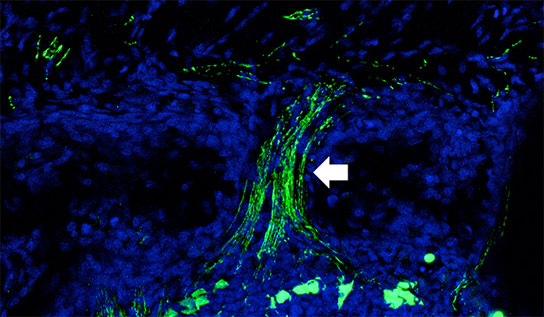
    New olfactory sensory neurons (in green) begin to form the olfactory nerve (solid arrow) after three days. Credit: Yale University

    New research from Yale University sheds light on sensory neural development and possible new ways to identify mechanisms that can repair damage to the central nervous system.

    Smell is the only sensory system with a back up, which throughout most of adult life forms new sensory neurons that express specific odor receptors. Now Yale researchers led by Charles Greer and Diego Rodriguez-Gil have discovered a way to track every step of the process over time.

    The findings shed light on all sensory neural development and perhaps ways to identify mechanisms that can repair damage to the central nervous system, which generally lacks the ability to replace damaged parts. The team found, for instance, that the 1,200 different types of odor receptors do more than just detect smells in the environment, but they also act as a sort of molecular glue, expressed late in maturation, that locks axons into proper targets in the brain.

    The study appears the week of April 20 in the Proceedings of the National Academy of Sciences.

    Reference: “Odorant receptors regulate the final glomerular coalescence of olfactory sensory neuron axons” by Diego J. Rodriguez-Gil, Dianna L. Bartel, Austin W. Jaspers, Arie S. Mobley, Fumiaki Imamura and Charles A. Greer, 20 April 2015, PNAS.
    DOI: 10.1073/pnas.1417955112


    Never miss a breakthrough: Join the SciTechDaily newsletter.
    Follow us on Google and Google News.

    Neurology Yale University
    Share. Facebook Twitter Pinterest LinkedIn Email Reddit

    Related Articles

    Yale Research Shows Immune Cells Are an Ally, Not Enemy, in Battle Against Alzheimer’s

    New Research Identifies Enzyme Crucial to the Shaping and Division of Brain Cells

    Molecular Map Pinpoints Genetic Variants of Autoimmune Diseases

    Neurobiologists Block the Effects of Stress

    Study Shows Human Brain Development is Divided into Three Major Phases

    Suppressing NgR1 Returns Brain to Adolescent Levels of Plasticity

    Neurologists Repair Neurons Associated With Traumatic Nerve Injury Pain

    GATA1 Plays a Role in the Loss of Connections Between Neurons and in Symptoms of Depression

    Yale Neurologists Discover the Source of Diabetic Neuropathy Pain

    Leave A Reply Cancel Reply

    • Facebook
    • Twitter
    • Pinterest
    • YouTube

    Don't Miss a Discovery

    Subscribe for the Latest in Science & Tech!

    Trending News

    Long COVID Brain Scans Reveal Damage to Dopamine Neurons

    Scientists Warn a Silent Oxygen Crisis Is Spreading Through Earth’s Waters

    James Webb Telescope Discovers Hidden Giant Planet in Famous Star System

    Scientists Build the First 3D Cloak That Makes Objects Invisible To Heat

    Common Food Additive Linked To Gut Inflammation

    Black Hole Collisions May Follow a Surprisingly Simple Rule

    The Eye Has a Hidden Cleanup System and Scientists Just Discovered It

    The Truth About Vikings Is More Complicated Than Museums Admit

    Follow SciTechDaily
    • Facebook
    • Twitter
    • YouTube
    • Pinterest
    • Newsletter
    • RSS
    SciTech News
    • Biology News
    • Chemistry News
    • Earth News
    • Health News
    • Physics News
    • Science News
    • Space News
    • Technology News
    Recent Posts
    • The Surprising Brain Chemistry That Turns Ants Into Caregivers
    • “Zombie Cells” Reveal a Hidden Weakness That Could Help Fight Aging
    • A Fiber Frozen at -196°C Unlocks a New Way To Store Light
    • Scientists Solve a Decades-Old Mystery Inside Atomic Nuclei
    • Alien Signals May Be Hiding in a Radio Band SETI Has Barely Explored
    Copyright © 1998 - 2026 SciTechDaily. All Rights Reserved.
    • Science News
    • About
    • Contact
    • Editorial Board
    • Privacy Policy
    • Terms of Use

    Type above and press Enter to search. Press Esc to cancel.