

Close Menu
    Facebook X (Twitter) Instagram
    SciTechDaily
    • Biology
    • Chemistry
    • Earth
    • Health
    • Physics
    • Science
    • Space
    • Technology
    Facebook X (Twitter) Pinterest YouTube RSS
    SciTechDaily
    Home»Biology»Yale Neurologists Discover the Source of Diabetic Neuropathy Pain
    Biology

    Yale Neurologists Discover the Source of Diabetic Neuropathy Pain

    By Bill Hathaway, Yale UniversityMay 16, 2012No Comments3 Mins Read
    Facebook Twitter Pinterest Telegram LinkedIn WhatsApp Email Reddit
    Share
    Facebook Twitter LinkedIn Pinterest Telegram Email Reddit
    Abstract Pain Concept
    Researchers have pinpointed the source of neuropathic pain in many diabetics and are optimistic about their ability to target it.

    Yale researchers have identified the source of neuropathic pain that many diabetics suffer from and believe they may be able to target it. While working with rats, the researchers found that changes in the structure of dendritic spines are associated with pain and they also found a drug that interferes with formation of these spines, reducing pain in lab animals.

    Nearly half of all diabetics suffer from neuropathic pain, an intractable, agonizing, and still mysterious companion of the disease. Now Yale researchers have identified an unexpected source of the pain and a potential target to alleviate it.

    A team of researchers from Yale and the West Haven Veterans Affairs Medical Center describes in the May 15 issue of the Journal of Neuroscience how changes in the structure of dendritic spines – microscopic projections on the receiving branches of nerve cells — are associated with pain in laboratory rats with diabetes.
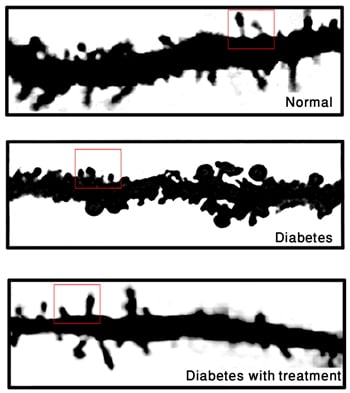
    unexpected source of diabetic neuropathy pain
    Normal dendritic spines — microscopic projections on the receiving branches of nerve cells — are shown at the top compared to those of diabetic rat. At the bottom, spines after receiving treatment. Yale study suggests that neuropathic pain associated with diabetes may be caused by reshaping of these spines in nerve cells, and might be treated by drugs.

    “How diabetes leads to neuropathic pain is still a mystery,” said Andrew Tan, an associate research scientist in neurology at the Yale School of Medicine and lead author of the study. “An interesting line of study is based on the idea that neuropathic pain is due to faulty ‘rewiring’ of pain circuitry.”

    With a growing number of diabetics, the condition represents a huge unmet medical need. Once neuropathic pain is established, it is a lifelong condition.

    “Here we reveal that these dendritic spines, first studied in memory circuit processing, also contribute to the sensation of pain in diabetes,” Tan said. A single neuron may contain hundreds to thousands of dendritic spines.

    The Yale team led by Tan and senior author Dr. Stephen G. Waxman, the Bridget Marie Flaherty Professor of Neurology, professor of neurobiology and pharmacology, found abnormal dendritic spines were associated with the onset and maintenance of pain. They also found that a drug that interferes with formation of these spines reduced pain in lab animals, suggesting that targeting abnormal spines could be a therapeutic strategy.

    Tan said that these dendritic spines in nerve cells seem to store memory of pain, just as they are crucial in memory and learning in the human brain.

    “We have identified a single, key molecule that controls structural changes in these spines and hopefully we can develop therapeutic approaches that target that molecule and reduce diabetic pain,” Waxman said.

    Reference: “Maladaptive Dendritic Spine Remodeling Contributes to Diabetic Neuropathic Pain” by Andrew M. Tan, Omar A. Samad, Tanya Z. Fischer, Peng Zhao, Anna-Karin Persson and Stephen G. Waxman, 16 May 2012, Journal of Neuroscience.
    DOI: 10.1523/JNEUROSCI.1017-12.2012

    Other authors on the paper are Omar A. Samad, Tanya Z. Fischer, Peng Zhao and Anna-Karin Persson,

    The research was funded by the Department of Veterans Affairs.

    Never miss a breakthrough: Join the SciTechDaily newsletter.
    Follow us on Google and Google News.

    Dendritic Cell Diabetes Disease Nerve Cells Neurology Pain Management Popular Yale University
    Share. Facebook Twitter Pinterest LinkedIn Email Reddit

    Related Articles

    Molecular Map Pinpoints Genetic Variants of Autoimmune Diseases

    Trigger for the Onset of Alzheimer’s Disease Identified

    Synthetic Antioxidant Suppresses Symptoms of Huntington’s Disease in Mice

    Brain Scans Help Predict Whether Patients Will Respond to Therapy

    Neurologists Repair Neurons Associated With Traumatic Nerve Injury Pain

    KL001 Interacts With Cryptochrome, May Offer a New Way to Treat Diabetes

    Non-Depleting Antibodies Reverse Type 1 Diabetes in Mice

    Scientists Use Modified Version Rabies to Trace Neural Pathways in the Brain

    Scientists Create Stem-Cell-Derived Neurons from Alzheimer’s Disease

    Leave A Reply Cancel Reply

    • Facebook
    • Twitter
    • Pinterest
    • YouTube

    Don't Miss a Discovery

    Subscribe for the Latest in Science & Tech!

    Trending News

    Don’t Miss: A Brilliant Venus and Glowing Harvest Moon Light Up the Sky

    New Twist on the Einstein Problem Reveals Unexpected Physics

    JWST Captures Stunning Evidence of How Supermassive Black Holes Feed

    Early Exercise May Permanently Change How Much Energy the Body Uses To Move

    New Molecule Wipes Out Aggressive Lymphoma Tumors in Mice in Just 11 Days

    The Human Family Tree May Need a Major Rewrite

    Scientists Find a Surprising Cancer-Fighting Effect in Dark Sweet Cherries

    New AI Detects Hidden Warning Signs of Solar Eruptions Hours Before They Emerge

    Follow SciTechDaily
    • Facebook
    • Twitter
    • YouTube
    • Pinterest
    • Newsletter
    • RSS
    SciTech News
    • Biology News
    • Chemistry News
    • Earth News
    • Health News
    • Physics News
    • Science News
    • Space News
    • Technology News
    Recent Posts
    • Scientists May Have Finally Explained Why Astronauts Get Constipated in Space
    • Pomegranates Could Unlock a New Treatment for Heart Failure
    • Africa’s Giant Herbivores Were Disappearing Millions of Years Before Humans Could Hunt Them
    • This Utah Mountain Is Hiding Enough Ice To Fill 600 Olympic Pools
    • Vagus Nerve Stimulation Could Unlock the Brain’s Hidden Learning Potential
    Copyright © 1998 - 2026 SciTechDaily. All Rights Reserved.
    • Science News
    • About
    • Contact
    • Editorial Board
    • Privacy Policy
    • Terms of Use

    Type above and press Enter to search. Press Esc to cancel.