
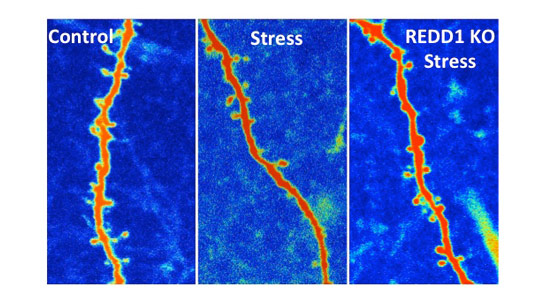
By deleting the REDD1 gene in mice, researchers from Yale University were able to block the synaptic and behavioral deficits caused by stress.
Ketamine, an anesthetic sometimes abused as a street drug, increases the synaptic connections between brain cells and in low doses acts as a powerful antidepressant, Yale researchers have found. However, stress has the opposite effect, shrinking the number of synaptic spines, triggering depression.
In the April 13 online issue of the journal Nature Medicine, Yale researchers found that the expression of a single gene called REDD1 enables stress to damage brain cells and cause depressive behavior.
“We found if we delete REDD1, we can block the effects of stress in mice,” said Ron Duman, the Elizabeth Mears and House Jameson Professor of Psychiatry and professor of neurobiology.
In recent studies, the Yale team showed that ketamine activates the mTORC1 pathway, which in turn spurs synthesis of synaptic proteins and connections. In the new study, they show that the REDD1 gene expression blocks mTORC1 activity and decreases the number of synaptic connections. The new study by Duman and lead author Kristie Ota showed that mice without the REDD1 gene were impervious to the synaptic and behavioral deficits caused by stress. By contrast, when the gene was over-expressed, mice exhibited loss of synaptic connections and increased depression and anxiety behaviors.
In addition, post-mortem examinations of people who had suffered from depression showed high levels of REDD1 in cortical regions associated with depression.
Yale’s work with ketamine has already led to development of new classes of antidepressants, which are currently in clinical trials. Duman said these new findings may provide a new drug target that directly blunts the negative impacts of stress.
Other Yale authors include Rong-Jian Liu, Bhavya Voleti, Jaime G. Maldonado-Aviles, Vanja Duric, Masaaki Iwata, Sophie Dutheil, Catharine Duman. Ralph J. DiLeone, and George K. Aghajanian.
Funding for research was provided by the National Institutes of Health.
Reference: “REDD1 is essential for stress-induced synaptic loss and depressive behavior” by Kristie T Ota, Rong-Jian Liu, Bhavya Voleti, Jaime G Maldonado-Aviles, Vanja Duric, Masaaki Iwata, Sophie Dutheil, Catharine Duman, Steve Boikess, David A Lewis, Craig A Stockmeier, Ralph J DiLeone, Christopher Rex, George K Aghajanian and Ronald S Duman, 13 April 2014, Nature Medicine.
DOI: 10.1038/nm.3513
Never miss a breakthrough: Join the SciTechDaily newsletter.
Follow us on Google and Google News.
2 Comments
Stress is one of the major contributor for the decline in health, in getting Diabetes, Hypertension, increase in cholesteral, heart blocks and all the major diseases ruining the life apart from lack of exercise of sedative style invariably. Hence, it is high time hyper-stress is treated as a disease in future and medicines to block their working on neuro degeneration is stopped. Thank You.
Please, how about considering environmental causes to help PREVENT stress to brain and body? All the focus on finding new drugs/treatments ignores some of the truths found in independent science that radiofrequency radiation is causing biological stress, and behavioral/neurological impacts in the population as we speak.
Please view: Increasing incidence of burnout due to magnetic and electromagnetic fields of cell phone networks and other wireless communication technologies, by Warnke and Hensinger
See also “2014 Children and EMF” by Dr. Erica Mallery-Blythe at youtube, and Dr. Leif Salford’s presentation there on radiofrequency impact on the blood brain barrier.
It is frustrating to see all the effort going into expensive and invasive treatments for impacts being caused by various exposures that actually cause degenerative impacts, including oxidative and physical and psychological stress.