
Close Menu
    Facebook X (Twitter) Instagram
    SciTechDaily
    • Biology
    • Chemistry
    • Earth
    • Health
    • Physics
    • Science
    • Space
    • Technology
    Facebook X (Twitter) Pinterest YouTube RSS
    SciTechDaily
    Home»Space»Cassini Captures New Images of Saturn’s Moon Rhea
    Space

    Cassini Captures New Images of Saturn’s Moon Rhea

    By Jia-Rui Cook, Jet Propulsion LaboratoryMarch 12, 2013No Comments3 Mins Read
    Facebook Twitter Pinterest Telegram LinkedIn WhatsApp Email Reddit
    Share
    Facebook Twitter LinkedIn Pinterest Telegram Email Reddit
    Cassini Images of Saturn Moon
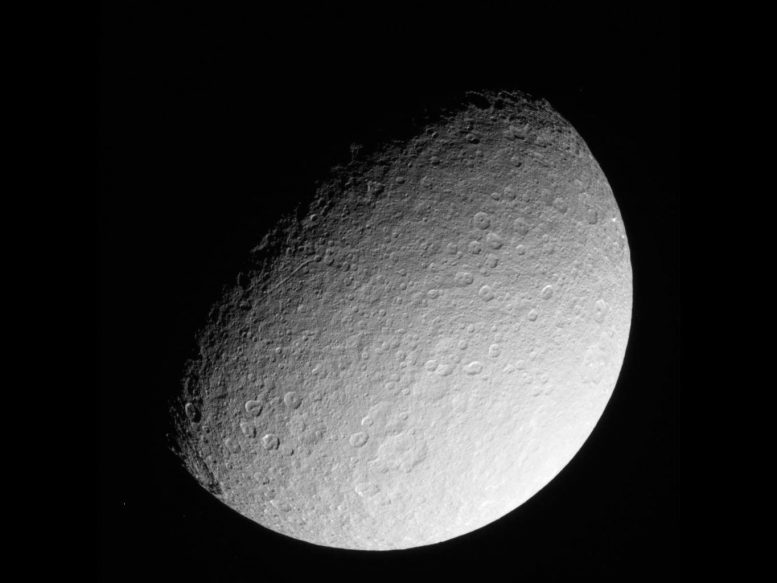
    This image was taken on March 10, 2013, and received on Earth March 10, 2013, by NASA’s Cassini spacecraft. The camera was pointing toward Rhea at approximately 174,181 miles (280,317 kilometers) away, and the image was taken using the CL1 and CL2 filters. This image has not been validated or calibrated. Credit: NASA/JPL/Space Science Institute

    NASA’s Cassini spacecraft captured several new photos of Saturn’s moon Rhea as it flew by Rhea at an altitude of 620 miles (997 kilometers) on March 9, 2013.

    Following its last close flyby of Saturn’s moon Rhea, NASA’s Cassini spacecraft captured these raw, unprocessed images of the battered icy moon. They show an ancient, cratered surface bearing the scars of collisions with many space rocks. Scientists are still trying to understand some of the curious features they see in these Rhea images, including a curving, narrow fracture or a graben, which is a block of ground lower than its surroundings and bordered by cliffs on either side. This feature looks remarkably recent, cutting most of the craters it crosses, with only a few small craters superimposed.
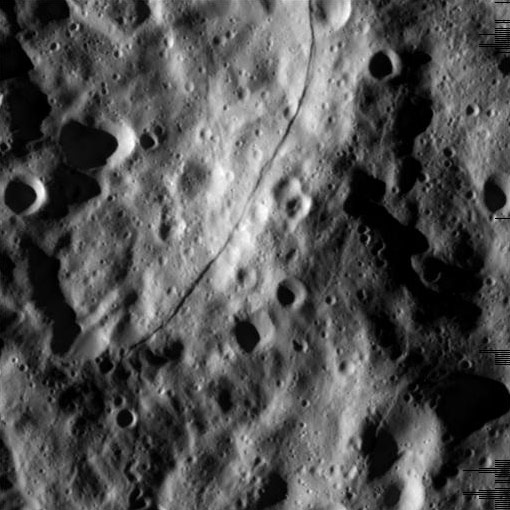
    Cassini Image of the Moon Rhea
    This image was taken on March 09, 2013, and received on Earth on March 10, 2013, by NASA’s Cassini spacecraft. The camera was pointing toward Rhea at approximately 1,727 miles (2,779 kilometers) away, and the image was taken using the CL1 and CL2 filters. This image has not been validated or calibrated. Credit: NASA/JPL-Caltech/Space Science Institute

    Cassini flew by Rhea at an altitude of 620 miles (997 kilometers) on March 9, 2013. This flyby was designed primarily for the radio science sub-system to measure Rhea’s gravity field. During closest approach and while the radio science sub-system was measuring the icy satellite’s gravity field, the imaging team rode along and captured 12 images of Rhea’s rough and icy surface. Outbound from Rhea, Cassini’s cameras captured a set of global images from a distance of about 167,000 miles (269,000 kilometers).

    New Cassini Images of Rhea
    This image was taken on March 09, 2013, and received on Earth March 10, 2013, by NASA’s Cassini spacecraft. The camera was pointing toward Rhea at approximately 2,348 miles (3,778 kilometers) away, and the image was taken using the CL1 and CL2 filters. This image has not been validated or calibrated. Credit: NASA/JPL-Caltech/Space Science Institute

    Data from Cassini’s cosmic dust analyzer were also collected to try to detect any dusty debris flying off the surface from tiny meteoroid bombardments. These data will help scientists understand the rate at which “foreign” objects are raining into the Saturn system.

    This was the mission’s fourth close encounter with Rhea. The spacecraft will pass the moon, but at a much greater distance, in a few years.

    Never miss a breakthrough: Join the SciTechDaily newsletter.
    Follow us on Google and Google News.

    Astronomy Cassini-Huygens Mission JPL NASA
    Share. Facebook Twitter Pinterest LinkedIn Email Reddit

    Related Articles

    Cassini Detects Particles Being Accelerated to Ultra-High Energies

    Storm Spawns the Largest Tropospheric Vortex Ever Seen on Saturn

    New Cassini Image of Saturn and Its Rings

    Limited River Erosion on Saturn’s Moon Titan Has Scientists Looking for Possible Explanations

    NASA’s Cassini Spots Lightning in Saturn’s Northern Hemisphere

    Cassini Images Show Signs That the Seasons Are Turning On Saturn’s Moon Titan

    Cassini Data Reveals Likely Subsurface Ocean on Titan

    Heat from Within the Planet Powers Saturn’s Jet Streams

    Cassini Detects Methane Lakes on Titan

    Leave A Reply Cancel Reply

    • Facebook
    • Twitter
    • Pinterest
    • YouTube

    Don't Miss a Discovery

    Subscribe for the Latest in Science & Tech!

    Trending News

    Largest-Ever Study Finds Medicinal Cannabis Ineffective for Anxiety, Depression, PTSD

    250-Million-Year-Old Egg Solves One of Evolution’s Biggest Mysteries

    Living With Roommates Might Be Changing Your Gut Microbiome Without You Knowing

    Century-Old Cleaning Chemical Linked to 500% Increased Risk of Parkinson’s Disease

    What if Your Memories Never Happened? Physicists Take a New Look at the Boltzmann Brain Paradox

    One of the Universe’s Largest Stars May Be Getting Ready To Explode

    Scientists Discover Enzyme That Could Supercharge Ozempic-Like Weight Loss Drugs

    Popular Sweetener Linked to DNA Damage – “It’s Something You Should Not Be Eating”

    Follow SciTechDaily
    • Facebook
    • Twitter
    • YouTube
    • Pinterest
    • Newsletter
    • RSS
    SciTech News
    • Biology News
    • Chemistry News
    • Earth News
    • Health News
    • Physics News
    • Science News
    • Space News
    • Technology News
    Recent Posts
    • Scientists Prove There Are Just Six Degrees of Separation in a Social Network
    • Bee Bacteria Could Fix a Major Flaw in Plant-Based Milk
    • Scientists Discover a Surprising Way To Make Bread Healthier and More Nutritious
    • Natural Compounds Boost Bone Implant Success While Killing Bacteria and Cancer Cells
    • After 60 Years, Scientists Uncover Unexpected Brain Effects of Popular Diabetes Drug Metformin
    Copyright © 1998 - 2026 SciTechDaily. All Rights Reserved.
    • Science News
    • About
    • Contact
    • Editorial Board
    • Privacy Policy
    • Terms of Use

    Type above and press Enter to search. Press Esc to cancel.