
Close Menu
    Facebook X (Twitter) Instagram
    SciTechDaily
    • Biology
    • Chemistry
    • Earth
    • Health
    • Physics
    • Science
    • Space
    • Technology
    Facebook X (Twitter) Pinterest YouTube RSS
    SciTechDaily
    Home»Space»Cassini Image: Tethys ‘Eyes’ Saturn
    Space

    Cassini Image: Tethys ‘Eyes’ Saturn

    By NASAJune 15, 2015No Comments2 Mins Read
    Facebook Twitter Pinterest Telegram LinkedIn WhatsApp Email Reddit
    Share
    Facebook Twitter LinkedIn Pinterest Telegram Email Reddit
    Cassini Views Craters on Tethys
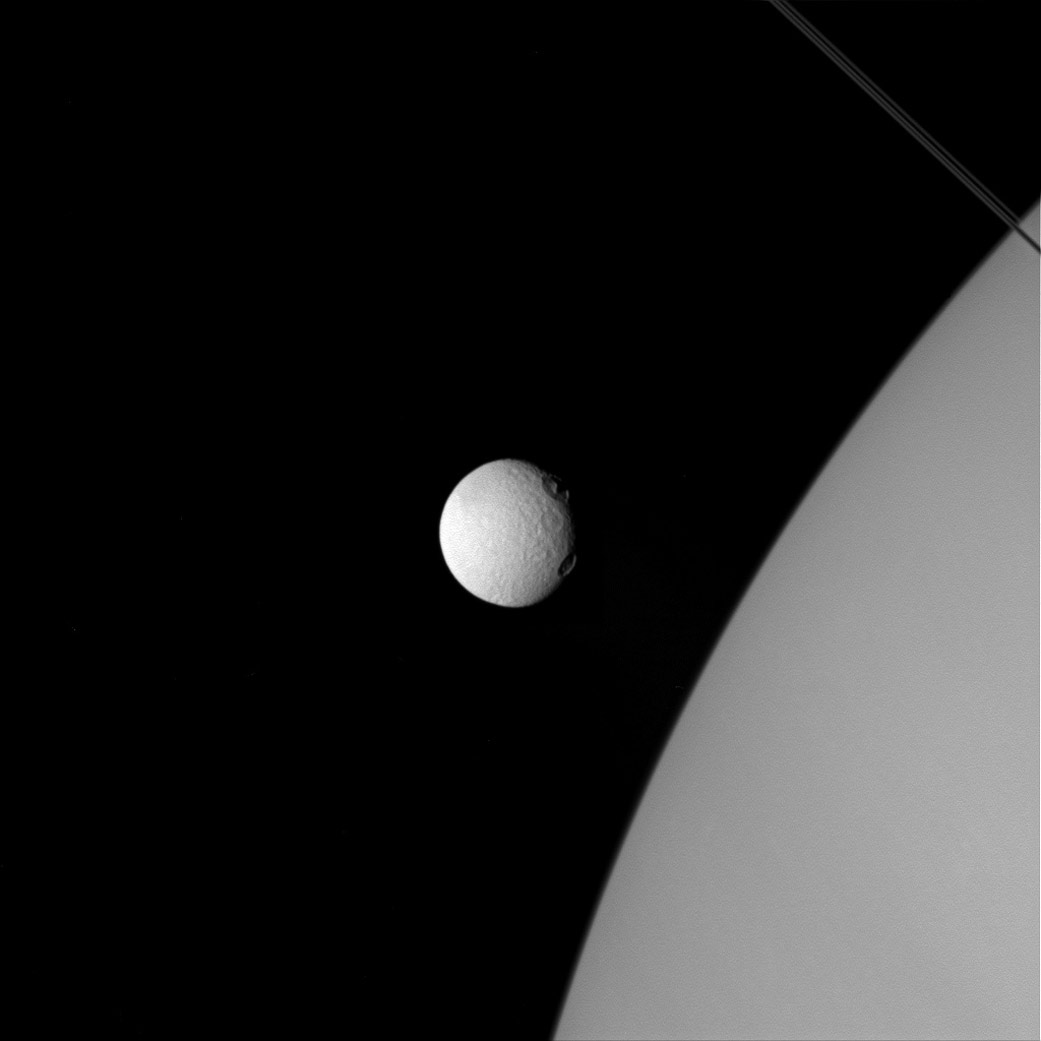
    The two large craters on Tethys, near the line where day fades to night, almost resemble two giant eyes observing Saturn. Credit: NASA/JPL-Caltech/Space Science Institute

    This newly released image from the Cassini Spacecraft shows two large craters on Saturn’s moon Tethys.

    The two large craters on Tethys, near the line where day fades to night, almost resemble two giant eyes observing Saturn.

    The location of these craters on Tethys’ terminator throws their topography into sharp relief. Both are large craters, but the larger and southernmost of the two shows a more complex structure. The angle of the lighting highlights a central peak in this crater. Central peaks are the result of the surface reacting to the violent post-impact excavation of the crater. The northern crater does not show a similar feature. Possibly the impact was too small to form a central peak, or the composition of the material in the immediate vicinity couldn’t support the formation of a central peak.

    In this image Tethys is significantly closer to the camera, while the planet is in the background. Yet the moon is still utterly dwarfed by the giant Saturn.

    This view looks toward the anti-Saturn side of Tethys. North on Tethys is up and rotated 42 degrees to the right. The image was taken in visible light with the Cassini spacecraft wide-angle camera on April 11, 2015.

    The view was obtained at a distance of approximately 75,000 miles (120,000 kilometers) from Tethys. Image scale at Tethys is 4 miles (7 kilometers) per pixel.

    The Cassini mission is a cooperative project of NASA, ESA (the European Space Agency) and the Italian Space Agency. The Jet Propulsion Laboratory, a division of the California Institute of Technology in Pasadena, manages the mission for NASA’s Science Mission Directorate, Washington. The Cassini orbiter and its two onboard cameras were designed, developed, and assembled at JPL. The imaging operations center is based at the Space Science Institute in Boulder, Colorado.

    Never miss a breakthrough: Join the SciTechDaily newsletter.
    Follow us on Google and Google News.

    Astronomy Cassini-Huygens Mission Saturn Tethys
    Share. Facebook Twitter Pinterest LinkedIn Email Reddit

    Related Articles

    Cassini Views Saturn’s Icy Moon Tethys

    New Cassini Image – Tethys Tops Saturn

    Ices and Shadows – Cassini Views Saturn’s Moon Tethys

    Cassini Spacecraft Image Shows the Difference between Janus and Tethys

    New Cassini View of Saturn and Tethys

    Bull’s-Eye Moons – Cassini Views Enceladus and Tethys

    New Cassini Image Shows Tethys Dwarfed by Saturn and Its Rings

    New Cassini Night Side Image of Saturn and Tethys

    NASA’s Cassini Views Saturn’s Moon Tethys

    Leave A Reply Cancel Reply

    • Facebook
    • Twitter
    • Pinterest
    • YouTube

    Don't Miss a Discovery

    Subscribe for the Latest in Science & Tech!

    Trending News

    Popular Sugar-Free Sweetener Linked to Liver Disease, Study Warns

    What Is Hantavirus? The Deadly Disease Raising Alarm Worldwide

    Scientists Just Discovered How the Universe Builds Monster Black Holes

    Scientists Unveil New Treatment Strategy That Could Outsmart Cancer

    A Simple Vitamin May Hold the Key to Treating Rare Genetic Diseases

    Scientists Think the Real Fountain of Youth May Be Hiding in Your Gut

    Ravens Don’t Follow Wolves, They Predict Them

    This Common Knee Surgery May Be Doing More Harm Than Good

    Follow SciTechDaily
    • Facebook
    • Twitter
    • YouTube
    • Pinterest
    • Newsletter
    • RSS
    SciTech News
    • Biology News
    • Chemistry News
    • Earth News
    • Health News
    • Physics News
    • Science News
    • Space News
    • Technology News
    Recent Posts
    • Why Are So Many New Fathers Dying? Scientists Say the U.S. Has a Dangerous Blind Spot
    • Scientists Identify Simple Supplement That Greatly Reduces Alzheimer’s Damage
    • You May Have a Dangerous Type of Cholesterol Even if Your Tests Look Normal
    • Study Reveals Dangerous Flaw in AI Symptom Checkers
    • New MRI Breakthrough Captures Stunningly Clear Images of the Eye and Brain
    Copyright © 1998 - 2026 SciTechDaily. All Rights Reserved.
    • Science News
    • About
    • Contact
    • Editorial Board
    • Privacy Policy
    • Terms of Use

    Type above and press Enter to search. Press Esc to cancel.