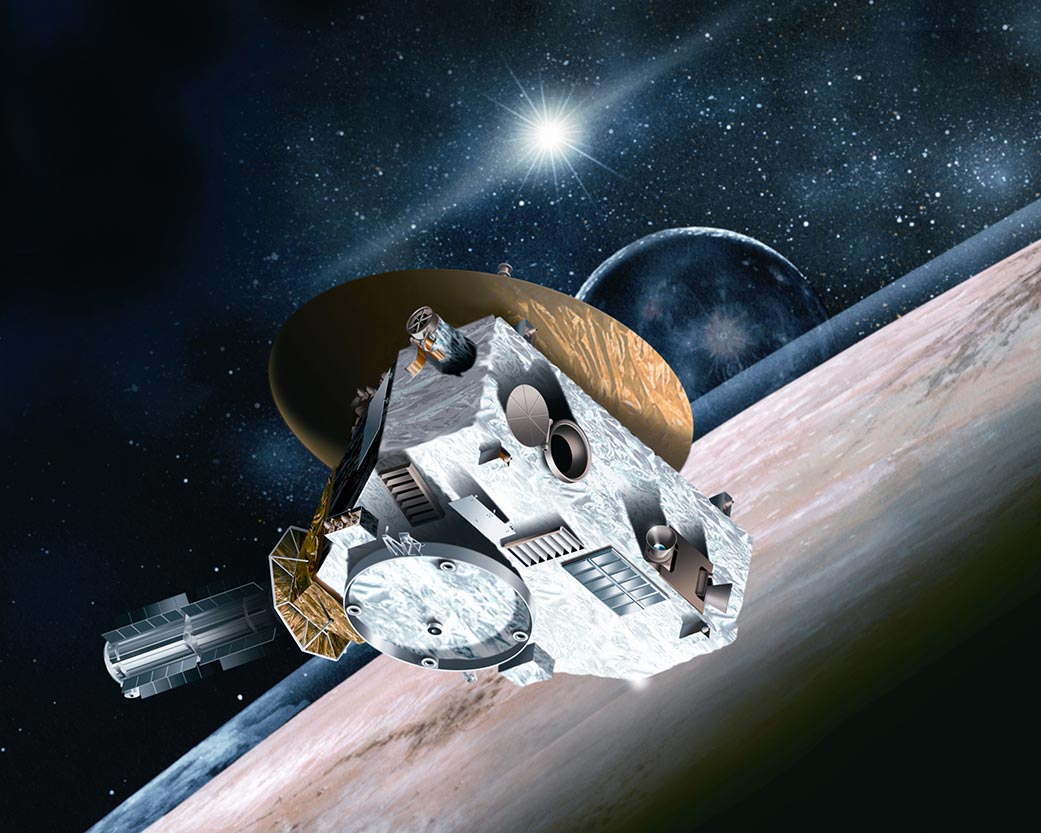
Artist conception of New Horizons Spacecraft. Credit: Johns Hopkins University Applied Physics Laboratory/Southwest Research Institute
One year ago, NASA’s New Horizons mission made history by exploring Pluto and its moons – giving humankind our first real look at this fascinating world on the frontier of our solar system.
Since those amazing days in July 2015 the New Horizons spacecraft has transmitted numerous images and many other kinds of data home for scientists and the public alike to study, analyze, and just plain love. From Pluto’s iconic “heart” and sweeping ice‐mountain vistas to its flowing glaciers and dramatic blue skies, it’s hard to pick just one favorite picture. So the mission team has picked 10 – and in no special order, placed them here.
Click on the images for more information. You’ve seen nine of them before, and the team added a 10th favorite, also sure to become one of New Horizons’ “greatest hits.”
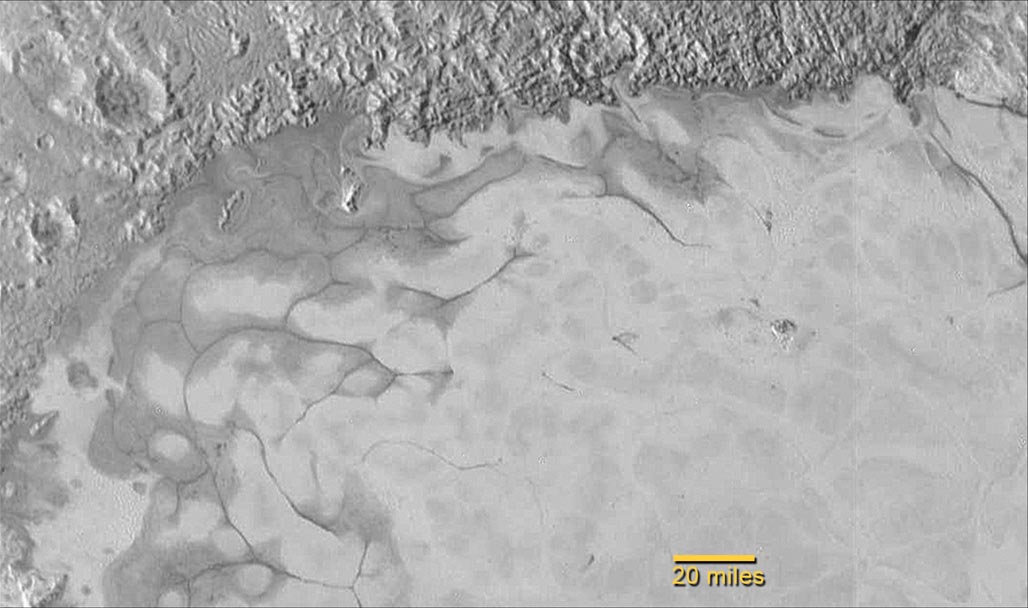
New Horizons discovers flowing ices in Pluto’s heart-shaped feature. In the northern region of Pluto’s Sputnik Planum (Sputnik Plain), swirl-shaped patterns of light and dark suggest that a surface layer of exotic ices has flowed around obstacles and into depressions, much like glaciers on Earth. Credit: NASA/JHUAPL/SwRI
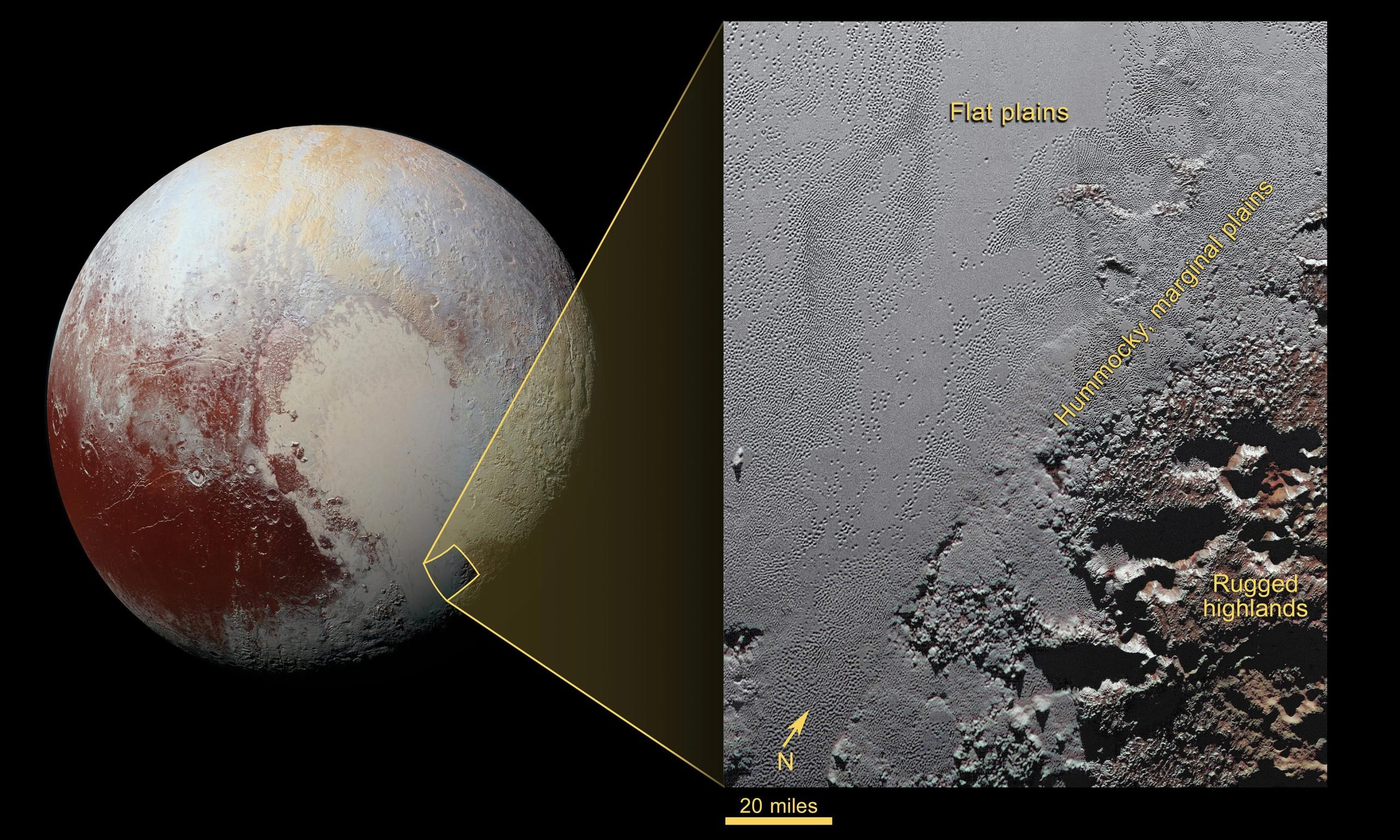
This dramatic image from NASA’s New Horizons spacecraft shows the dark, rugged highlands known as Krun Macula (lower right), which border a section of Pluto’s icy plains. Credit: NASA/JHUAPL/SwRI
Pluto’s Blue Sky: Pluto’s haze layer shows its blue color in this picture taken by the New Horizons Ralph/Multispectral Visible Imaging Camera (MVIC). The high-altitude haze is thought to be similar in nature to that seen at Saturn’s moon Titan. The source of both hazes likely involves sunlight-initiated chemical reactions of nitrogen and methane, leading to relatively small, soot-like particles (called tholins) that grow as they settle toward the surface. This image was generated by software that combines information from blue, red, and near-infrared images to replicate the color a human eye would perceive as closely as possible. Credit: NASA/JHUAPL/SwRI
Charon in Enhanced Color NASA’s New Horizons captured this high-resolution enhanced color view of Charon just before closest approach on July 14, 2015. The image combines blue, red and infrared images taken by the spacecraft’s Ralph/Multispectral Visual Imaging Camera (MVIC); the colors are processed to best highlight the variation of surface properties across Charon. Charon’s color palette is not as diverse as Pluto’s; most striking is the reddish north (top) polar region, informally named Mordor Macula. Charon is 754 miles (1,214 kilometers) across; this image resolves details as small as 1.8 miles (2.9 kilometers). Credit: NASA/JHUAPL/SwRI
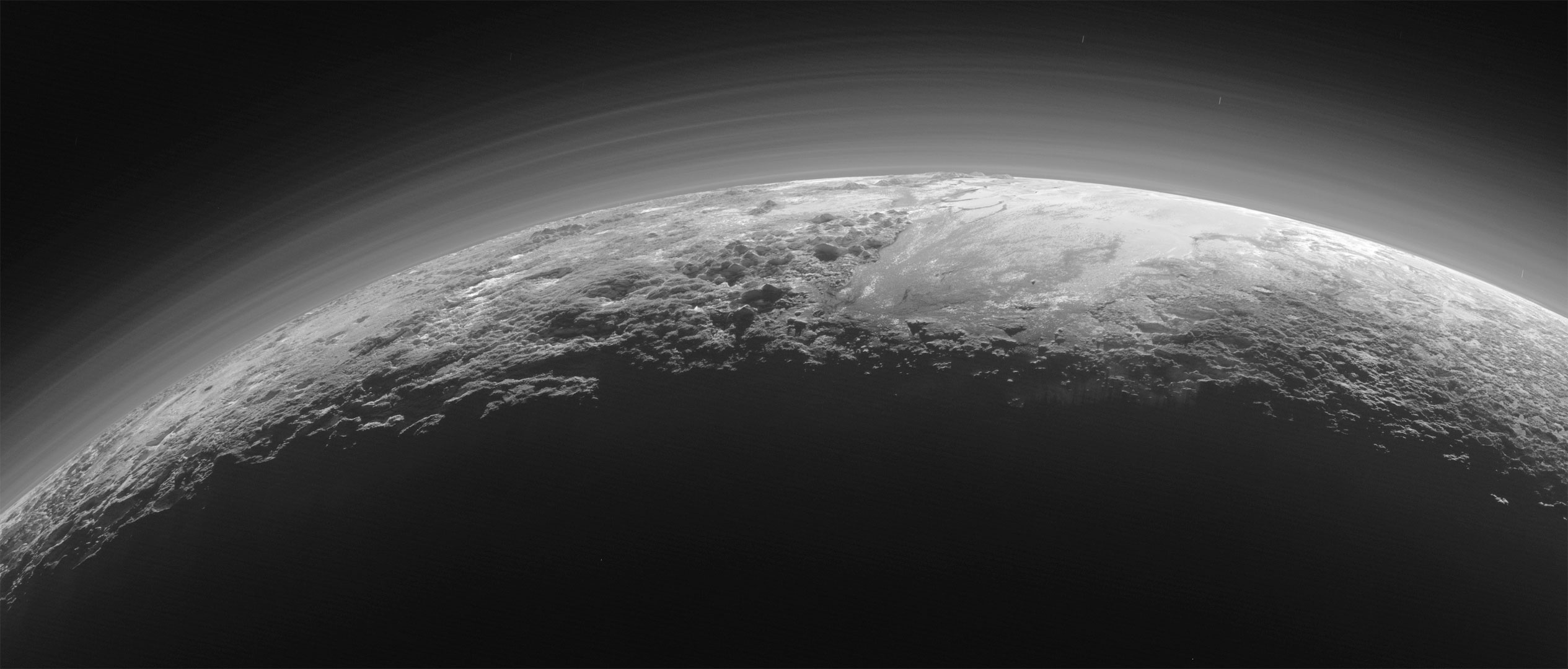
Pluto’s Majestic Mountains, Frozen Plains and Foggy Hazes: Just 15 minutes after its closest approach to Pluto on July 14, 2015, NASA’s New Horizons spacecraft looked back toward the sun and captured this near-sunset view of the rugged, icy mountains and flat ice plains extending to Pluto’s horizon. The smooth expanse of the informally named icy plain Sputnik Planum (right) is flanked to the west (left) by rugged mountains up to 11,000 feet (3,500 meters) high, including the informally named Norgay Montes in the foreground and Hillary Montes on the skyline. To the right, east of Sputnik, rougher terrain is cut by apparent glaciers. The backlighting highlights over a dozen layers of haze in Pluto’s tenuous but distended atmosphere. The image was taken from a distance of 11,000 miles (18,000 kilometers) to Pluto; the scene is 780 miles (1,250 kilometers) wide. Credit: NASA/JHUAPL/SwRI
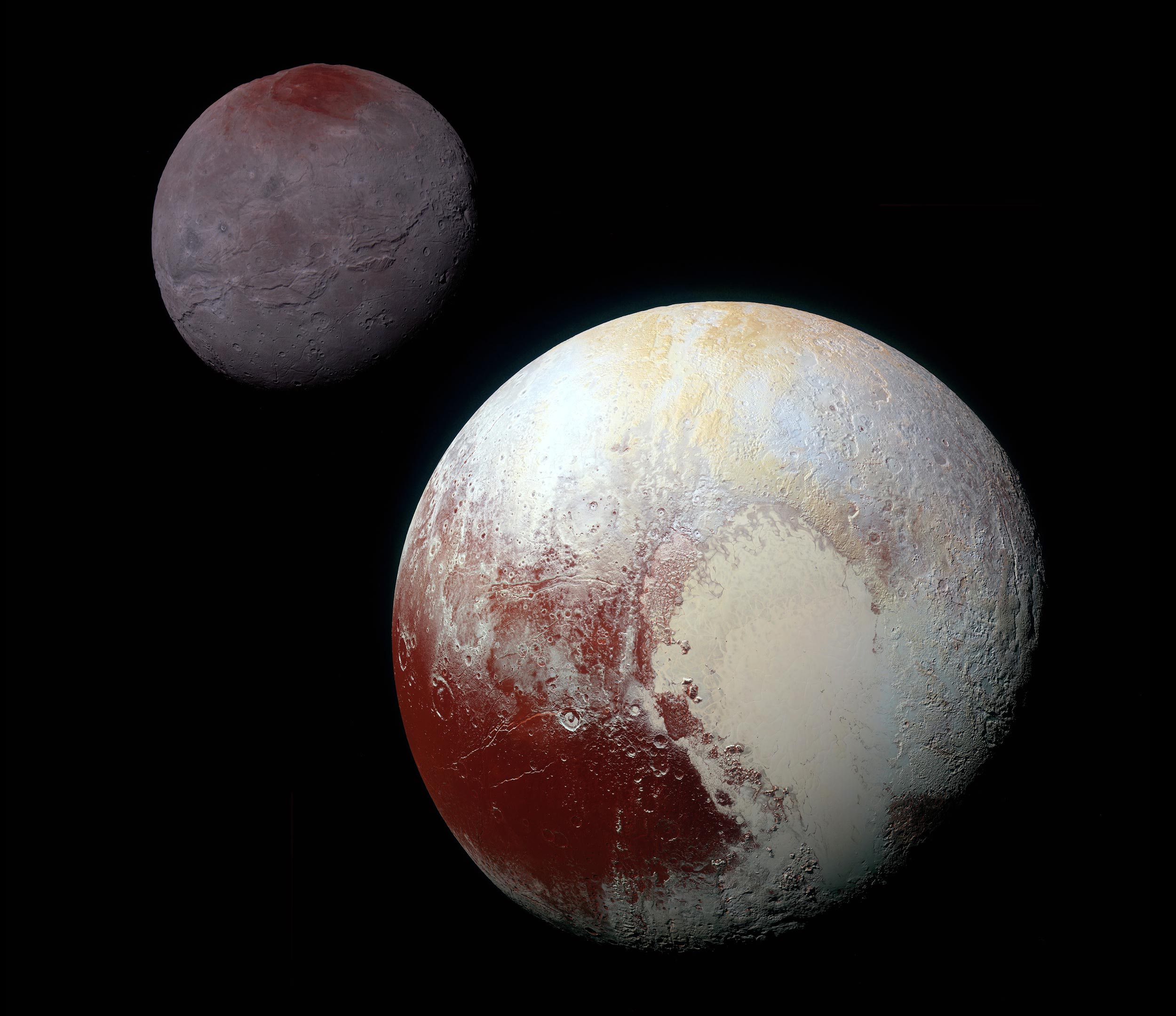
Pluto and its largest moon, Charon, are two of the most well-known residents of the Kuiper Belt. This composite of enhanced color images of Pluto (lower right) and Charon (upper left), was taken by NASA’s New Horizons spacecraft as it passed through the Pluto system on July 14, 2015. The color and brightness of both Pluto and Charon have been processed identically to allow direct comparison of their surfaces, and to highlight the similarity between Charon’s polar red terrain and Pluto’s equatorial red terrain. Pluto and Charon are shown with approximately correct relative sizes, but their true separation is not to scale. Credit: NASA/JHUAPL/SwRI
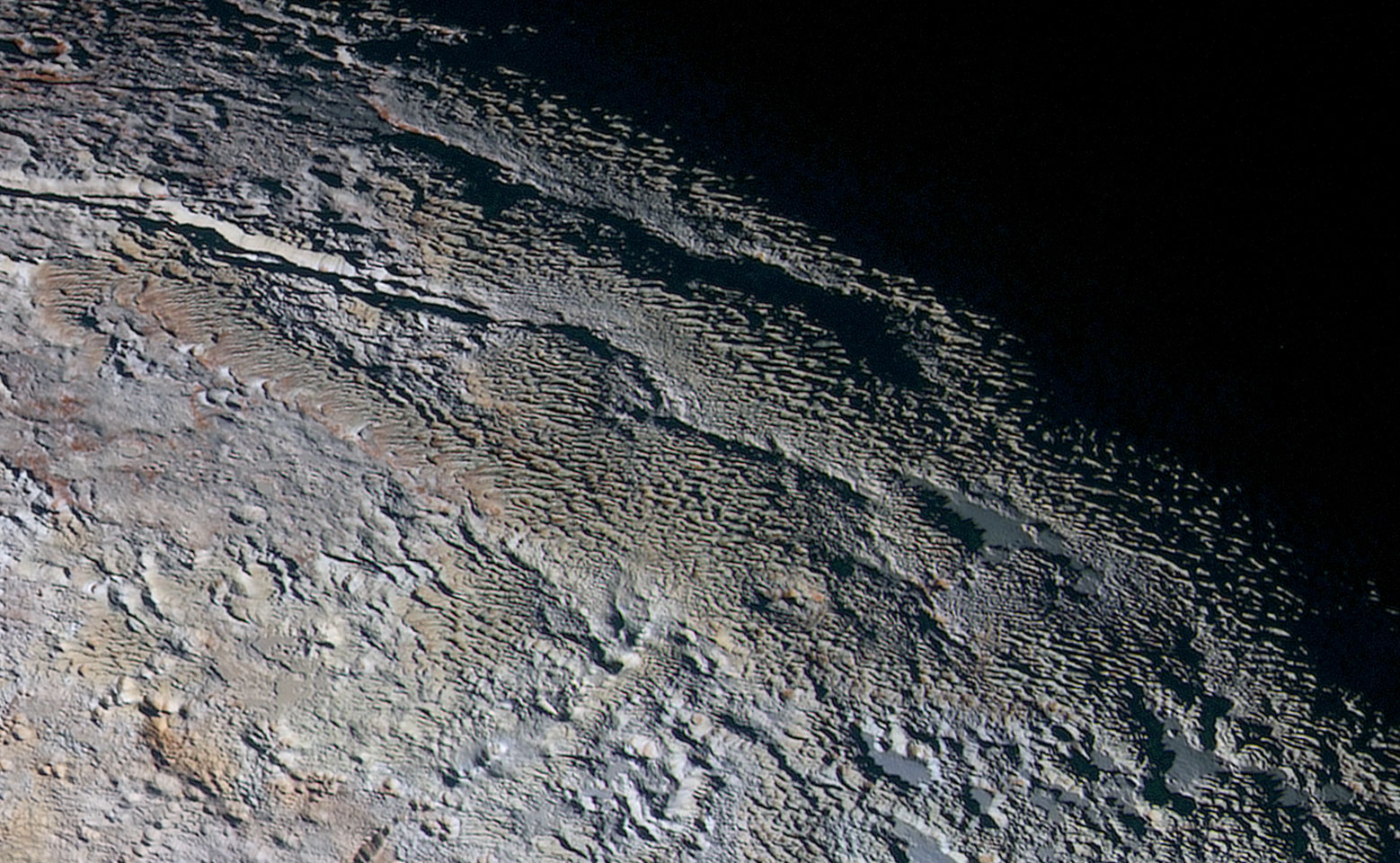
In this extended color image of Pluto taken by NASA’s New Horizons spacecraft, rounded and bizarrely textured mountains, informally named the Tartarus Dorsa, rise up along Pluto’s day-night terminator and show intricate but puzzling patterns of blue-gray ridges and reddish material in between. This view, roughly 330 miles (530 kilometers) across, combines blue, red and infrared images taken by the Ralph/Multispectral Visual Imaging Camera (MVIC) on July 14, 2015, and resolves details and colors on scales as small as 0.8 miles (1.3 kilometers). Credit: NASA/JHUAPL/SWRI
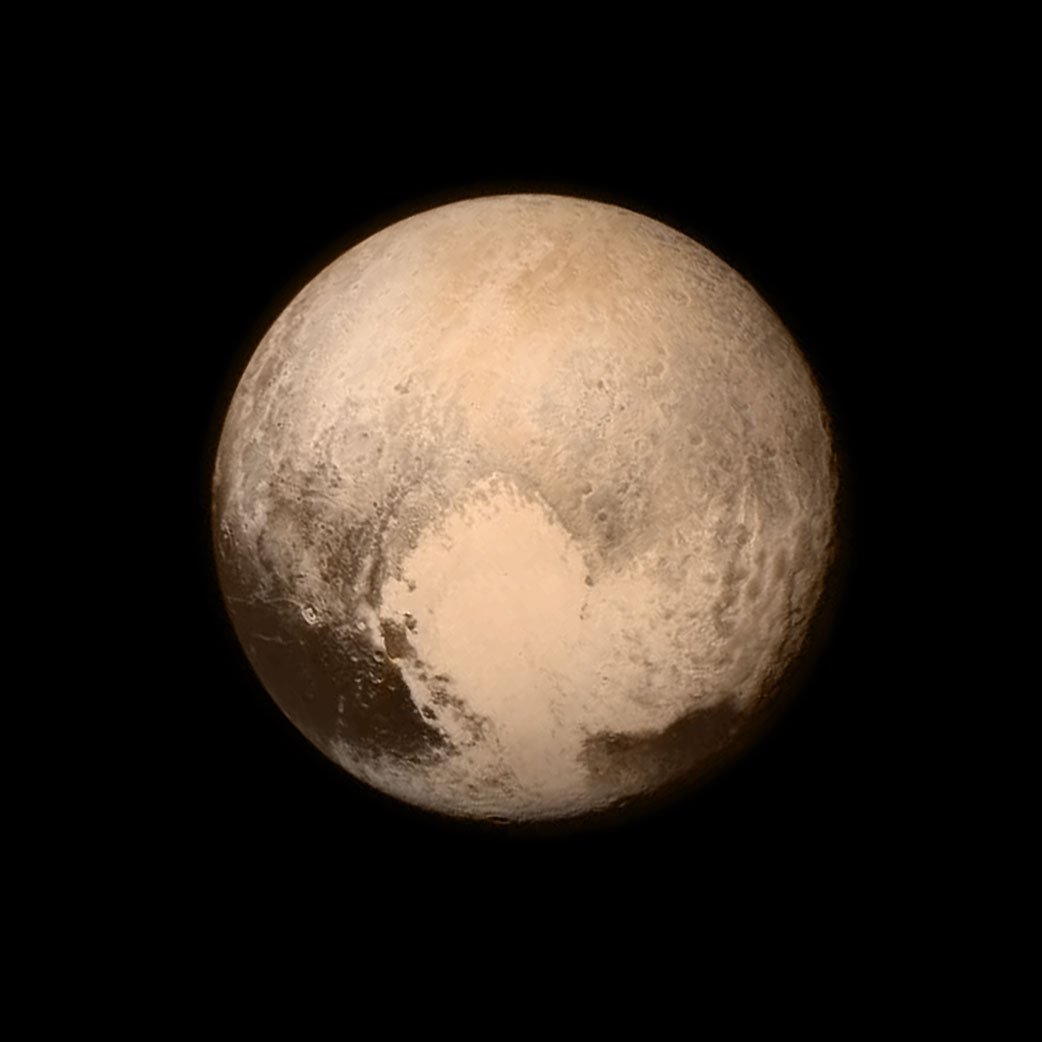
Pluto nearly fills the frame in this image from the Long Range Reconnaissance Imager (LORRI) aboard NASA’s New Horizons spacecraft, taken on July 13, 2015, when the spacecraft was 476,000 miles (768,000 kilometers) from the surface. This is the last and most detailed image sent to Earth before the spacecraft’s closest approach to Pluto on July 14. The color image has been combined with lower-resolution color information from the Ralph instrument that was acquired earlier on July 13. This view is dominated by the large, bright feature informally named the “heart,” which measures approximately 1,000 miles (1,600 kilometers) across. The heart borders darker equatorial terrains, and the mottled terrain to its east (right) are complex. However, even at this resolution, much of the heart’s interior appears remarkably featureless—possibly a sign of ongoing geologic processes. Credit: NASA/APL/SwRI
This dramatic image from NASA’s New Horizons spacecraft shows the dark, rugged highlands known as Krun Macula (lower right), which border a section of Pluto’s icy plains. Credit: NASA/JHUAPL/SwRI
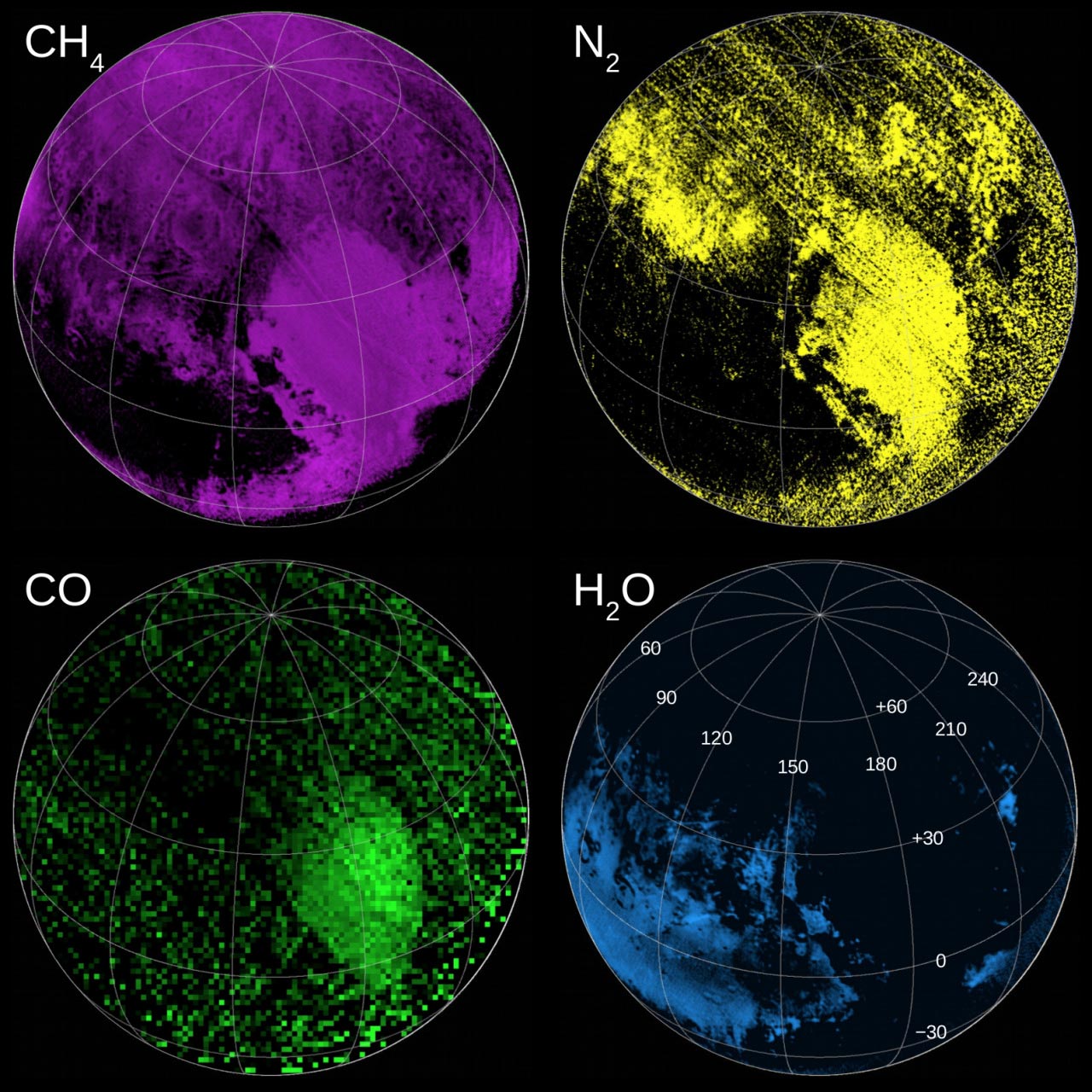
10. Colorful Composition Maps of Pluto
The powerful instruments on New Horizons not only gave scientists insight on what Pluto looked like, their data also confirmed (or, in many cases, dispelled) their ideas of what Pluto was made of. These compositional maps – assembled using data from the Linear Etalon Imaging Spectral Array (LEISA) component of the Ralph instrument – indicate the regions rich in ices of methane (CH4), nitrogen (N2) and carbon monoxide (CO), and, of course, water ice (H2O). Credit: NASA/JHUAPL/SwRI
Water which ran on Pluto’s surface is clearly visible in the good old days and the crack on the Pluto shows the track of the water after its impact with comets. Thank You.




1 Comment
Water which ran on Pluto’s surface is clearly visible in the good old days and the crack on the Pluto shows the track of the water after its impact with comets. Thank You.