
Close Menu
    Facebook X (Twitter) Instagram
    SciTechDaily
    • Biology
    • Chemistry
    • Earth
    • Health
    • Physics
    • Science
    • Space
    • Technology
    Facebook X (Twitter) Pinterest YouTube RSS
    SciTechDaily
    Home»Space»New Horizons Spacecraft Views Jagged Shores of Pluto’s Highlands
    Space

    New Horizons Spacecraft Views Jagged Shores of Pluto’s Highlands

    By SciTechDailyJune 10, 20162 Comments3 Mins Read
    Facebook Twitter Pinterest Telegram LinkedIn WhatsApp Email Reddit
    Share
    Facebook Twitter LinkedIn Pinterest Telegram Email Reddit
    Pluto Krun Macula New Horizons
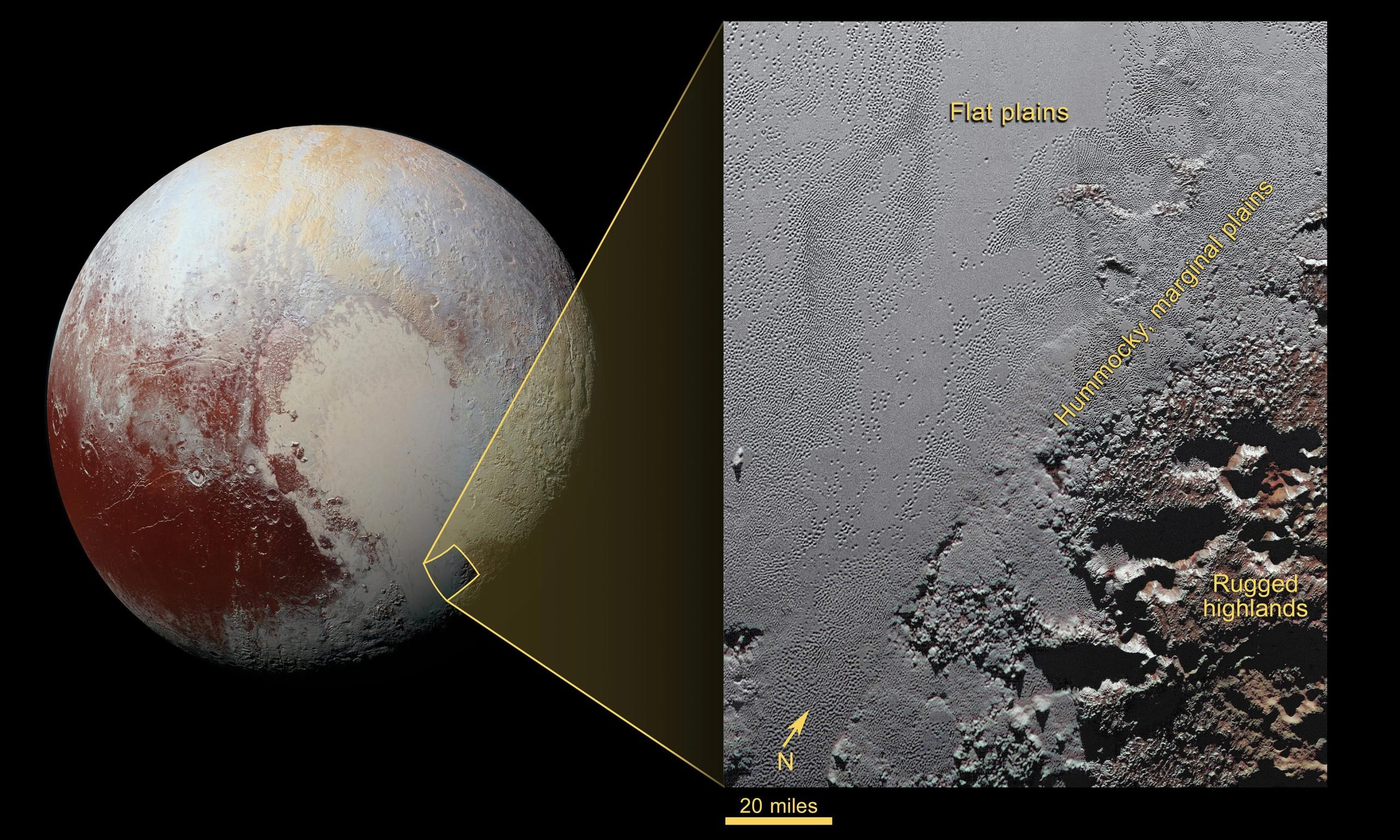
    This dramatic image from NASA’s New Horizons spacecraft shows the dark, rugged highlands known as Krun Macula (lower right), which border a section of Pluto’s icy plains. Credit: NASA/JHUAPL/SwRI

    NASA’s New Horizons spacecraft zooms in Pluto’s great ice plains and Krun Macula.

    This enhanced color view from NASA’s New Horizons spacecraft shows the southeastern portion of Pluto’s great ice plains, where at lower right the plains border rugged, dark highlands informally named Krun Macula. (Krun is the lord of the underworld in the Mandaean religion, and a ‘macula’ is a dark feature on a planetary surface.)

    Pluto is believed to get its dark red color from tholins, complex molecules found across much of the surface. Krun Macula rises 1.5 miles (2.5 kilometers) above the surrounding plain – informally named Sputnik Planum – and is scarred by clusters of connected, roughly circular pits that typically reach between 5 and 8 miles (8 and 13 kilometers) across, and up to 1.5 miles (2.5 kilometers) deep.

    New Horizons Views Pluto’s Highlands
    This dramatic image from NASA’s New Horizons spacecraft shows the dark, rugged highlands known as Krun Macula (lower right), which border a section of Pluto’s icy plains. Credit: NASA/JHUAPL/SwRI

    At the boundary with Sputnik Planum, these pits form deep valleys reaching more than 25 miles (40 kilometers) long, 12.5 miles (20 kilometers) wide, and almost 2 miles (3 kilometers) deep – almost twice as deep as the Grand Canyon in Arizona – and have floors covered with nitrogen ice. New Horizons scientists think these pits may have formed through surface collapse, although what may have prompted such a collapse is a mystery.

    This scene was created using three separate observations made by New Horizons in July 2015. The right half of the image is composed of 260 feet- (80 meter-) per-pixel data from the Long Range Reconnaissance Imager (LORRI), obtained at 9,850 miles (15,850 kilometers) from Pluto, about 23 minutes before New Horizons’ closest approach. The left half is composed of 410 feet- (125 meter-) per-pixel LORRI data, obtained about six minutes earlier, with New Horizons 15,470 miles (24,900 kilometers) from Pluto.

    These data respectively represent portions of the highest- and second-highest-resolution observations obtained by New Horizons in the Pluto system. The entire scene was then colorized using 2,230 feet- (680 meter-) per-pixel data from New Horizons’ Ralph/Multispectral Visual Imaging Camera (MVIC), obtained at 21,100 miles (33,900 kilometers) from Pluto, about 45 minutes before the closest approach.

    Never miss a breakthrough: Join the SciTechDaily newsletter.
    Follow us on Google and Google News.

    Astronomy New Horizons Planetary Science Pluto Popular
    Share. Facebook Twitter Pinterest LinkedIn Email Reddit

    Related Articles

    New Horizons Reveals ‘Snakeskin’ Pluto Image and More

    NASA Releases New Pluto Images Taken by the New Horizons Spacecraft

    NASA Reveals New Pluto Images from New Horizons Spacecraft

    Data from NASA’s New Horizons Hints at Underground Ocean on Pluto

    New Horizons Reveals Flowing Ices, Exotic Surface Chemistry, Mountains, and Haze on Pluto

    New Horizons Reveals a Dense Region of Atmospheric Ions Behind Pluto

    NASA’s New Horizons Spacecraft Reaches Historic Encounter with Pluto

    New Horizons Reveals Signs of Pluto’s Geology

    Dwarf Planet Pluto: The ‘Other’ Red Planet

    2 Comments

    1. Ian on June 11, 2016 1:59 am

      Its too bad that New Horizons was a one shot deal, after passing Pluto its heading out of the solar system. Hopefully what ever pictures we got from it will be sufficient to tell us Pluto’s mysteries…… Unfortunately that is never the case, and for every question answered, usually two more are generated…….

      Reply
    2. Jody on June 12, 2016 12:13 am

      it looks a lot like metal hit with an arc welder

      Reply
    Leave A Reply Cancel Reply

    • Facebook
    • Twitter
    • Pinterest
    • YouTube

    Don't Miss a Discovery

    Subscribe for the Latest in Science & Tech!

    Trending News

    Even Occasional Binge Drinking May Triple Liver Damage Risk

    Liftoff! NASA’s Artemis II Launch Sends Astronauts Around the Moon for First Time in 50 Years

    Scientists Discover New Way To Eliminate “Zombie Cells” Driving Aging

    This New Quantum Theory Could Change Everything We Know About the Big Bang

    This One Vitamin May Help Protect Your Brain From Dementia Years Later

    Stopping Weight-Loss Drugs Like Ozempic Can Quickly Erase Heart Benefits

    A 500-Million-Year-Old Surprise Is Forcing Scientists to Rethink Spider Evolution

    Coffee and Blood Pressure: What You Need To Know Before Your Next Cup

    Follow SciTechDaily
    • Facebook
    • Twitter
    • YouTube
    • Pinterest
    • Newsletter
    • RSS
    SciTech News
    • Biology News
    • Chemistry News
    • Earth News
    • Health News
    • Physics News
    • Science News
    • Space News
    • Technology News
    Recent Posts
    • DNA Meets Electronics: Scientists Create Ultra-Low Power Memory Breakthrough
    • A Strange Quantum Effect Could Power Future Electronics Without Batteries
    • This Breakthrough Solar Panel Generates Power From Both Sunlight and Raindrops
    • Greenland’s Ice Is Melting Faster Than Ever, and Scientists Are Alarmed
    • NASA Artemis II Nears Dramatic Moon Flyby With Record-Breaking Moment Ahead
    Copyright © 1998 - 2026 SciTechDaily. All Rights Reserved.
    • Science News
    • About
    • Contact
    • Editorial Board
    • Privacy Policy
    • Terms of Use

    Type above and press Enter to search. Press Esc to cancel.