
The result opens the path to study in a new and unique way the extreme state of matter that is thought to have existed shortly after the Big Bang.
The CMS collaboration has seen evidence of top quarks in collisions between heavy nuclei at the Large Hadron Collider (LHC).
This isn’t the first time this special particle – the heaviest known elementary particle – has “made an appearance” at particle colliders. The top quark was first observed in proton–antiproton collisions at the Tevatron collider 25 years ago, and has since been spotted and studied in proton–proton and proton–nucleus collisions at the LHC. But the new finding, described in a paper just accepted for publication in Physical Review Letters, is sure to excite experimentalists and theorists alike, for analysis of top quarks in heavy-nuclei collisions offers a new and unique way to study the quark–gluon plasma that forms in these collisions and is thought to have existed in the early moments of the universe. In addition, such analysis could cast new light on the arrangement of quarks and gluons inside heavy nuclei.
There isn’t exactly a shortage of particles, or “probes”, with which to investigate the quark–gluon plasma. The LHC experiments have long been using several types of particles to study the properties of this extreme state of matter, in which quarks and gluons are not confined within composite particles but instead roam like particles in a liquid with small frictional resistance. But all of the existing probes provide time-averaged information about the plasma. By contrast, the top quark, owing to the particular way in which it transforms, or “decays” into other particles, can provide snapshots of the plasma at different times of its lifetime.
“Faster-moving top quarks provide later-time snapshots. By assembling snapshots taken with top quarks at a range of different speeds, we hope that it will eventually be possible to create a movie of the quark–gluon plasma’s evolution,” explains CERN-based researcher Guilherme Milhano, who co-authored a theoretical study on probing the quark–gluon plasma with top quarks. “The new CMS result represents the very first step down that road.”
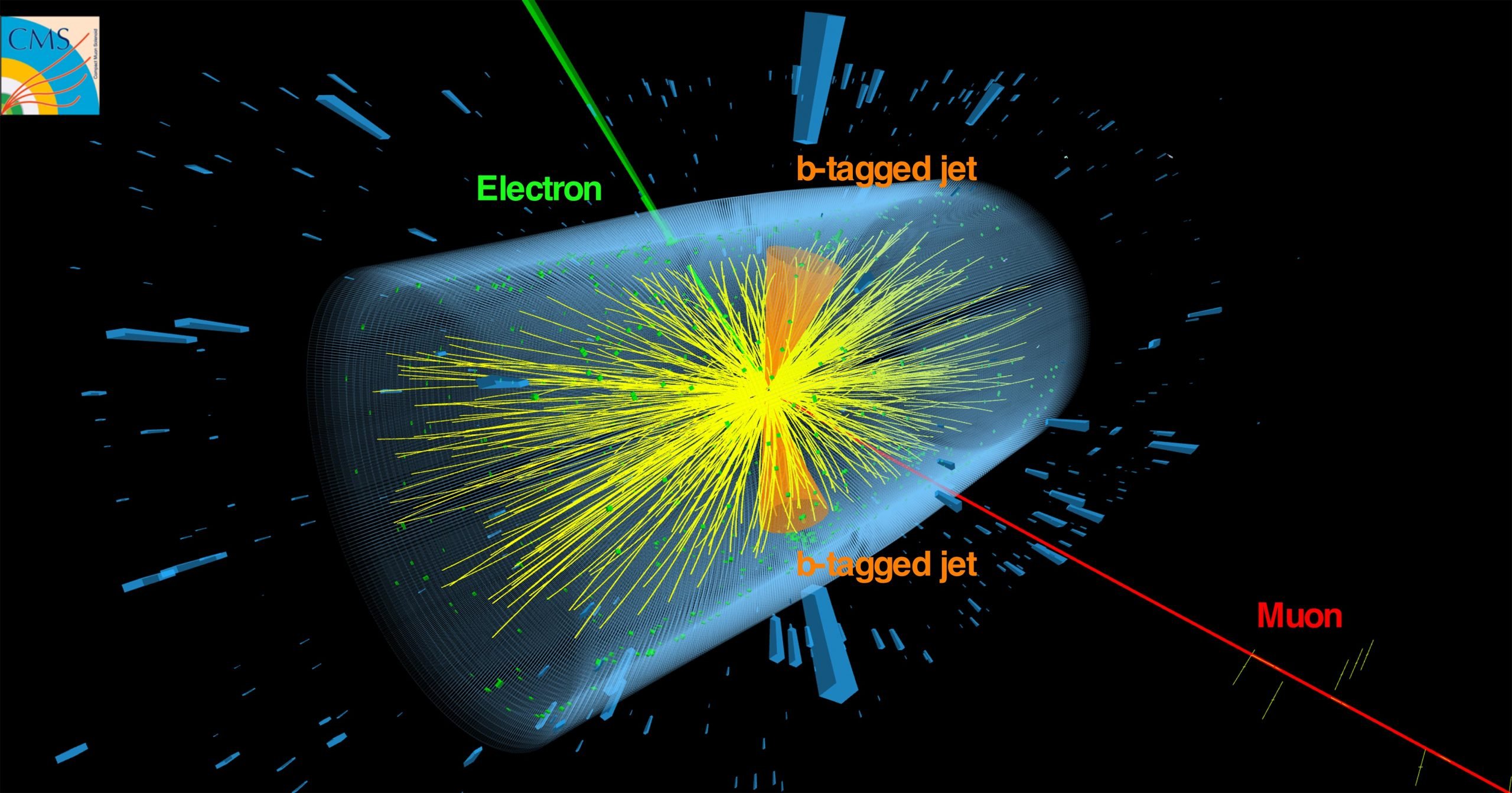
The CMS collaboration saw evidence of top quarks in a large data sample from lead–lead collisions at an energy of 5.02 TeV. The team searched for collisions producing a top quark and a top antiquark. These quarks decay very quickly into a W boson and a bottom quark, which in turn also decay very rapidly into other particles. The CMS physicists looked for the particular case in which the final decay products are charged leptons (electrons or their heavier cousins muons) and “jets” of multiple particles originating from bottom quarks.
After isolating and counting these top–antitop collision events, CMS estimated the probability for lead–lead collisions to produce top–antitop pairs via charged leptons and bottom quarks. The result has a statistical significance of about four standard deviations, so it doesn’t yet cross the threshold of five standard deviations that is required to claim observation of top-quark production. But it represents significant evidence of the process – there’s only a 0.003% chance that the result is a statistical fluke. What’s more, the result is consistent with theoretical predictions, as well as with extrapolations from previous measurements of the probability in proton–proton collisions at the same collision energy.
“Our result demonstrates the capability of the CMS experiment to perform top-quark studies in the complex environment of heavy-nuclei collisions,” says CMS physicist Georgios Krintiras, a postdoctoral researcher at the University of Kansas, “and it’s the first stepping stone in using the top quark as a new and powerful probe of the quark–gluon plasma.”
Reference: “Evidence for top quark production in nucleus-nucleus collisions” by A. M. Sirunyan et al. (CMS Collaboration), 24 November 2020, Physical Review Letters.
DOI: 10.1103/PhysRevLett.125.222001
Never miss a breakthrough: Join the SciTechDaily newsletter.
Follow us on Google and Google News.
6 Comments
These investigations are very interesting, but are they wise to do? I’m pointing on the risk of creation of strangelets, for instance. Since we do not fullty understand what is happening at these energylevels, it is like playing a game without completely overseeing the risks. I don’t feel comfortable about it; it should be discussed in a wider community.
Leave alone, why play god, your not god, play with fire and you get burned. Its a dangerous game, im no scientist,but common sense says its stupid to go any further. Proves nothing if we all die does it…..
The LHC collides fewer protons in one year than there are in 1% of a grain of sand. The LHC won’t make a black hole that will destroy the Earth (mass 6 x 10^24 kg) with a few protons, no matter how quickly we accelerate them – even if they form a black hole.
A black hole with a mass equivalent to a grain of sand would evaporate in approximately 0.00000000000000000000000000000001 seconds. This is why the planet is still here.
Ferdinand:
Particles containing strange quarks normally decay instantaneously. The strange matter hypothesis suggests that a large quark condensate may possibly produce stable strange matter that is not subject to instantaneous decay.
No quark condensates big enough to threaten the planet have ever been produced at the LHC. The mass/energy content of a grain of sand being released over the course of a century is not a viable candidate for destroying planets, whether it is via singularities or strangelets.
Pam:
Fear and ignorance of science are in no way an indicator of common sense.
Stating you’re “no scientist”, sounding off on a subject you know absolutely nothing about and then hysterically claiming scientists are ‘playing god’ is NOT common sense.
Please don’t burn down any windmills. It did not end well for the Luddites.
… yeah, one shoots one stream into another one, but if one could create more stream, would that be of some use?…
… and could that collider thing be in the space around a planet with four or more satellites…
Well SAURON it’s 4:1 on the comments so looks like you must be wrong!
The abundance of morons on the internet is always amusing.