
Close Menu
    Facebook X (Twitter) Instagram
    SciTechDaily
    • Biology
    • Chemistry
    • Earth
    • Health
    • Physics
    • Science
    • Space
    • Technology
    Facebook X (Twitter) Pinterest YouTube RSS
    SciTechDaily
    Home»Physics»Large Hadron Collider ATLAS Finds Evidence of Spectacular Four-Top Quark Production
    Physics

    Large Hadron Collider ATLAS Finds Evidence of Spectacular Four-Top Quark Production

    By ATLAS CollaborationMay 27, 20202 Comments5 Mins Read
    Facebook Twitter Pinterest Telegram LinkedIn WhatsApp Email Reddit
    Share
    Facebook Twitter LinkedIn Pinterest Telegram Email Reddit
    Candidate Four-Top-Quark Event
    Event display of a candidate four-top-quark event, where two of the top quarks decay leptonically (one with a resulting muon (red) and one with an electron (green)), and two top quarks decay hadronically (green and yellow rectangles). The jets (b-tagged jets) are shown as yellow (blue) cones. Credit: ATLAS Collaboration/CERN

    In a new result released today, the ATLAS Collaboration announced strong evidence of the production of four top quarks. This rare Standard Model process is expected to occur only once for every 70 thousand pairs of top quarks created at the LHC and has proven extremely difficult to measure.

    The top quark is the most massive elementary particle in the Standard Model, clocking in at 173 GeV, which is equivalent to the mass of a gold atom. But contrary to gold, whose mass is mostly due to the nuclear binding force, the top quark gets all its mass from the interaction with the Higgs field. So when four top quarks are produced in a single event, they create the heaviest particle final state ever seen at the LHC, with almost 700 GeV in total. This is an ideal environment to search for new physics with yet unknown particles contributing to the process. Should they exist, physicists will see additional production of four top quarks above what is predicted by the Standard Model, further motivating a detailed study of the process.

    In this new search for four-top-quark production, ATLAS physicists studied the full Run 2 dataset recorded between 2015 and 2018. When produced through proton–proton collisions at the LHC, this process leaves spectacular signatures in the ATLAS detector. The four top quarks produce four W bosons and four jets – collimated sprays of particles – originating from bottom quarks. The W bosons then, in turn, each decay into two jets or one charged lepton (electron, muon or tau leptons) and an invisible neutrino. As a final step, the tau leptons decay into a lighter lepton or a jet, with additional neutrinos.

    BDT ATLAS Four Top Quark
    Figure 2: The boosted decision tree (BDT) score output for the signal region (SR). The data are shown in black; the simulated signal in red. The y-axis shows the number of events and is in the logarithmic-scale. The band includes the total uncertainty on the post profile-likelihood fit (post-fit) computation. The ratio of the data to the total post-fit computation is shown in the lower panel. Credit: ATLAS Collaboration/CERN

    For this result, physicists chose to focus on collision events producing two leptons with the same charge or three leptons. Despite accounting for only 12% of all four-top-quark decays, these signatures are easier to distinguish from background processes in the ATLAS detector. Detecting a signal nevertheless required a detailed understanding of the remaining background processes and the use of sophisticated separation techniques.


    When four top quarks are produced in a single event, they create the heaviest particle final state ever seen at the LHC, with almost 700 GeV in total.


    ATLAS physicists trained a multivariate discriminant (boosted decision tree) using the distinct features of the signal, including the high numbers of jets, their quark-flavor origin (bottom quark or not), and the energies and angular distributions of the measured particles. The main background processes that resemble the signal stem from the production of a pair of top quarks in association with other particles, such as a W or Z boson, a Higgs boson, or another top quark. Some of these processes have themselves only recently been observed by the ATLAS and CMS Collaborations.
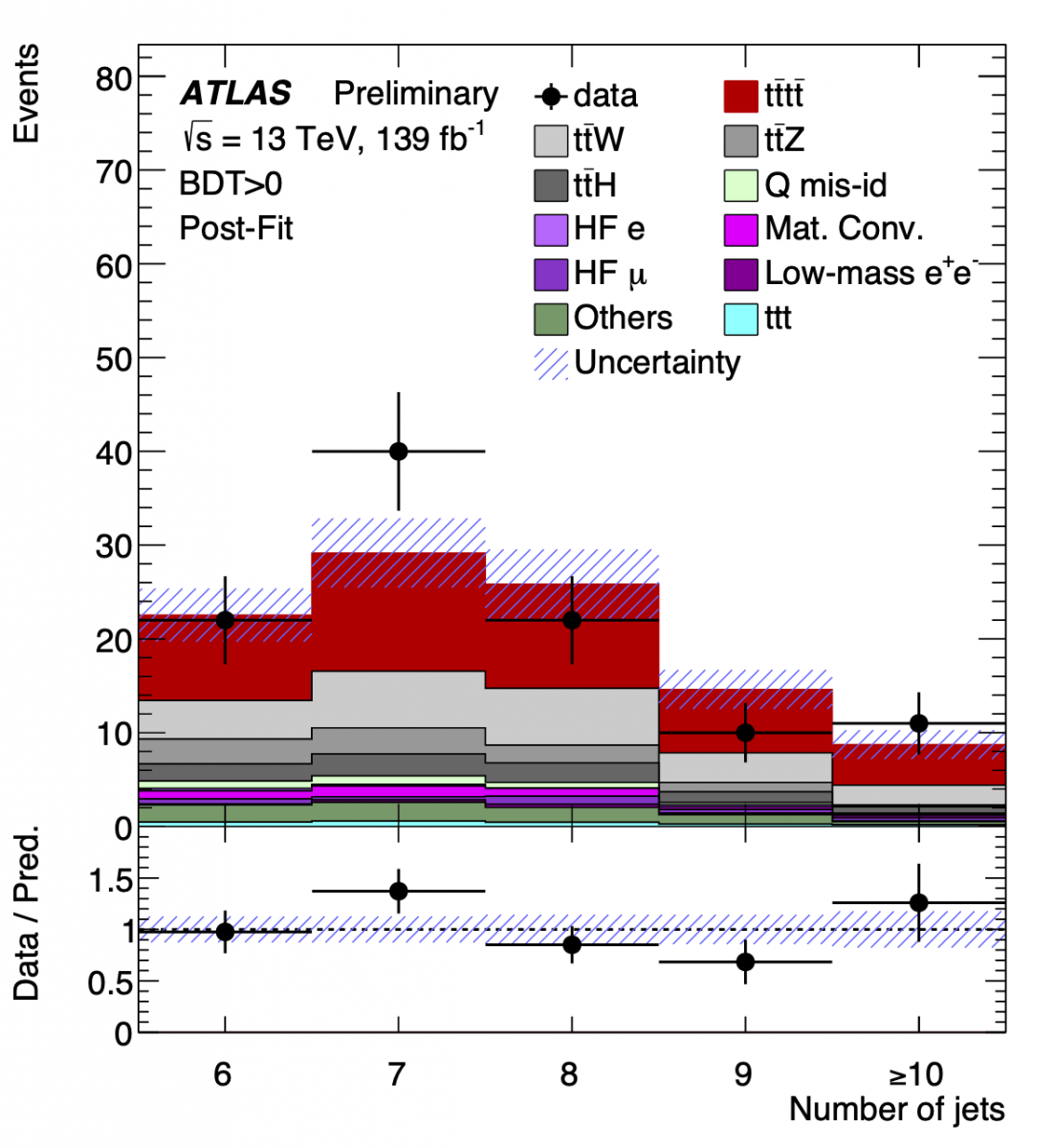
    Comparison ATLAS Four Top Quark
    Comparison between data and prediction for signal-region events with a BDT score greater than 0 for the distributions of the number of jets. The band includes the total uncertainty on the post profile-likelihood fit (post-fit) computation. The ratio of the data to the total post-fit computation is shown in the lower panel. Credit: ATLAS Collaboration/CERN

    Each background process was individually evaluated, primarily through dedicated simulations which included information from the best available theoretical predictions. The most difficult background processes – the top-quark-pair production with a W boson and backgrounds with fake leptons – had to be determined using data from dedicated control regions. Fake leptons arise when the charge of a lepton is misidentified, or when leptons come from a different process, but are attributed to the signal. Both had to be well-understood and precisely evaluated in order to reduce the systematic uncertainty on the final result.

    ATLAS measured the cross section for the production of four top quarks to be 24 +7–6 fb, which is consistent with the Standard Model prediction (12 fb) at 1.7 standard deviations. The signal significance amounts to 4.3 standard deviations, for an expected significance of 2.4 standard deviations were the four-top-quark signal equal to the Standard Model prediction. The measurement provides strong evidence for this process.

    Additional data from the next LHC run – along with further developments of the analysis techniques employed – will improve the precision of this challenging measurement.

    Never miss a breakthrough: Join the SciTechDaily newsletter.
    Follow us on Google and Google News.

    CERN Large Hadron Collider Particle Physics
    Share. Facebook Twitter Pinterest LinkedIn Email Reddit

    Related Articles

    New CERN Study Suggests Subatomic Particles Could Defy the Standard Model

    CERN Reports Observation of Pentaquark Particles

    Physicists Confirm Discovery of Four-Quark Hadron

    New Results Indicate That Particle Discovered at LHC Is a Higgs Boson

    The Large Hadron Collider Prepares for Shutdown

    CERN to Announce the Latest Results from ATLAS and CMS

    Discussing the Search for the Higgs Particle

    More Data of Elusive Higgs Boson from Defunct US Tevatron Collider

    Higgs Boson Signals Gain Strength at Large Hadron Collider

    2 Comments

    1. ziane.ziane on July 6, 2020 1:37 am

      the article is really very helpful.

      Reply
    2. zianezo on July 6, 2020 1:39 am

      Hi thanks.

      Reply
    Leave A Reply Cancel Reply

    • Facebook
    • Twitter
    • Pinterest
    • YouTube

    Don't Miss a Discovery

    Subscribe for the Latest in Science & Tech!

    Trending News

    Largest-Ever Study Finds Medicinal Cannabis Ineffective for Anxiety, Depression, PTSD

    250-Million-Year-Old Egg Solves One of Evolution’s Biggest Mysteries

    Living With Roommates Might Be Changing Your Gut Microbiome Without You Knowing

    Century-Old Cleaning Chemical Linked to 500% Increased Risk of Parkinson’s Disease

    What if Your Memories Never Happened? Physicists Take a New Look at the Boltzmann Brain Paradox

    One of the Universe’s Largest Stars May Be Getting Ready To Explode

    Scientists Discover Enzyme That Could Supercharge Ozempic-Like Weight Loss Drugs

    Popular Sweetener Linked to DNA Damage – “It’s Something You Should Not Be Eating”

    Follow SciTechDaily
    • Facebook
    • Twitter
    • YouTube
    • Pinterest
    • Newsletter
    • RSS
    SciTech News
    • Biology News
    • Chemistry News
    • Earth News
    • Health News
    • Physics News
    • Science News
    • Space News
    • Technology News
    Recent Posts
    • Scientists Uncover Potential Brain Risks of Popular Fish Oil Supplements
    • Scientists Prove There Are Just Six Degrees of Separation in a Social Network
    • Bee Bacteria Could Fix a Major Flaw in Plant-Based Milk
    • Scientists Discover a Surprising Way To Make Bread Healthier and More Nutritious
    • Natural Compounds Boost Bone Implant Success While Killing Bacteria and Cancer Cells
    Copyright © 1998 - 2026 SciTechDaily. All Rights Reserved.
    • Science News
    • About
    • Contact
    • Editorial Board
    • Privacy Policy
    • Terms of Use

    Type above and press Enter to search. Press Esc to cancel.