
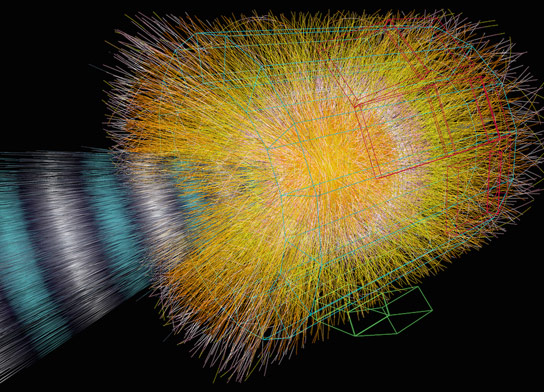
Nuclear scientists at the U.S. Department of Energy’s Lawrence Berkeley National Lab have made the most precise extraction to date of a key property of the quark-gluon plasma, which reveals the microscopic structure of this almost perfect liquid.
By combining data from two high-energy accelerators, nuclear scientists have refined the measurement of a remarkable property of exotic matter known as quark-gluon plasma. The findings reveal new aspects of the ultra-hot, “perfect fluid” that give clues to the state of the young universe just microseconds after the Big Bang.
The multi-institutional team known as the JET Collaboration, led by researchers at the U.S. Department of Energy’s Lawrence Berkeley National Lab (Berkeley Lab), published their results in a recent issue of the journal Physical Review C. The JET Collaboration is one of the Topical Collaborations in nuclear theory established by the DOE Office of Science in 2010. JET, which stands for Quantitative Jet and Electromagnetic Tomography, aims to study the probes used to investigate high-energy, heavy-ion collisions. The Collaboration currently has 12 participating institutions with Berkeley Lab as the leading institute.
“We have made, by far, the most precise extraction to date of a key property of the quark-gluon plasma, which reveals the microscopic structure of this almost perfect liquid,” says Xin-Nian Wang, physicist in the Nuclear Science Division at Berkeley Lab and managing principal investigator of the JET Collaboration. Perfect liquids, Wang explains, have the lowest viscosity-to-density ratio allowed by quantum mechanics, which means they essentially flow without friction.
Hot Plasma Soup
To create and study the quark-gluon plasma, nuclear scientists used particle accelerators called the Relativistic Heavy-ion Collider (RHIC) at the Brookhaven National Laboratory in New York and the Large Hadron Collider (LHC) at CERN in Switzerland. By accelerating heavy atomic nuclei to high energies and blasting them into each other, scientists are able to recreate the hot temperature conditions of the early universe.
Inside protons and neutrons that make up the colliding atomic nuclei are elementary particles called quarks, which are bound together tightly by other elementary particles called gluons. Only under extreme conditions, such as collisions in which temperatures exceed by a million times those at the center of the sun, do quarks and gluons pull apart to become the ultra-hot, frictionless perfect fluid known as quark-gluon plasma.
“The temperature is so high that the boundaries between different nuclei disappear so everything becomes a hot-plasma soup of quarks and gluons,” says Wang. This ultra-hot soup is contained within a chamber in the particle accelerator, but it is short-lived—quickly cooling and expanding—making it a challenge to measure. Experimentalists have developed sophisticated tools to overcome the challenge, but translating experimental observations into precise quantitative understanding of the quark-gluon plasma has been difficult to achieve until now, he says.
Looking Inside
In this new work, Wang’s team refined a probe that makes use of a phenomenon researchers at Berkeley Lab first theoretically outlined 20 years ago: energy loss of a high-energy particle, called a jet, inside the quark gluon plasma.
“When a hot quark-gluon plasma is generated, sometimes you also produce these very energetic particles with an energy a thousand times larger than that of the rest of the matter,” says Wang. This jet propagates through the plasma, scatters, and loses energy on its way out.
Since the researchers know the energy of the jet when it is produced, and can measure its energy coming out, they can calculate its energy loss, which provides clues to the density of the plasma and the strength of its interaction with the jet. “It’s like an x-ray going through a body so you can see inside,” says Wang.
One difficulty in using a jet as an x-ray of the quark-gluon plasma is the fact that a quark-gluon plasma is a rapidly expanding ball of fire—it doesn’t sit still. “You create this hot fireball that expands very fast as it cools down quickly to ordinary matter,” Wang says. So it’s important to develop a model to accurately describe the expansion of plasma, he says. The model must rely on a branch of theory called relativistic hydrodynamics in which the motion of fluids is described by equations from Einstein’s theory of special relativity.
Over the past few years, researchers from the JET Collaboration have developed such a model that can describe the process of expansion and the observed phenomena of an ultra-hot perfect fluid. “This allows us to understand how a jet propagates through this dynamic fireball,” says Wang
Employing this model for the quark-gluon plasma expansion and jet propagation, the researchers analyzed combined data from the PHENIX and STAR experiments at RHIC and the ALICE and CMS experiments at LHC since each accelerator created quark-gluon plasma at different initial temperatures. The team determined one particular property of the quark-gluon plasma, called the jet transport coefficient, which characterizes the strength of interaction between the jet and the ultra-hot matter. “The determined values of the jet transport coefficient can help to shed light on why the ultra-hot matter is the most ideal liquid the universe has ever seen,” Wang says.
Peter Jacobs, head of the experimental group at Berkeley Lab that carried out the first jet and flow measurements with the STAR Collaboration at RHIC, says the new result is “very valuable as a window into the precise nature of the quark gluon plasma. The approach taken by the JET Collaboration to achieve it, by combining efforts of several groups of theorists and experimentalists, shows how to make other precise measurements of properties of the quark gluon plasma in the future.”
The team’s next steps are to analyze future data at lower RHIC energies and higher LHC energies to see how these temperatures might affect the plasma’s behavior, especially near the phase transition between ordinary matter and the exotic matter of the quark-gluon plasma.
This work was supported by the DOE Office of Science, Office of Nuclear Physics and used the facilities of the National Energy Research Scientific Computing Center (NERSC) located at Berkeley Lab.
Reference: “Extracting the jet transport coefficient from jet quenching in high-energy heavy-ion collisions” by Karen M. Burke, Alessandro Buzzatti, Ningbo Chang, Charles Gale, Miklos Gyulassy, Ulrich Heinz, Sangyong Jeon, Abhijit Majumder, Berndt Müller, Guang-You Qin, Björn Schenke, Chun Shen, Xin-Nian Wang, Jiechen Xu, Clint Young and Hanzhong Zhang (JET Collaboration), 29 July 2014, Physical Review C.
DOI: 10.1103/PhysRevC.90.014909
Never miss a breakthrough: Join the SciTechDaily newsletter.
Follow us on Google and Google News.
2 Comments
Analysis of quark-gluon plasma in the initial universe after Big Bang, can be easily understood, if we know that the kinetic energy of high energy particles are responsible for the emission of heat and in this case as X-rays and high energy gamma rays. In thermodynamics, when heat is added to the molecular velocity of the otherwise gas molecules which are in random motion, results in pressure and its measure of so called temperature. The rate of cooling is a hyperbolic curve by Newton’s law of cooling and the temperature falls of steeply and rapidly and stays still in a gradual descent in temperature. In the Universe also, after the Big Bang, the quark-gluon plasma initiated a very very high temperature which fell off rapidly in microseconds sending X-Rays and gamma rays as photons of high energy.This Boson field hangs on till today and who knows, that even Higgs Boson might have fallen off and got radiated throughout to weave the particles into atoms. Thank You.
thanks for the helpful information shared.