
Flight 19 for NASA’s Ingenuity is scheduled to take place no earlier than Sunday, January 23, 2022.
The Martian atmosphere, although less dense than Earth’s, exhibits similar dynamic weather patterns that impact flight operations, such as seasonal changes and dust storms. Flight planning on Mars, especially at Jezero Crater, relies heavily on forecasts from limited resources like the Mars Environmental Dynamics Analyzer and orbital imagers. The presence of dust significantly affects solar power and air density, complicating flight schedules and necessitating adaptive strategies.
Mars Climate and Flight Delays
The atmosphere of Mars is much less dense than Earth’s; however, the Mars climate shares many similarities to Earth: seasons, changing winds, ice clouds, and dust storms, among others. Predicting weather events, as is true for Earth, is always an uncertain endeavor. In preparing for Flight 19, we found out that unexpected Mars weather can result in a familiar and unfortunate scenario here on Earth: a delayed flight. Fortunately, Ingenuity carries no passengers, and all its luggage is “carry-on,” so the consequence is little more than waiting for better weather.
Martian Weather Forecasting for Aviation
With 18 flights completed to date, weather forecasting has become an integral piece of Martian flight planning. Since the first flight on April 19, 2021, Jezero Crater has progressed through spring and into summer. We are currently approaching the end of summer and the beginning of autumn, which starts February 24. With the changing seasons come new challenges, including a decrease in air density that required modifications to how we fly.
As weather forecasters, our job is to provide an evaluation of current weather conditions against flight requirements. What are these requirements for acceptable and safe flying? Favorable conditions hinge on two key properties: air density and wind speed. Although we do not have the advantage of a large number of weather stations or orbiting weather satellites at Mars, as is the case on Earth, we do have a number of tools at our disposal to determine if conditions are acceptable for flight. The most useful forecasting resource is the Mars Environmental Dynamics Analyzer (MEDA) – an operating weather station aboard the Perseverance rover. Using this powerful suite of instruments, we can calculate the air density and measure winds throughout the day and track their changes with season as we prepare for future flights. We are not without assistance from orbital assets, either – both the Mars Color Imager (MARCI) and Mars Climate Sounder (MCS) aboard the Mars Reconnaissance Orbiter (MRO) provide daily updates on the state of the atmosphere – useful for understanding activity outside of Jezero crater that could impact future weather.
Challenges of Dust in Mars’ Atmosphere
As Mars transitions into autumn, we expect an increase in the amount of dust in the atmosphere globally; levels will remain heightened through winter (this period of the year is referred to as the “dusty season”). Dust plays a major role in Mars’ climate, and its characterization is especially important for solar-powered surface assets like Ingenuity. Atmospheric dust will decrease the amount of sunlight that reaches Ingenuity’s solar panels, which charge the batteries needed for flight. Furthermore, dust in the atmosphere is heated by sunlight and warms the surrounding atmosphere, resulting in a reduction of the already-low-density air in which Ingenuity must fly. Members of the operations team have been actively discussing the upcoming dusty season and how to respond to the effects of this changing environment.
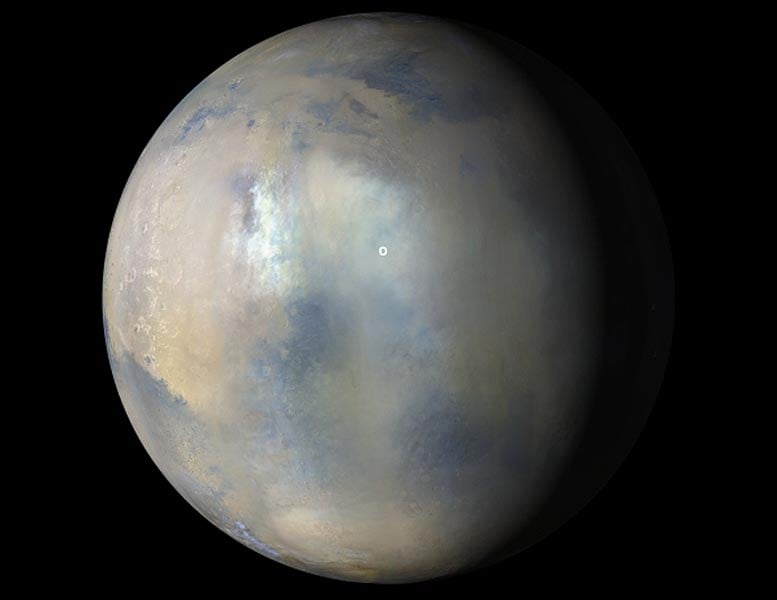
A strong regional dust storm appeared on the first day of the new year, encompassing Jezero crater just as we scheduled Flight 19. The presence of this storm came quite early – even before the dusty season traditionally starts! In fact, we have never seen a storm of this strength so early in the Mars year before. The first signs of the approaching dust storm were spotted by Perseverance, which observed increased dust lifting within Jezero crater. In orbit, MRO captured images of this growing regional dust storm, which showed signs of expansion from the southern hemisphere into the northern hemisphere – potentially towards Jezero crater. Our weather forecast team had to make a decision to go forward with the flight or not. The data we analyze from MEDA and orbital assets can have a lag of a few hours to a few days, and so we had to make a forecast for Flight 19 a few days into the future. It was clear that there was considerable uncertainty on the horizon. The weather team recommended delaying Flight 19, which was ultimately adopted by the Ingenuity team (Flight 19 originally scheduled for January 5, 2022, or Perseverance mission sol 313).
Learning from the Impact of Dust Storms
The grounding of Ingenuity proved to be the right decision. In the days following the flight delay, the dust storm moved over Jezero crater, and we were able to clearly see its effects in both MEDA data and from orbit (Figure 1). Most notable was a sharp drop in air density – about a 7% deviation below what was observed pre-dust storm. This observed decrease would have put density below the lower threshold of safe flight and would have imparted undue risk to the spacecraft. We also observed the effect of dust in the amount of sunlight absorbed by Ingenuity’s solar array, which fell well below normal “clear sky” levels, a drop of about 18%.
The dust storm has dissipated, and right now, it’s looking like we’ll fly Ingenuity no earlier than this Sunday, January 23. The dust storm and its impact on planning is an important learning experience for the entire team. Future events later in the dusty season are expected and have the potential to grow into global-scale storms like those observed most recently in 2018, 2007, and 2001. We will remain diligent in our efforts to safely fly Ingenuity for the foreseeable future.
Written by Jonathan Bapst and Michael Mischna (Ingenuity Weather/Environment Team, NASA-JPL).
Never miss a breakthrough: Join the SciTechDaily newsletter.
Follow us on Google and Google News.
2 Comments
Awesome stuff.
“Most notable was a sharp drop in air density – about a 7% deviation below what was observed pre-dust storm. This observed decrease would have put density below the lower threshold of safe flight”.
That amazing helicopter is truly living at the edge of what is possible.