
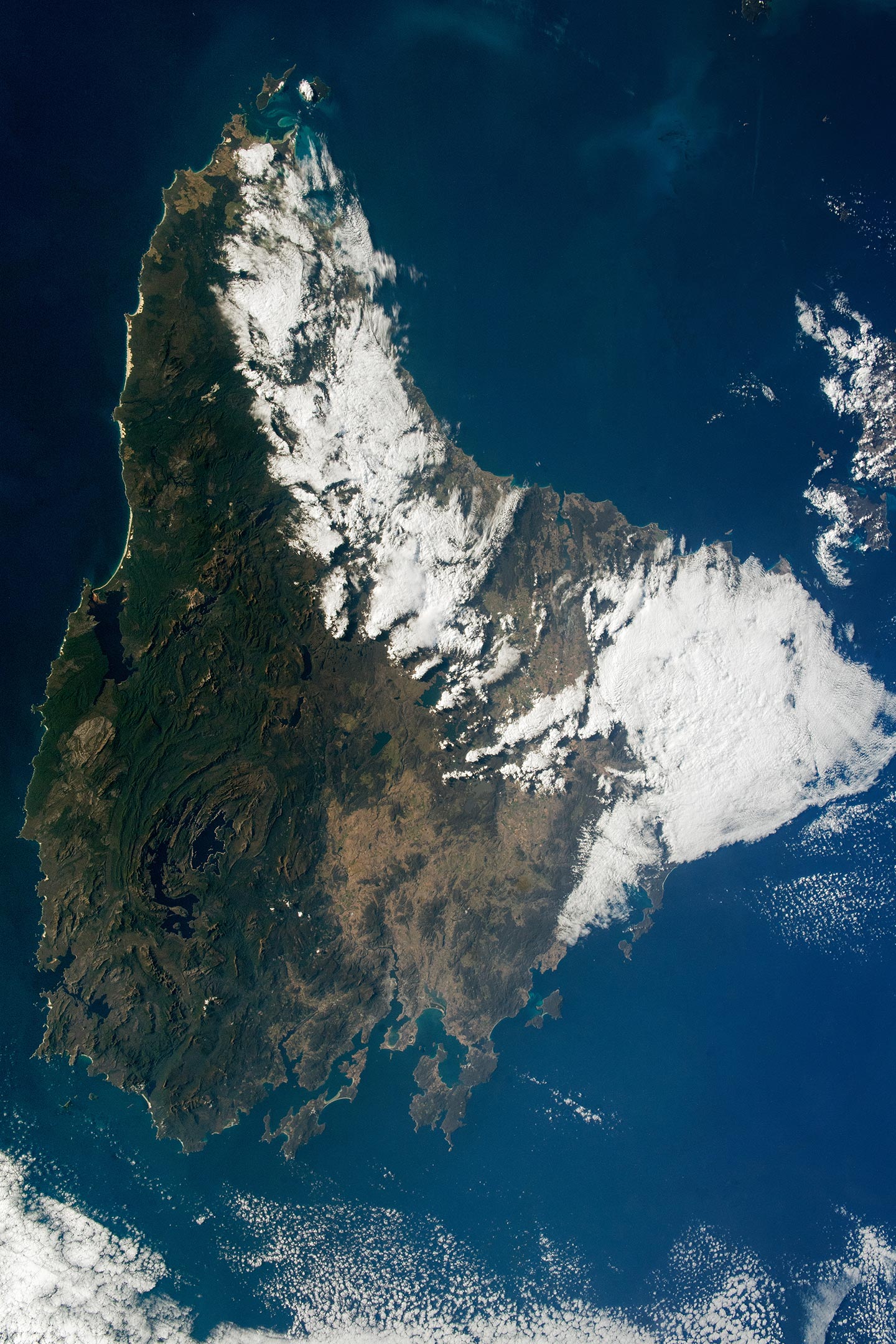
The island is Australia’s smallest state, but its mainland fills the frame of this astronaut photograph.
An astronaut aboard the International Space Station (ISS) took this photo of Australia’s island state of Tasmania while the station orbited almost directly overhead. From this vantage point, the island’s broad geographic features stand out, including its rugged terrain and coasts.
Contrasting Landscapes: Coastlines and Interior
Along the west coast, a line of bright tan beaches contrasts with the darker waters and mountainous interior. Clouds cover much of the northern part of the island. Mainland Tasmania spans about 400 kilometers (250 miles) at its widest, from roughly north to south. Some of the state’s smaller islands lie outside the scope of this scene, including several in the Bass Strait. The strait separates Tasmania from the nearby Australian mainland.
Human Presence: Towns and Roads
The photo’s wide field of view, achieved with a relatively short focal-length lens, makes roads and towns difficult to see, though both are found throughout the island. Approximately half a million people live in Tasmania. The capital city of Hobart lies on the south end of the island, where the River Derwent meets the ocean.
Agriculture in Tasmania: North vs. South
Agricultural land is interspersed across the island’s inland and coastal areas. To the north, agriculture plots dominate the relatively flat land. In contrast, the terrain to the south (north of Hobart) is characterized by agricultural plots selectively etched into the hillsides.
Central Highlands: Conservation and Lakes
Less infrastructure has been developed in the west-central part of the island, where protected land, such as the Central Plateau Conservation Area, makes up much of the Central Highlands region. This region also includes several large lakes, such as Lake Gordon.
Tasmania Overview
Tasmania is an island state of Australia, located about 240 kilometers to the south of the mainland across the Bass Strait. Known for its vast, rugged wilderness areas, much of which is protected within parks and reserves, Tasmania offers a blend of natural beauty and unique wildlife, including the famous Tasmanian devil.
The state’s capital, Hobart, is home to the well-known Museum of Old and New Art (MONA), a vibrant cultural scene, and historic architecture. Tasmania’s economy is primarily driven by tourism, agriculture, and forestry. The island is renowned for its fresh produce and fine wines, with its climate favoring cool-climate viticulture.
With a relatively small population of around 541,000 people, Tasmania promotes a relaxed lifestyle amidst stunning landscapes, from the serene beaches along its coast to the craggy mountain peaks and extensive hiking trails of its interior. The island’s history as a penal colony in the 18th and 19th centuries is also a significant aspect of its heritage, attracting those interested in its rich, albeit tumultuous, past.
Astronaut photograph ISS070-E-53369 was acquired on January 5, 2024, with a Nikon D5 digital camera using a focal length of 32 millimeters. It is provided by the ISS Crew Earth Observations Facility and the Earth Science and Remote Sensing Unit, Johnson Space Center. The image was taken by a member of the Expedition 70 crew. The image has been cropped and enhanced to improve contrast, and lens artifacts have been removed. The International Space Station Program supports the laboratory as part of the ISS National Lab to help astronauts take pictures of Earth that will be of the greatest value to scientists and the public, and to make those images freely available on the Internet.
Never miss a breakthrough: Join the SciTechDaily newsletter.
Follow us on Google and Google News.
1 Comment
Beautiful,my home.