
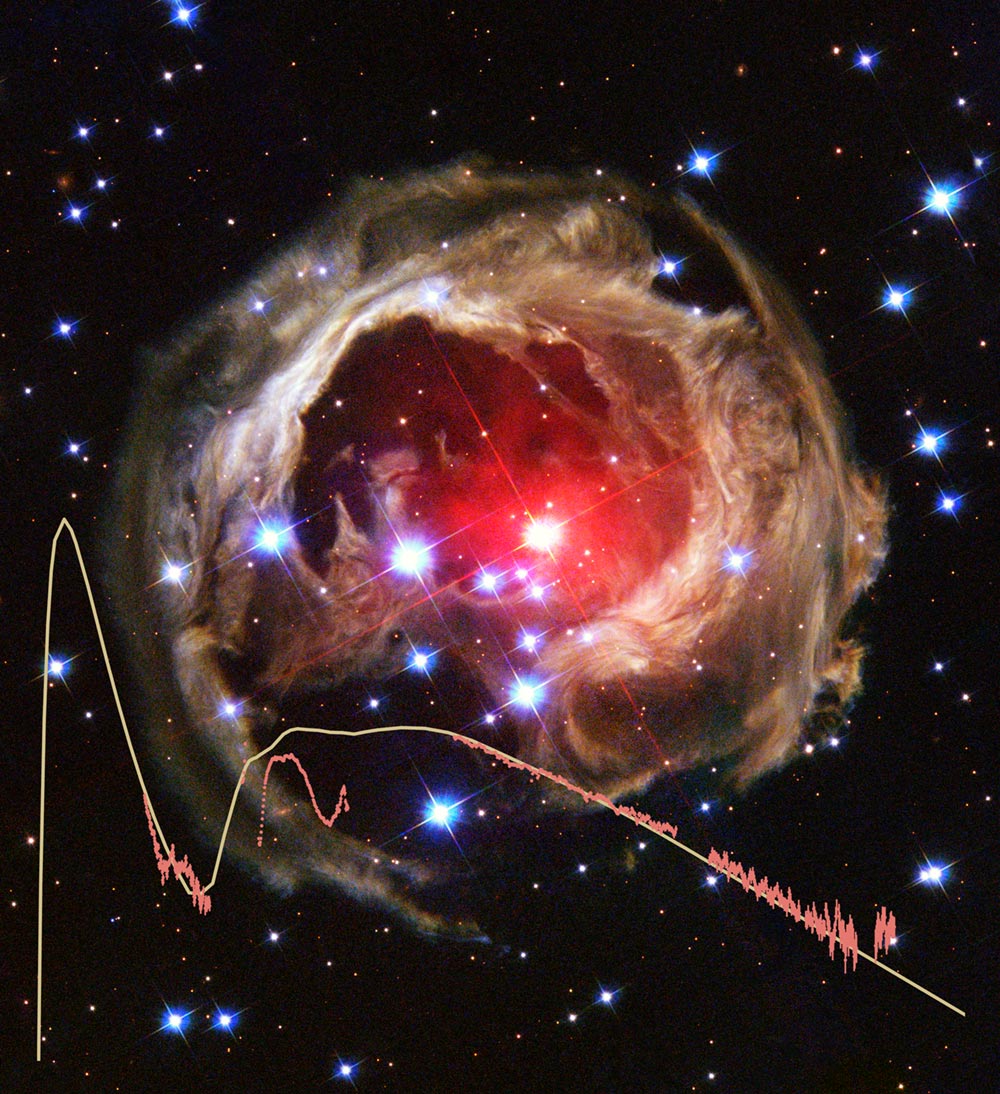
SOFIA’s observations of V838 Monocerotis show significant post-merger changes in dust chemistry, highlighting a rare opportunity to study the evolutionary processes of dust and its role in planet formation.
Everything we see in the universe is a snapshot of the past: As light takes its time to reach our telescopes, the system we’re observing continues to evolve, and what we end up seeing is a moment in its history. By revisiting an object over the course of decades, we can look not only into its past, but can watch its history unfold.
Monitoring Stellar Evolution with SOFIA
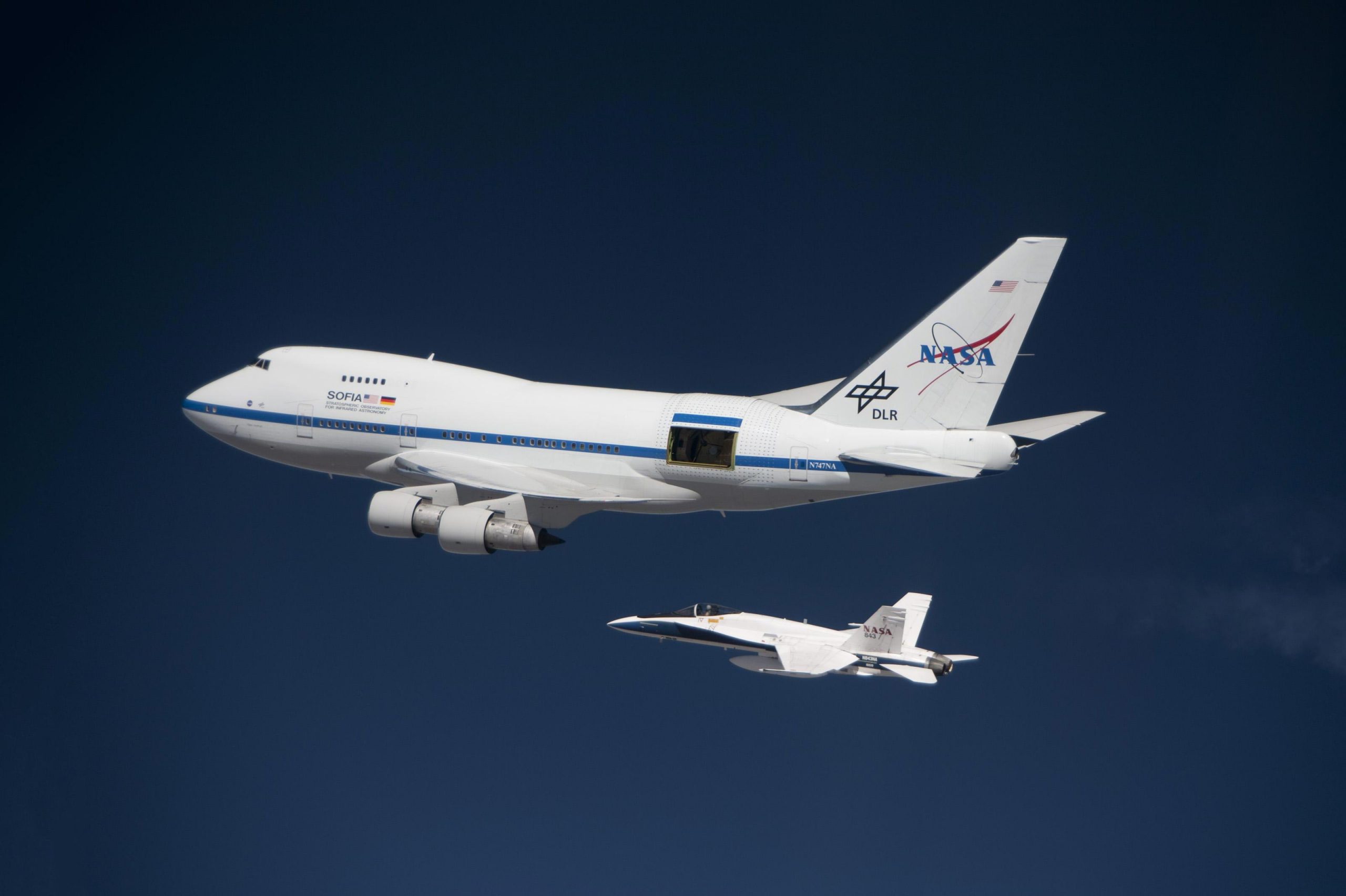
Eleven years after it was last observed and 17 years after a stellar merger occurred, SOFIA looked at V838 Monocerotis, or V838 Mon, a binary star system about 19 thousand light-years away from Earth, capturing a snapshot in time of its makeup. This confirmed that the dust chemistry of the system has changed significantly over the course of nearly two decades following the merger, particularly over the past decade. This provided a history we otherwise cannot look at and offered an archaeological view of its evolution.
Because V838 Mon is quite bright and can saturate other telescopes, SOFIA is the only observatory capable of observing it at infrared wavelengths required to monitor this dust process. The researchers used SOFIA’s FORCAST camera, which allows for low-resolution spectroscopy and deep imaging of bright objects.
Dust Transformation in Astronomical Observations
“It’s very rare to see this progression of dust transformation in objects that is predicted to happen,” said Charles Woodward, astrophysicist at the University of Minnesota and lead author on the paper describing the observation. “To catch one is pretty cool.”
Material expelled as a result of a merger may provide hints about how our own early solar system evolved. Understanding how dust condensation occurs from material originally in a hot gas phase is related to how rocky planets, like Earth, form out of the gas and debris that surround young stars.
“It’s these small, micron-sized pieces of material that eventually build into planets like the one we sit on,” Woodward said.
Geology and Chemistry of Cosmic Dust
In environments like this that are conducive to forming dust, the way that the different materials are incorporated and condense affects the geology of the final product. This is especially true when aluminum – which is very chemically active and can quickly deplete its surrounding oxygen – is involved. In V838 Mon, the chemical composition of the dust has changed from primarily comprising of alumina components in 2008 to being dominated by silicates, as the alumina bond with their oxygen neighbors. Notably, this progression can be seen in real time.
“If we look at theoretical condensation sequences for how this is supposed to work, this is an example of us being able to test those hypotheses,” Woodward said.
While most astronomical events occur on a timescale of millions of years, this is one example of human-timescale astronomy, reminding us that immense changes can occur in a very short period of time.
“Often when people think about astronomy, things are in stasis and they take millions and billions of years to occur. This was in the blink of an eye that the source went through evolution,” Woodward said. “Certain astrophysical phenomena are really dynamic.”
Reference: “The Infrared Evolution of Dust in V838 Monocerotis” by C. E. Woodward, A. Evans, D. P. K. Banerjee, T. Liimets, A. A. Djupvik, S. Starrfield, G. C. Clayton, S. P. S. Eyres, R. D. Gehrz and R. M. Wagner, 7 October 2021, The Astronomical Journal.
DOI: 10.3847/1538-3881/ac1f1e
SOFIA is a joint project of NASA and the German Space Agency at DLR. DLR provides the telescope, scheduled aircraft maintenance, and other support for the mission. NASA’s Ames Research Center in California’s Silicon Valley manages the SOFIA program, science, and mission operations in cooperation with the Universities Space Research Association, headquartered in Columbia, Maryland, and the German SOFIA Institute at the University of Stuttgart. The aircraft is maintained and operated by NASA’s Armstrong Flight Research Center Building 703, in Palmdale, California.
Never miss a breakthrough: Join the SciTechDaily newsletter.
Follow us on Google and Google News.