
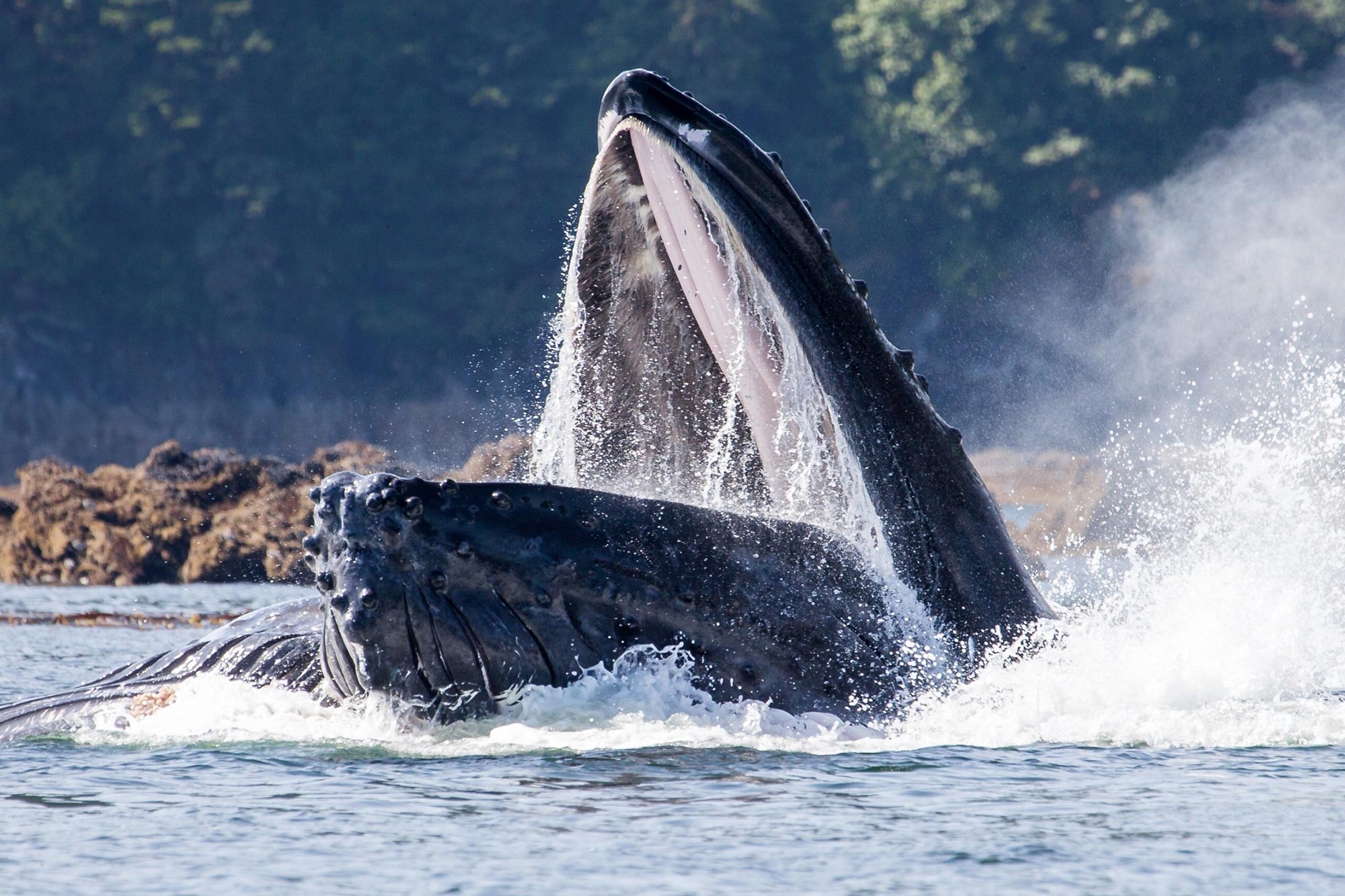
Researchers have discovered that whales use a unique anatomical feature known as an ‘oral plug’ to prevent drowning while feeding. This mechanism, similar to human swallowing reflexes, helps lunge-feeding whales like fin whales consume large amounts of krill without water entering their lungs, supporting their large body sizes and massive energy needs.
Ever wondered whether whales can burp, and why they don’t drown when they gulp down gallons of water and krill? New UBC research may just hold the answer.
Researchers found that lunge-feeding whales have an ‘oral plug’, a fleshy bulb in their mouths that moves backward to seal off the upper airways during feeding, while their larynx closes to block the lower airways.
This plug prevents water from entering their lungs when they feed, according to a paper published on January 20, 2022, in Current Biology. “It’s kind of like when a human’s uvula moves backward to block our nasal passages, and our windpipe closes up while swallowing food,” says lead author Dr. Kelsey Gil, a postdoctoral researcher in the department of zoology.
Lunge-Feeding Mechanism Unveiled
Lunge-feeding whales eat by, you guessed it, lunging at their prey, accelerating at high speed, and opening their mouths to engulf water and krill. Sometimes this amount can be larger than their own bodies, says Dr. Gil, an impressive feat given this group includes the humpback and the blue whale, the largest animal on Earth. Water is then drained via their baleen, leaving the tiny, tasty krill behind to be swallowed.
The researchers investigated fin whales specifically, a type of lunge-feeding whale and found the ‘oral plug’ needed to move in order to allow food to pass to the esophagus. The only way it could was towards the back of the head, and up, blocking off the nasal passages when the whale swallows. Simultaneously, cartilage closes at the entrance to the larynx, and the laryngeal sac moves upwards to block off the lower airways, says Dr. Gil. “We haven’t seen this protective mechanism in any other animals, or in the literature. A lot of our knowledge about whales and dolphins comes from toothed whales, which have completely separated respiratory tracts, so similar assumptions have been made about lunge-feeding whales.”
Comparing Whale and Human Swallowing Mechanisms
It turns out humans have a similar system to swallow food without getting anything in their lungs: we have the epiglottis and soft palate, a ‘lid’ of cartilage and a flap of muscle in our throat and mouth, respectively. Humans could probably eat underwater as well, says Dr. Gil, but it would be rather like swimming at high speed towards a hamburger and opening your mouth wide as you approached – difficult not to flood your lungs.
The whales’ oral plug and closing larynx are central to how lunge-feeding evolved, a key component in the enormous size of these creatures, the researchers say. “Bulk filter-feeding on krill swarms is highly efficient and the only way to provide the massive amount of energy needed to support such large body size. This would not be possible without the special anatomical features we have described,” says senior author Dr. Robert Shadwick, a professor in the UBC department of zoology.
Challenges and Future Research in Whale Anatomy
Investigating whale anatomy often involves trying to dissect whales that have died from stranding which comes with such challenges as trying to complete work before the tide rises. However, for this research, Dr. Gil and her colleagues dissected whales in Iceland in 2018, recovering tissue that wasn’t being used for food from a commercial whaling station. Working with whales in real-time would be wonderful, she says, but might require some advancements in technology. “It would be interesting to throw a tiny camera down a whale’s mouth while it was feeding to see what’s happening, but we’d need to make sure it was safe to eat and biodegradable.”
The team will continue to explore the mechanisms related to the pharynx, and of the small esophagus that is responsible for rapidly transporting hundreds of kilograms of krill to the stomach in less than a minute. With the many human impacts that disrupt food chains, and knowing how whales feed and how much they eat, it’s good to know as much as possible about these animals in order to protect them and their ecosystems, says Dr. Gil.
And there’s plenty more to find out, including whether whales cough, hiccup, and yes, burp. “Humpback whales blow bubbles out of their mouth, but we aren’t exactly sure where the air is from – it might make more sense, and be safer, for whales to burp out of their blowholes.”
Reference: “Anatomical mechanism for protecting the airway in the largest animals on earth” by Kelsey N. Gil, A. Wayne Vogl and Robert E. Shadwick, 20 January 2022, Current Biology.
DOI: 10.1016/j.cub.2021.12.040
Never miss a breakthrough: Join the SciTechDaily newsletter.
Follow us on Google and Google News.
2 Comments
Pathetic that anyone would consider this money well spent. It’s time for academics to stand down and do things useful to humans and not just some professors wallet. If all these liberal arts f*@ks got together they could build lots of houses in africa or nepal….quit f*@king off and do something useful.
Three weeks from now you will wish you had started today. Simply give it a shot on the accompanying site.
GOOD LUCK… WorkJoin1.com