
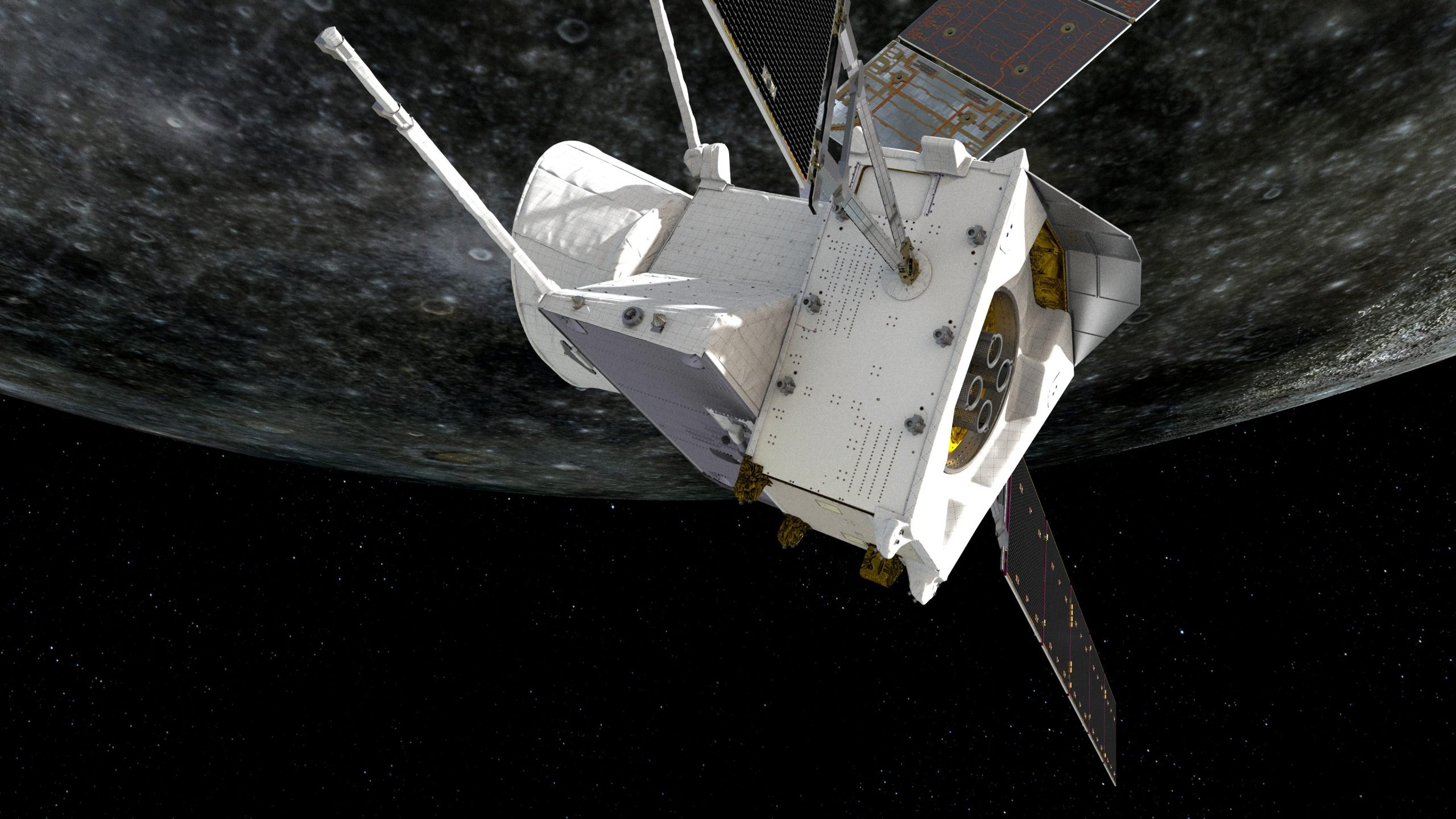
BepiColombo Begins First Mercury Flyby
The ESA/JAXA BepiColombo mission to Mercury will make the first of six flybys of its destination planet on October 1, 2021, before entering orbit in 2025.
Hot on the heels of its last Venus flyby in August, the spacecraft’s next exciting encounter is with Mercury at 23:34 UTC on October 1 (01:34 CEST October 2). It will swoop by the planet at an altitude of about 200 km, capturing imagery and science data that will give scientists a tantalizing first taste of what’s to come in the main mission.
The mission comprises two science orbiters which will be delivered into complementary orbits around the planet by the Mercury Transfer Module in 2025. The ESA-led Mercury Planetary Orbiter and the JAXA-led Mercury Magnetospheric Orbiter, Mio, will study all aspects of this mysterious inner planet from its core to surface processes, magnetic field and exosphere, to better understand the origin and evolution of a planet close to its parent star.
BepiColombo will make use of nine planetary flybys in total: one at Earth, two at Venus, and six at Mercury, together with the spacecraft’s solar electric propulsion system, to help steer into Mercury orbit.
On Track for Mercury Slingshot
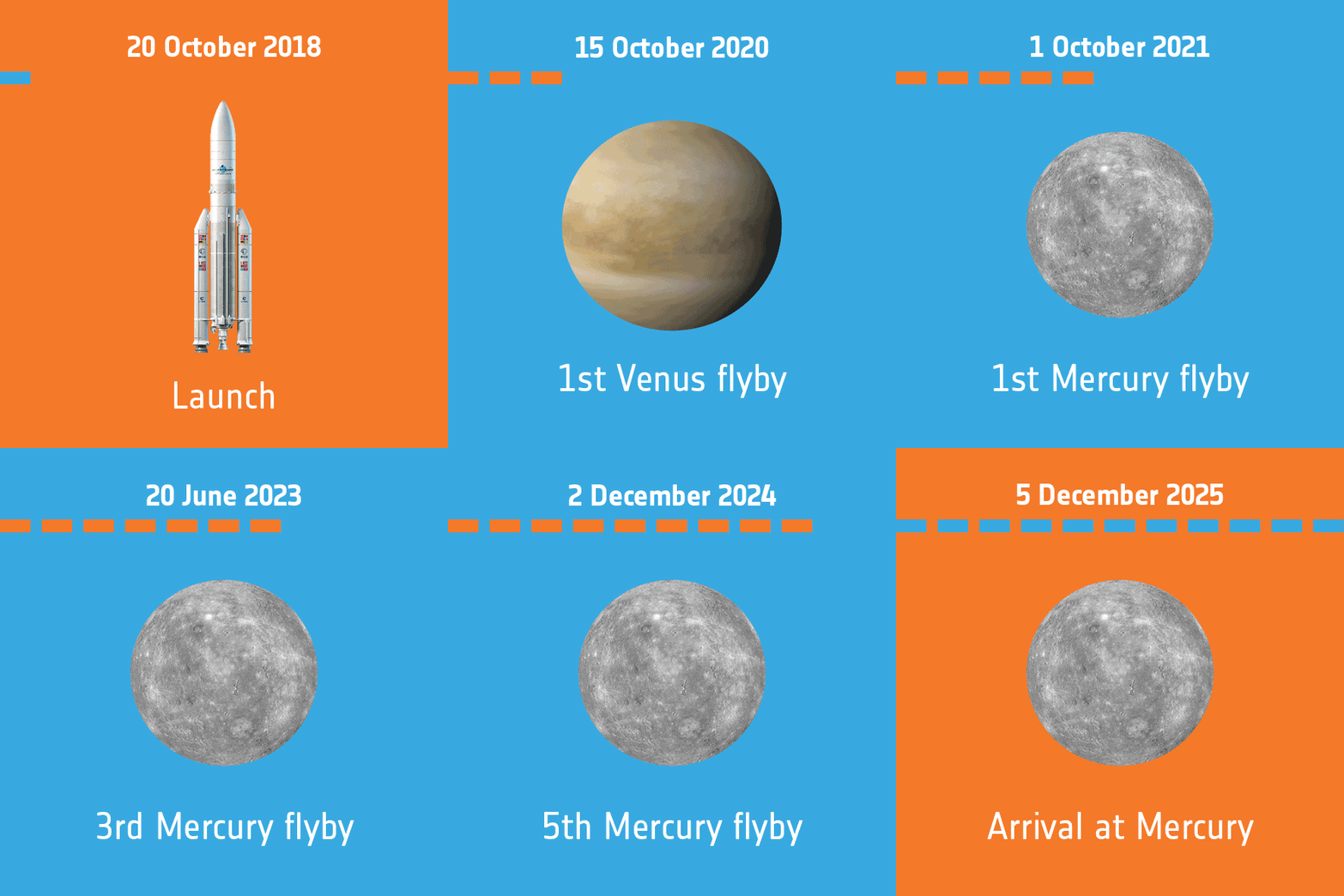
Gravitational flybys require extremely precise deep-space navigation work, ensuring that the spacecraft is on the correct approach trajectory.
One week after BepiColombo’s last flyby on August 10, a correction maneuver was performed to nudge the craft a little for this first flyby of Mercury, targeting an altitude of 200 km (124 mi). At present, the craft is predicted to pass the innermost planet at 198 km, and small adjustments can easily be made with solar electric propulsion maneuvers after the swing-by. As BepiColombo is more than 100 million km (62 million mi) away from Earth, with light taking 350 seconds (about six minutes) to reach it, being on target to within just two kilometers is no easy feat.
“It is because of our remarkable ground stations that we know where our spacecraft is with such precision. With this information, the Flight Dynamics team at ESOC knows just how much we need to maneuver, to be in the right place for Mercury’s gravitational assist,” explains Elsa Montagnon, Spacecraft Operations Manager for the mission.
“As is often the case, our mission’s path has been planned so meticulously that no further correction maneuvers are expected for this upcoming flyby. BepiColombo is on track.”
First Glimpse of Mercury
During the flybys it is not possible to take high-resolution imagery with the main science camera because it is shielded by the transfer module while the spacecraft is in cruise configuration. However, two of BepiColombo’s three monitoring cameras (MCAMs) will be taking photos from about five minutes after the time of close approach and up to four hours later. Because BepiColombo is arriving on the planet’s nightside, conditions are not ideal to take images directly at the closest approach, thus the closest image will be captured from a distance of about 1000 km.
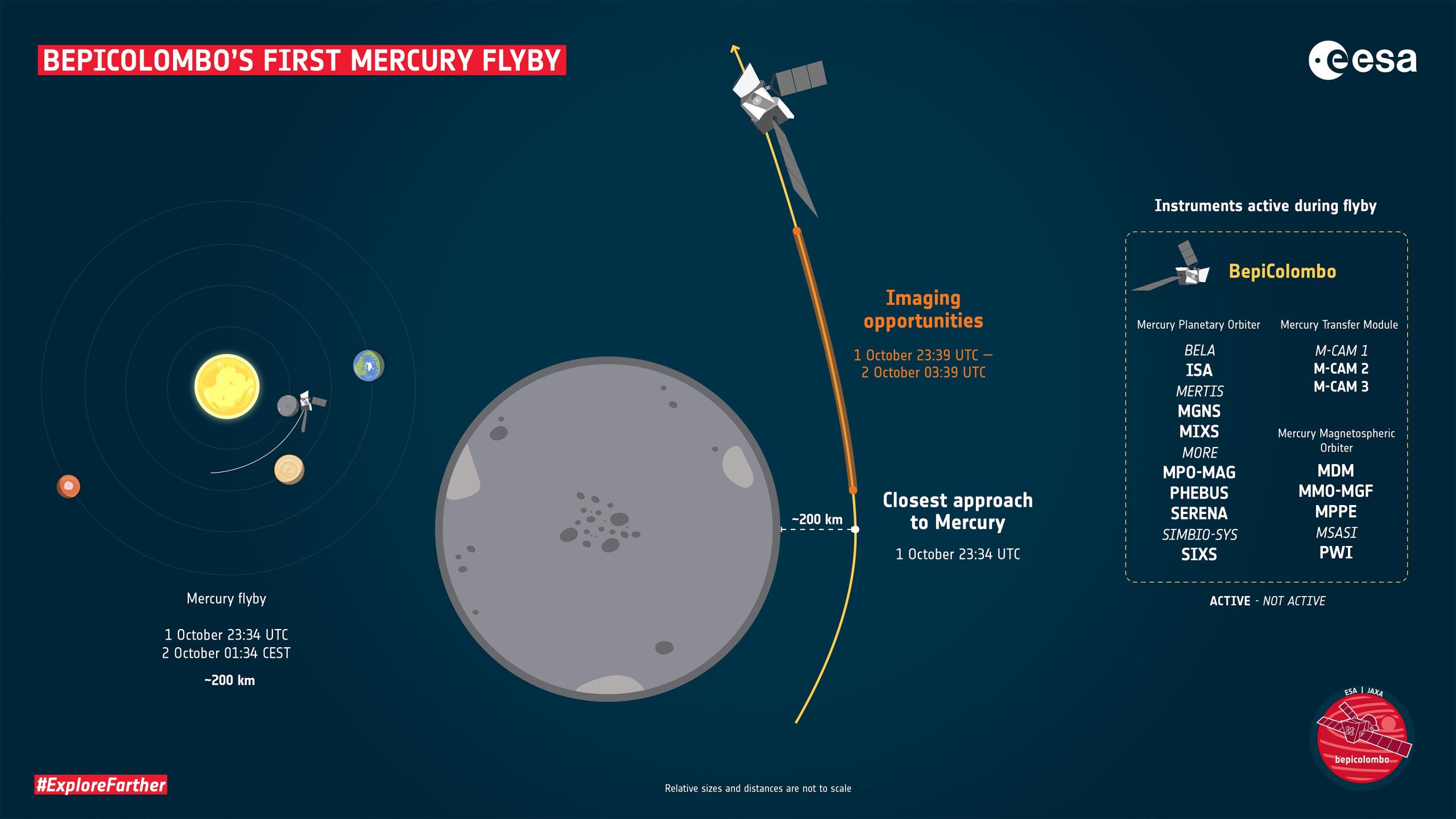
The first image to be downlinked will be from about 30 minutes after closest approach, and is expected to be available for public release at around 08:00 CEST on Saturday morning. The close approach and subsequent images will be downlinked one by one during Saturday morning.
The cameras provide black-and-white snapshots in 1024 x 1024 pixel resolution, and are positioned on the Mercury Transfer Module such that they also capture the spacecraft’s solar arrays and antennas. As the spacecraft changes its orientation during the flyby, Mercury will be seen passing behind the spacecraft’s structural elements.
In general, MCAM-2 will point towards the northern hemisphere of Mercury, while MCAM-3 will point towards the southern hemisphere. During the half hour following the close approach, imaging will alternate between the two cameras. Later imaging will be performed by MCAM-3.
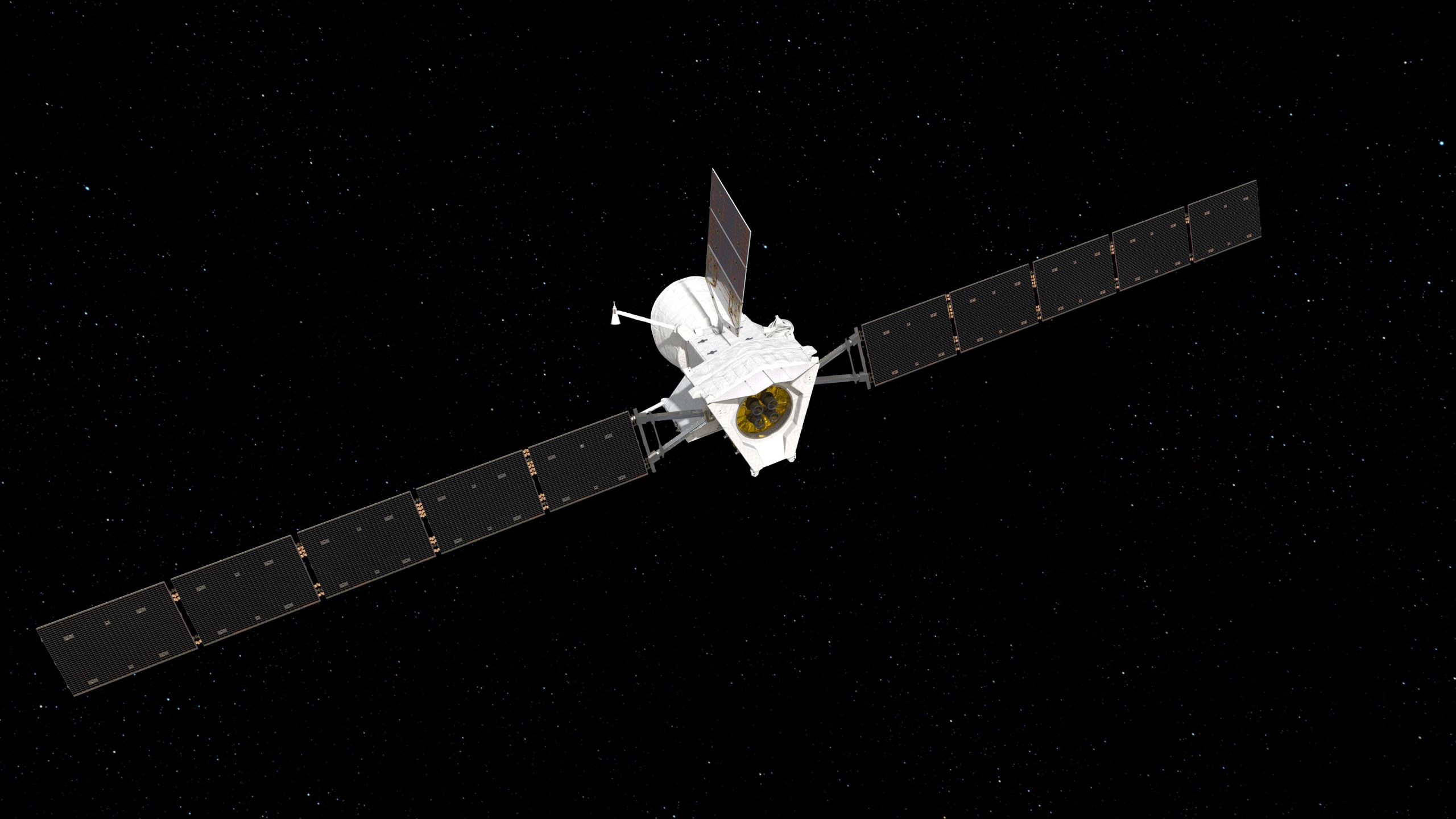
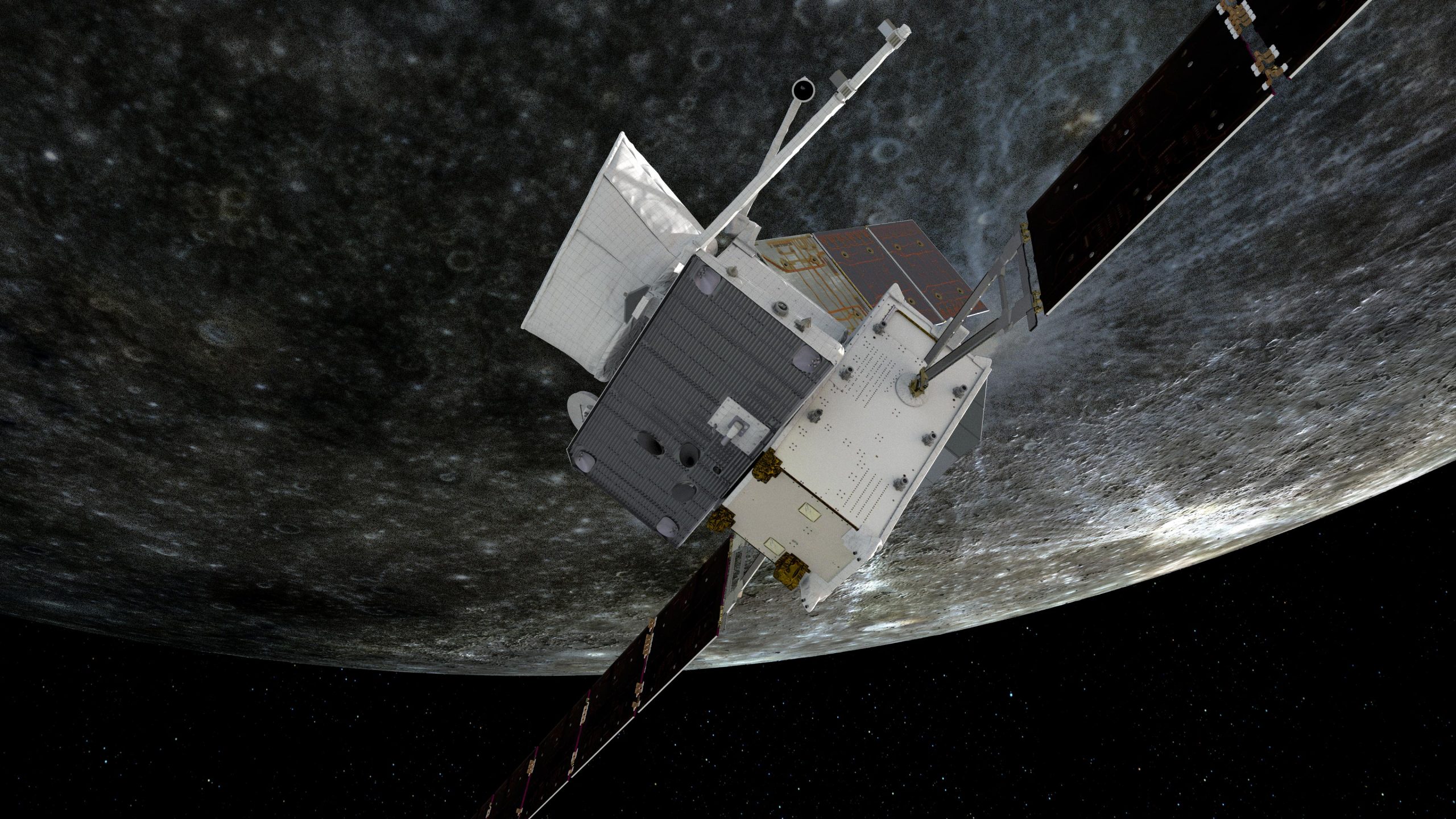
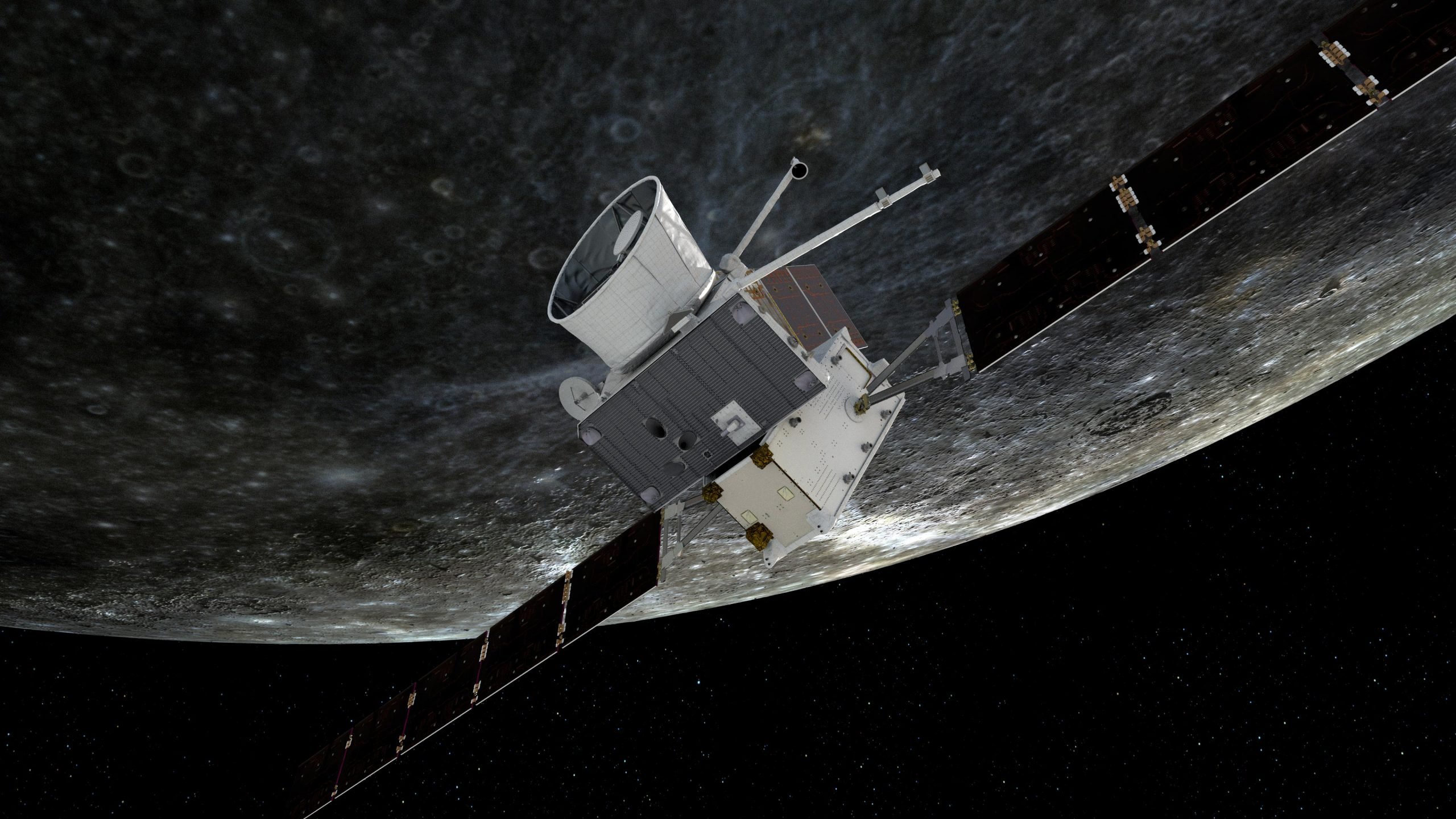
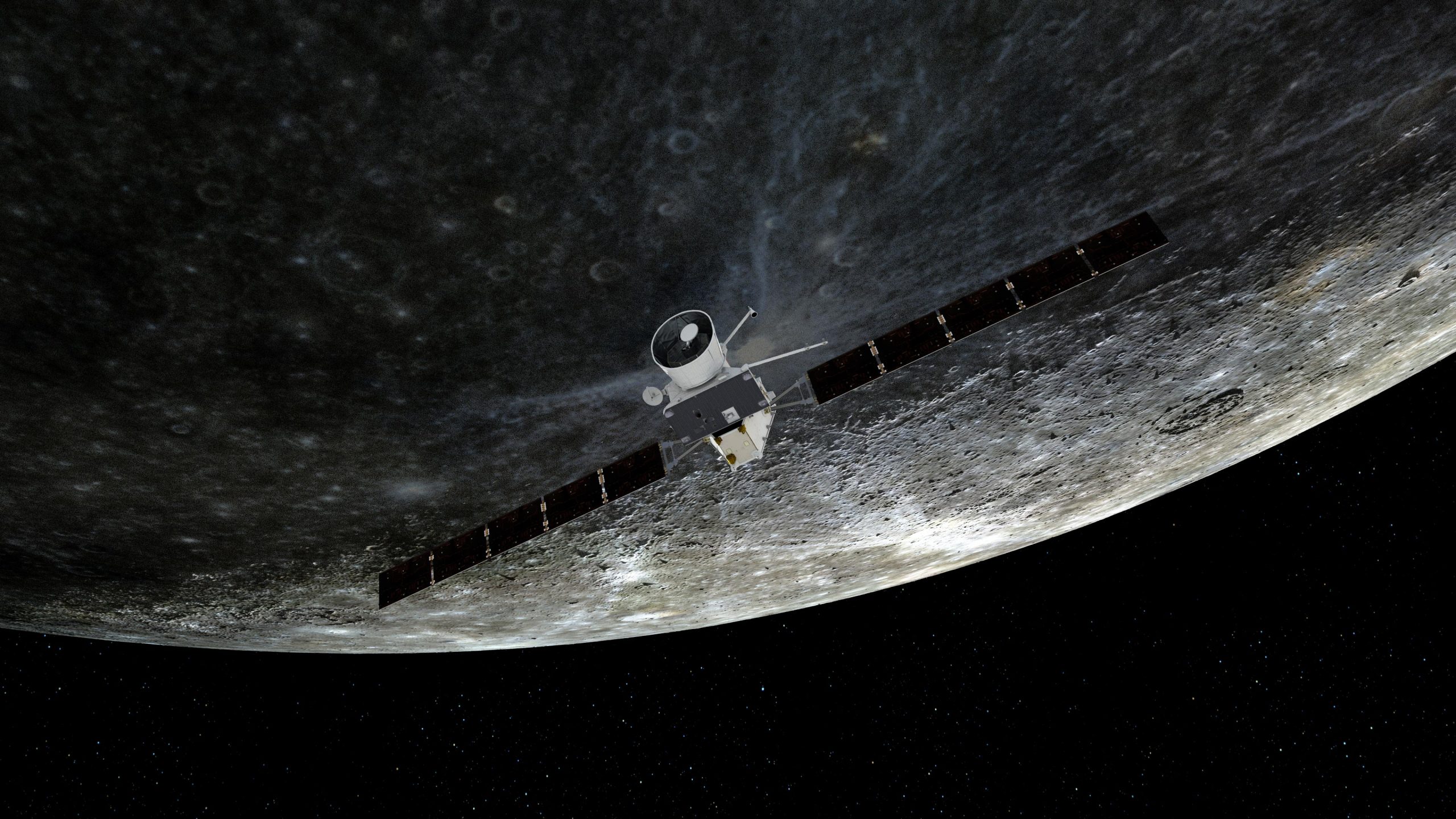
For the closest images it should be possible to identify large impact craters on the planet’s surface. Mercury has a heavily cratered surface much like the appearance of Earth’s Moon, plotting its 4.6 billion-year history. Mapping the surface of Mercury and analyzing its composition will help scientists understand more about its formation and evolution.
Even though BepiColombo is in ‘stacked’ cruise configuration for the flybys, it will be possible to operate some of the science instruments on both planetary orbiters, allowing a first taste of the planet’s magnetic, plasma, and particle environment.
“We’re really looking forward to seeing the first results from measurements taken so close to Mercury’s surface,” says Johannes Benkhoff, ESA’s BepiColombo project scientist. “When I started working as project scientist on BepiColombo in January 2008, NASA’s Messenger mission had its first flyby at Mercury. Now it’s our turn. It’s a fantastic feeling!”
Celebrating BepiColombo’s Namesake
The upcoming first Mercury flyby falls on the 101st anniversary of the birth of Giuseppe ‘Bepi’ Colombo (October 2, 1920–February 20, 1984), an Italian scientist and engineer for whom the BepiColombo mission is named. Colombo is known for explaining Mercury’s peculiar characteristic of rotating about its own axis three times in every two orbits of the Sun. He also realized that by careful choice of a spacecraft’s flyby point as it passed a planet, the planet’s gravity could help the spacecraft make further flybys. His interplanetary calculations enabled NASA’s Mariner 10 spacecraft to achieve three flybys of Mercury instead of one by using a flyby of Venus to change the spacecraft’s flight path – the first of many spacecraft to use such a gravity assist maneuver.
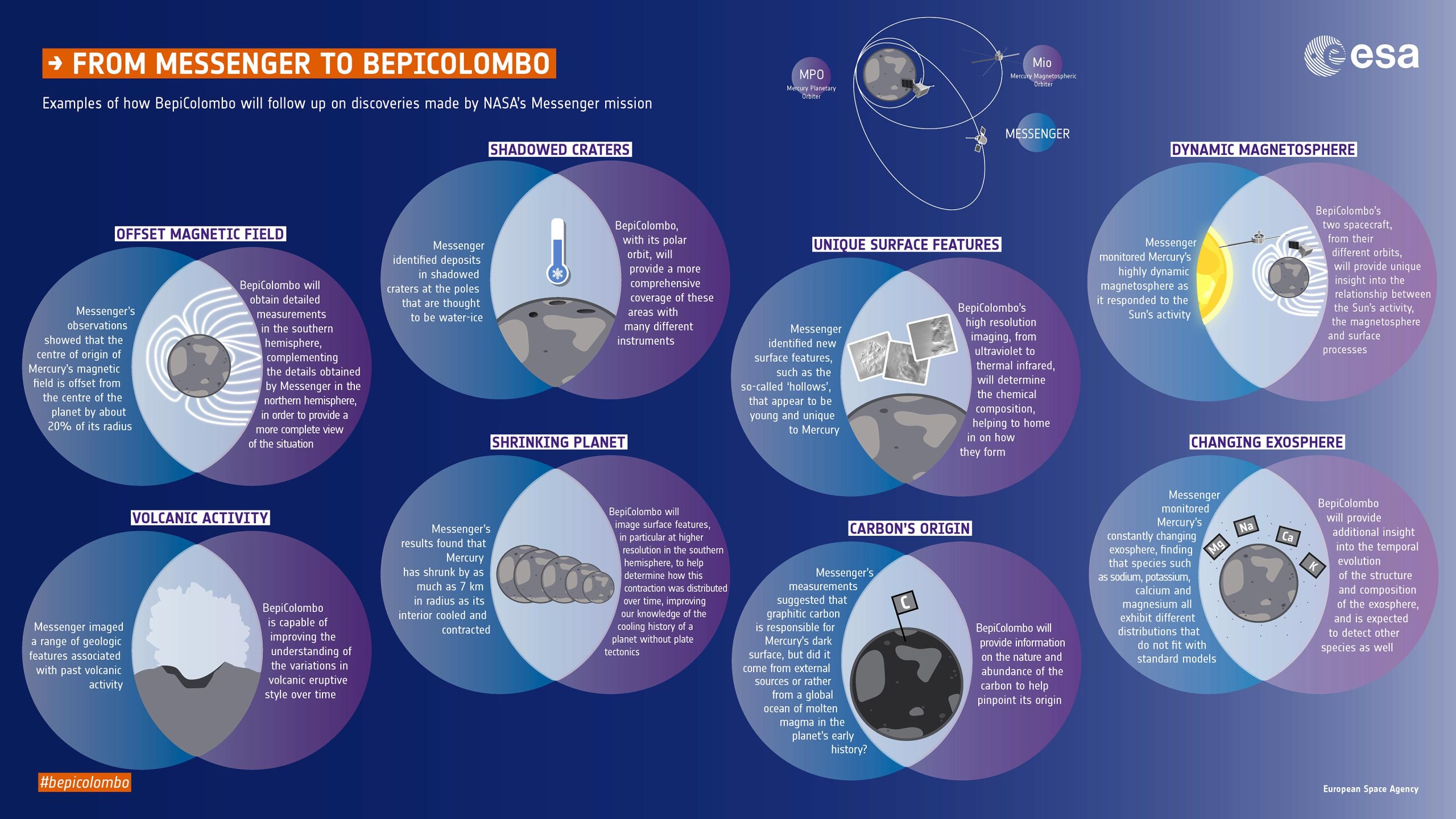
Following Mariner 10’s mission in 1974-75, NASA’s Messenger spacecraft flew by Mercury three times in 2008-09 and orbited the planet for four years (2011-2015). The BepiColombo mission will build on the successes of its predecessors to provide the best understanding of the Solar System’s innermost planet to date.
The first image is expected to be released early in the morning of Saturday, October 2 (provisionally 08:00 CEST); subsequent images may be released later in the day on Saturday and/or Monday, October 4. Additional science commentary may also be available in the week following the flyby. Timings are subject to change depending on actual spacecraft events and image availability.
Never miss a breakthrough: Join the SciTechDaily newsletter.
Follow us on Google and Google News.
1 Comment
Bonjour…..merci….