
Close Menu
    Facebook X (Twitter) Instagram
    SciTechDaily
    • Biology
    • Chemistry
    • Earth
    • Health
    • Physics
    • Science
    • Space
    • Technology
    Facebook X (Twitter) Pinterest YouTube RSS
    SciTechDaily
    Home»Biology»As Oceans Warm, Large Fish Struggle to Extract the Oxygen They Need From Their Environment
    Biology

    As Oceans Warm, Large Fish Struggle to Extract the Oxygen They Need From Their Environment

    By McGill UniversityFebruary 4, 2021No Comments3 Mins Read
    Facebook Twitter Pinterest Telegram LinkedIn WhatsApp Email Reddit
    Share
    Facebook Twitter LinkedIn Pinterest Telegram Email Reddit
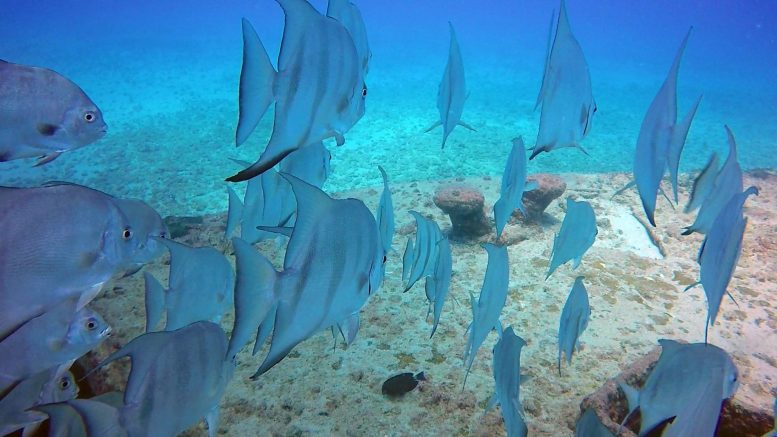
    Fish Shoal
    In warming waters, the demand for oxygen of many fish species will increase, progressively approaching the maximum oxygen supply capacity of their respiratory organs.

    New Tool Gauges Impacts of Warming Waters on Over 200 Fish Species

    Warming ocean waters could reduce the ability of fish, especially large ones, to extract the oxygen they need from their environment. Animals require oxygen to generate energy for movement, growth, and reproduction. In a recent paper in the Proceedings of the National Academy of Science, an international team of researchers from McGill, Montana and Radboud universities describe their newly developed model to determine how water temperature, oxygen availability, body size, and activity affect metabolic demand for oxygen in fish.

    The model is based on physicochemical principles that look at oxygen consumption and diffusion at the gill surface in relation to water temperature and body size. Predictions were compared against actual measurements from over 200 fish species where oxygen consumption rates were measured at different water temperatures and across individuals of different body sizes.

    Fish Will Need More Oxygen Than Their Gills Can Extract From Warming Water

    “Our data suggest that, as temperature increases, the demand for oxygen of many fish species will exceed their capacity to extract oxygen from the environment through their gills,” explains Juan Rubalcaba, a Marie Skłodowska-Curie Postdoctoral Fellow at McGill, and lead author on the paper. “As a result, the aerobic capacity of fish decreases in warming waters, and this reduction may be more important in larger fishes. This tells us that global warming could limit the aerobic capacity of fish, impairing their physiological performance in the future.”

    “Water temperature is already rising worldwide as a consequence of climate change and many fish species need to cope with this rapid temperature change, either by migrating toward colder regions or by adopting different life strategies such as shrinking in size over generations in order to avoid respiratory constraints,” said Art Woods, a professor of biological sciences at the University of Montana, and the senior author on the paper. “By including oxygen, this model stands apart by predicting observed patterns of variation in metabolic rate among fishes worldwide than current theories, which focus primarily on body size and temperature.”

    Reference: “Oxygen limitation may affect the temperature and size dependence of metabolism in aquatic ectotherms” by Juan G. Rubalcaba, Wilco C. E. P. Verberk, A. Jan Hendriks, Bart Saris and H. Arthur Woods, 30 November 2020, Proceedings of the National Academy of Science.
    DOI: 10.1073/pnas.2003292117

    The research was funded by the European Commission’s Marie Skłodowska-Curie Individual Fellowship

    Never miss a breakthrough: Join the SciTechDaily newsletter.
    Follow us on Google and Google News.

    Climate Change Fish Marine Biology McGill University Oceanography
    Share. Facebook Twitter Pinterest LinkedIn Email Reddit

    Related Articles

    Climate Change Will Reshuffle Marine Ecosystems in Unexpected Ways – “Like Putting Marine Biodiversity in a Blender”

    Tropical Fish Shoals Disrupted by Ocean Acidification and Warming

    Complexity Yields Simplicity: The Shifting Dynamics and Loss of Biodiversity in Temperate Marine Ecosystems

    Which Animals Will Survive Climate Change? Genetic Changes Help Scientists Predict

    Overfishing of Atlantic Cod Likely Did Not Cause Genetic Changes – Hope for Recovery

    Abundance of Life on Coral Reefs Has Been Puzzling Since Charles Darwin’s Day – New Research Provides Answers

    Ocean Acidification From Climate Change Is Damaging Shark Scales

    Scientists Were Wrong – Coral Reef Fish Not Affected by Ocean Acidification From Climate Change

    Bad News for Nemo: Species Can’t Adapt to Rapid Environmental Changes

    Leave A Reply Cancel Reply

    • Facebook
    • Twitter
    • Pinterest
    • YouTube

    Don't Miss a Discovery

    Subscribe for the Latest in Science & Tech!

    Trending News

    A Star Near the Milky Way’s Black Hole Is Losing Mass at an Astonishing Rate

    Scientists Solve a Vitamin B12 Mystery With an Unexpected Culprit

    Has the Autism Spectrum Become Too Broad? Leading Scientist Warns of Hidden Consequences

    Rewriting History: Researchers Uncover a Forgotten Amazon Civilization That May Have Housed 3 Million People

    New Research May Change How We Think About Weight Loss Drugs Like Ozempic

    Coffee Drinkers Show Surprising Differences in Fat, Muscle, and Hormones

    New Treatment Targets Gum Disease Without Killing Good Bacteria

    Scientists Discover a 245-Million-Year-Old Reptile With Its Organs Still Preserved

    Follow SciTechDaily
    • Facebook
    • Twitter
    • YouTube
    • Pinterest
    • Newsletter
    • RSS
    SciTech News
    • Biology News
    • Chemistry News
    • Earth News
    • Health News
    • Physics News
    • Science News
    • Space News
    • Technology News
    Recent Posts
    • Neuroscientist Challenges the Idea That Your Brain “Makes” Decisions
    • Mysterious “Golden Tree” Coral Discovered in Costa Rica’s Deep Pacific
    • Scientists Film Dolphins Using Seashells As Hunting Tools
    • Scientists Discover a Hidden Hormone Pathway That Protects the Liver From Damage
    • Quitting Alcohol Can Change the Brain in Surprising Ways, Mouse Study Finds
    Copyright © 1998 - 2026 SciTechDaily. All Rights Reserved.
    • Science News
    • About
    • Contact
    • Editorial Board
    • Privacy Policy
    • Terms of Use

    Type above and press Enter to search. Press Esc to cancel.