
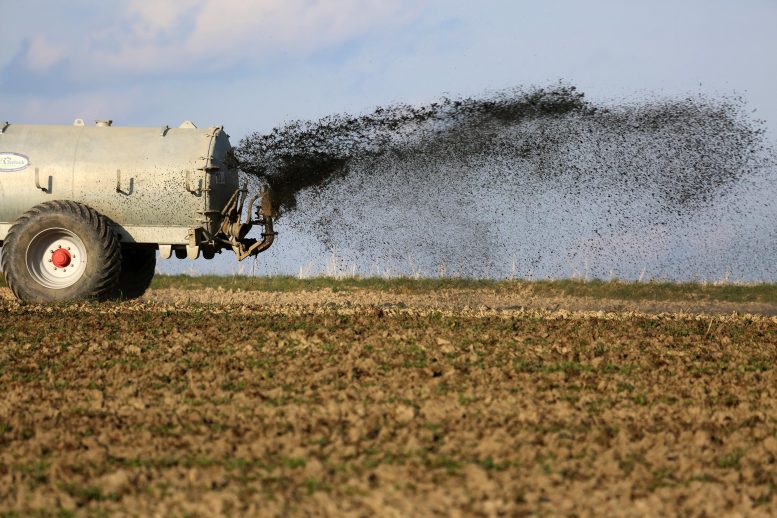
It may well be possible to remove nitrate from polluted groundwater and at the same time produce ammonia in a sustainable way, according to PhD candidate Phebe van Langevelde and Professor Marc Koper of the Leiden Institute of Chemistry in Joule on January 26, 2021. Together with a German colleague, they conducted a literature study into the possibilities.
Two Birds, One Stone
Nitrate is a pollutant that originates from traffic, industry, and agriculture. It is a nitrogen compound: NO3-. Environmental technologists are looking for a method to convert this into nitrogen gas, N2, but that turns out to be difficult. Ammonia, the nitrogen compound NH3, is an important raw material in chemistry, for instance, to produce fertilizer. It is made from nitrogen gas, but that process takes place at high pressure and temperature and therefore requires the use of fossil fuels.
A solution for both problems would be to combine these processes and convert nitrate directly into ammonia, according to Phebe van Langevelde. With her colleagues, she evaluated the options. “That total picture is new,” she says.
Bacteria Versus Elektrochemistry
The current method to convert nitrate to nitrogen gas uses bacteria. Electrochemistry could be a cheaper and more robust alternative. The starting material is dissolved in a liquid in which two electrodes are placed, coated with a catalyst. When voltage is applied to the electrodes, chemical reactions take place at their surface, depending on the catalyst applied. “So far, it has not been possible to convert nitrate into pure nitrogen gas in this way. Too many other products are formed,” Van Langevelde says. “It turns out to be much easier to convert nitrate into ammonia, for which suitable catalysts have been designed in the last few years, based on new materials.”
Sustainable and Safe
This may be not only a better way to remove nitrate from contaminated water, but also an environmentally friendly alternative to produce ammonia. The current, energy-consuming process based on nitrogen gas is the Haber-Bosch process, a mature technology that has been applied for over a century now. It will be difficult to replace. But the electrochemical approach from nitrate could be cheaper than the Haber-Bosch method. The process takes place at room temperature and is powered by electricity, which can be generated sustainably. It is also small-scale and could be applied locally. “So, you do not have to store large quantities of products, with associated safety risks,” Van Langevelde says. “The explosion in Beirut, for example, involved bulk storage of fertilizer.”
Additional Research
Before the electrochemical conversion of nitrate into ammonia can be applied in practice, additional fundamental research is still required, she notes, for example, research on suitable catalysts and formation of by-products. And the question remains: which wastewater streams are suitable? Waste streams from nuclear power plants and industry are possibilities, but they contain other substances that may disrupt the process. “And the amount of nitrate in contaminated groundwater is too small for this application. An extra step to concentrate the nitrate would therefore be needed. So, there are still some barriers to overcome, but the approach looks promising. It may contribute to the restoration of the global nitrogen cycle.”
Reference: “Electrocatalytic Nitrate Reduction for Sustainable Ammonia Production” by Phebe H. van Langevelde, Ioannis Katsounaros, Marc T. M. Koper, 26 January 2021, Joule.
DOI: 10.1016/j.joule.2020.12.025
Never miss a breakthrough: Join the SciTechDaily newsletter.
Follow us on Google and Google News.
2 Comments
It seems to me we are heading for a system of industrial grow farms, giant computer controlled hydroponic gardens. Recycing the polluted water is a high becoming high tech requirement to conserve water.
this subject has been already done in field level over large areas to ge residue free food. It is almost 25 years old. in the article the practical aspects are not given.