
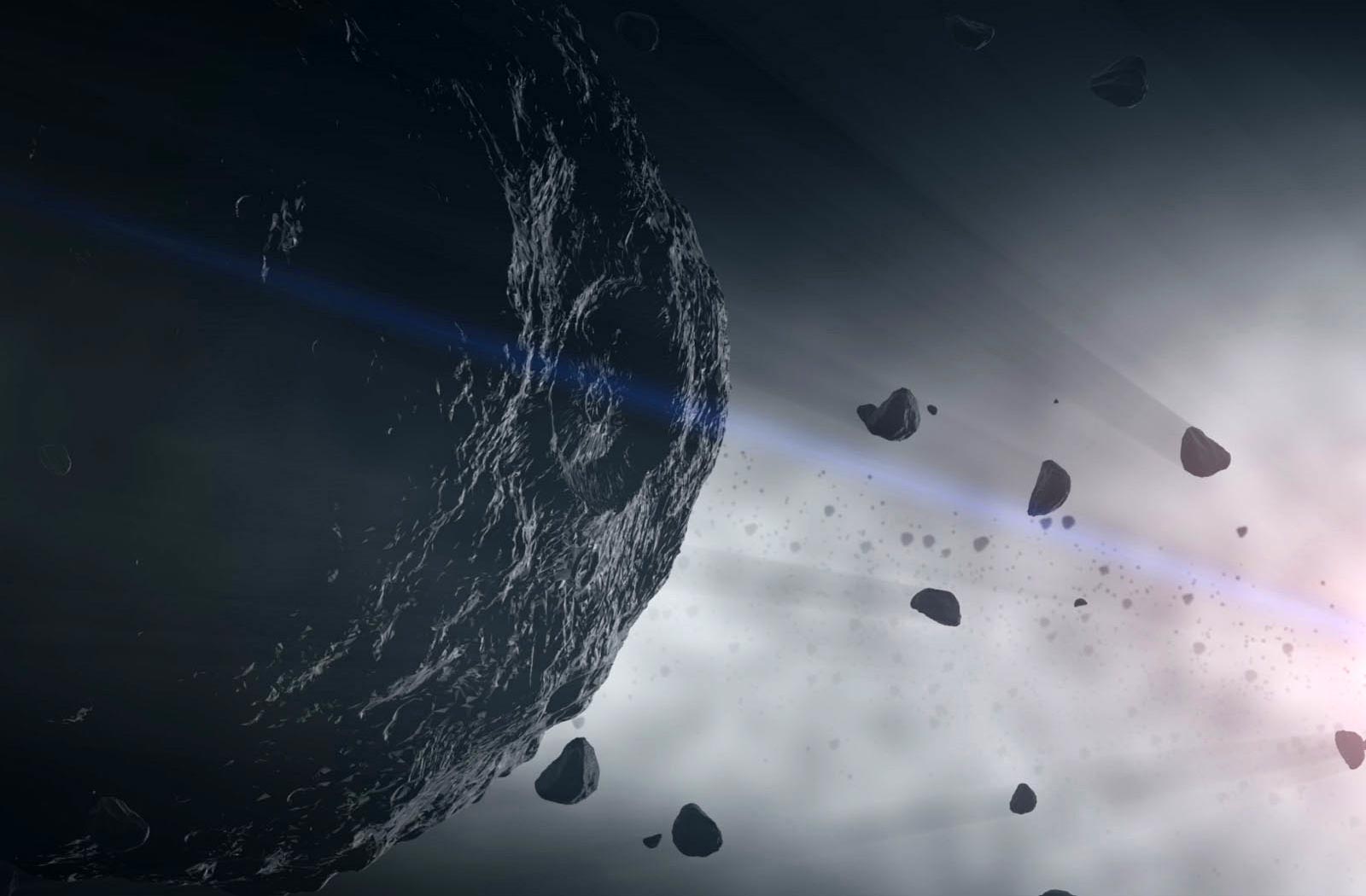
Asteroids have been orbiting the sun for thousands of millennia in deep space, standing as ancient storytellers, holding clues about the formation of the solar system. NASA’s first mission to collect a sample from an asteroid, the Origins, Spectral Interpretation, Resource Identification, Security-Regolith Explorer (OSIRIS-REx), has just made its first collection attempt of the potentially dangerous asteroid Bennu and bring its secrets home to Earth. But NASA also has several other asteroid missions coming up with varying purposes, as well as a dynamic program to help us identify and learn more about potentially dangerous objects to defend our planet.
Not all asteroids are the same. But scientists believe that asteroids similar to Bennu could have seeded Earth with water and organic compounds, and may be potentially rich in those resources and precious metals that could be valuable to humanity in the future to help power exploration of the solar system by robots and humans. Scientists are also eager to find more potentially hazardous asteroids, to learn more about their orbits and physical characteristics, and to develop potential protective measures to mitigate dangers posed to Earth.
In the next few years NASA will be launching several ambitious missions to study unique asteroids to fill in more pieces of the cosmic puzzle. The Double Asteroid Redirection Test (DART) and Lucy missions will launch in July and October 2021, respectively. The Psyche mission follows closely with a 2022 launch date. And while New Horizons continues to investigate the Kuiper Belt following its rewarding flybys of Pluto and Arrokoth, the latest asteroid-bound mission, Janus, is in development. OSIRIS-REx is scheduled to begin its journey back to Earth in 2021 with return in 2023.
NASA’s Planetary Defense Coordination Office (PDCO) tracks and characterizes potentially hazardous objects and studies strategies for mitigating their danger. The PDCO sponsors projects through its Near-Earth Object (NEO) Observations Program that employ a variety of ground and space based telescopes to search for NEOs, determine their orbits, and measure their physical characteristics.
“Asteroids and small bodies are important keys to understanding the history of the solar system,” said Lori Glaze, director of NASA’s Planetary Science Division. “The technology and engineering required to visit and study them has been improving rapidly, and we’re excited about the transformational science our missions to asteroids are going to provide us in the near future.”
DART
DART is the exciting first-ever planetary defense mission from PDCO. The mission will test planetary defense technologies for preventing an impact of Earth by a hazardous asteroid. DART will be the first demonstration of the kinetic impactor technique to change the motion of an asteroid in space. The target is the Didymos binary asteroid system consisting of the larger Didymos and its smaller ‘moonlet’ Dimorphos, with diameters of ~780 and 160 m (~2,600 and 530 ft), respectively. The spacecraft will hit Dimorphos with an almost head-on impact in September 2022 that will change the speed and path of Dimorphos. However, there is no concern that the system’s path will ever intersect with that of Earth. While an international observing campaign, using Earth-based telescopes, will be used by scientists to determine the change in the orbit of Dimorphos, close-up action is made possible through NASA’s international partnership with the Italian Space Agency and its Light Italian Cubesat for Imaging of Asteroid (LICIACube) which will capture imagery of impact effects on the surface and the anticipated ejecta plume it will produce. The Johns Hopkins University Applied Physics Laboratory in Laurel, Maryland leads the mission for NASA.
LUCY
The Lucy mission is unlike any other space mission in history, investigating eight asteroids orbiting our sun, providing unparalleled insights into planet formation processes. Lucy will take a 12-year journey to survey the diversity of one main-belt asteroid and seven Trojan asteroids—asteroids ensnared in Jupiter’s orbit—believed to be remnants of the same material that formed the outer planets. The instrument suite aboard Lucy will characterize surface geology, surface color, and composition, interior and bulk properties, in addition to satellites and rings of each asteroid. The mission’s name originates from the fossilized human ancestor (called “Lucy” by her discoverers) whose skeleton afforded researchers a unique understanding into the evolution of humanity. Similarly, the Lucy mission will transform knowledge of our planetary ancestry and evolution of the solar system. Lucy is led by principal investigator Hal Levison from the Southwest Research Institute in Boulder, Colorado.
PSYCHE
Dancing on orbit between Mars and Jupiter is the unique metal asteroid Psyche 16 — the destination for NASA’s Psyche mission. Scientists believe this asteroid may be like the unreachable metallic cores of terrestrial planets. In contrast to other rocky or icy bodies, scientists believe Psyche is comprised mainly of metallic iron and nickel – similar to Earth’s core – and possibly the “heart” of an early planet that lost its outer layers. The mission’s instruments will not only characterize topography but will help scientists determine if Psyche 16 is truly a proto-planet’s core or if it is unmolten material. They will also be able to conclude relative ages of regions of the asteroid’s surface and determine if small metal bodies contain similar light elements expected in the high-pressure cores of terrestrial planets. Psyche is led by principal investigator Lindy Elkins-Tanton from Arizona State University.
ASTROBIOLOGY
The O in OSIRIS-REx stands for Origins – understanding the origins of the solar system, which includes the origin of life on Earth. Bennu, the target of the OSIRIS-REx mission, will help us answer important astrobiology questions such as the role asteroids may have played in delivering life-forming compounds to Earth. It is a primitive carbonaceous asteroid that holds the record of our solar system’s earliest history. Rich in carbon, Bennu potentially contains organic molecules like those that make up life on Earth. While we have been able to study meteorites, they’ve been through the extremely harsh reentry to Earth. The sample being collected by OSIRIS-REx will be unaltered, enhancing the fidelity of scientific investigations and findings.
Asteroids will continue to be a source of intense scientific curiosity in the decades to come with these and other missions setting out to explore our numerous and diverse neighbors in space. As we grapple with the challenges of protecting ourselves from these ancient space rocks, we’ll also learn more about our solar system and how these mysterious objects played a role in our past and will affect our future.
Never miss a breakthrough: Join the SciTechDaily newsletter.
Follow us on Google and Google News.