
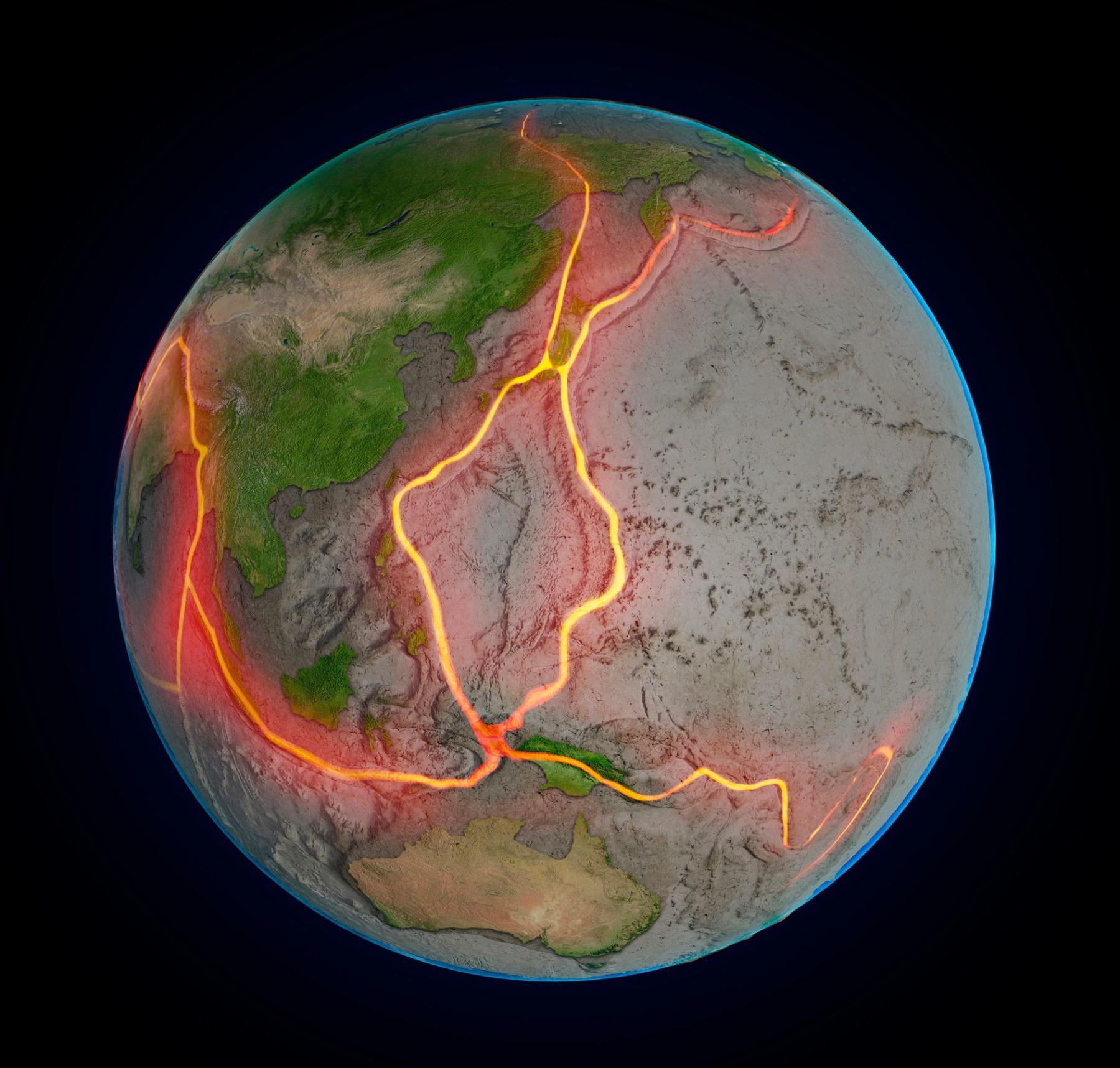
Earth’s rocks are missing more than a billion years of history in some places, and the slow rise and fall of continents may explain how those chapters disappeared.
A study led by University of Wollongong (UOW) PhD candidate Santosh Dhungana suggests that the slow rise and fall of continents helped create the Great Unconformity, a vast gap in Earth’s geological record. Published in Nature, the research links this missing history to currents of hot rock in the mantle that moved continents vertically over hundreds of millions of years.
Normally, rock layers preserve a sequence of events, with younger deposits accumulating above older ones. At the Great Unconformity, that sequence jumps: sedimentary rocks from around the beginning of the Cambrian period, roughly 540 million years ago, rest directly on much older crystalline rocks, including granite more than a billion years old.
“Imagine a book where a huge section in the middle has been ripped out. The Great Unconformity is that gap in Earth’s story, with the narrative jumping from the early chapters straight to a much later part of the story. Our research suggests these pages weren’t lost by chance,” Dhungana said.
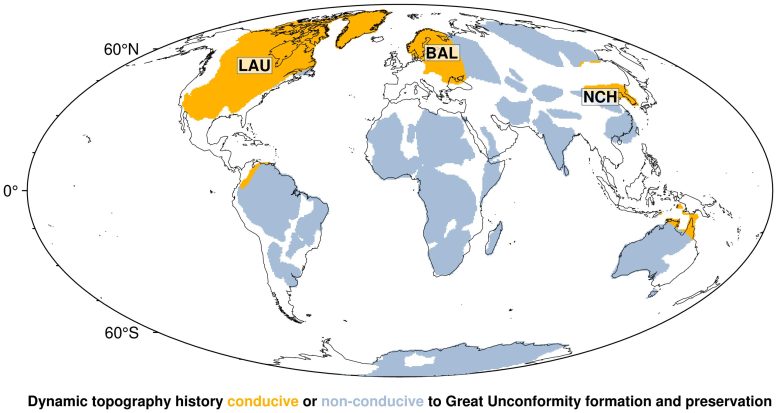
The Grand Canyon exposes one of the most striking examples of this geological gap. It lies within what was once the ancient continent Laurentia (modern North America). Similar boundaries appear in Europe, Australia, Africa, and Asia, although the missing intervals vary from about 200 million years to well over a billion.
Tracing Earth’s Missing History
Explaining the Great Unconformity requires accounting for both the removal of rock and the survival of the eroded surface beneath younger deposits. Dhungana said that although scientists had offered several explanations, those ideas had not been thoroughly tested against Earth’s behavior over time.
To investigate, he and his supervisor and co-author, Associate Professor Nicolas Flament, modeled mantle convection across hundreds of millions of years. The mantle consists of hot, solid rock that flows very slowly. Its currents can gently lift enormous stretches of land or allow them to sink.

The models indicated that mantle currents raised the ancient continental cores of Laurentia, Baltica (northern Europe), and North China during the Neoproterozoic Era, from about one billion to 540 million years ago. This prolonged uplift would have exposed rock to erosion. The era was followed by the Cambrian period, when animal life diversified dramatically.
How Sinking Continents Preserved The Gap
The next stage helped preserve what erosion had left behind. During the Phanerozoic eon, which spans the past 540 million years, the continental cores gradually sank. Seas spread across their worn surfaces, and accumulating sediment buried the boundary between the ancient rocks and the younger geological record.
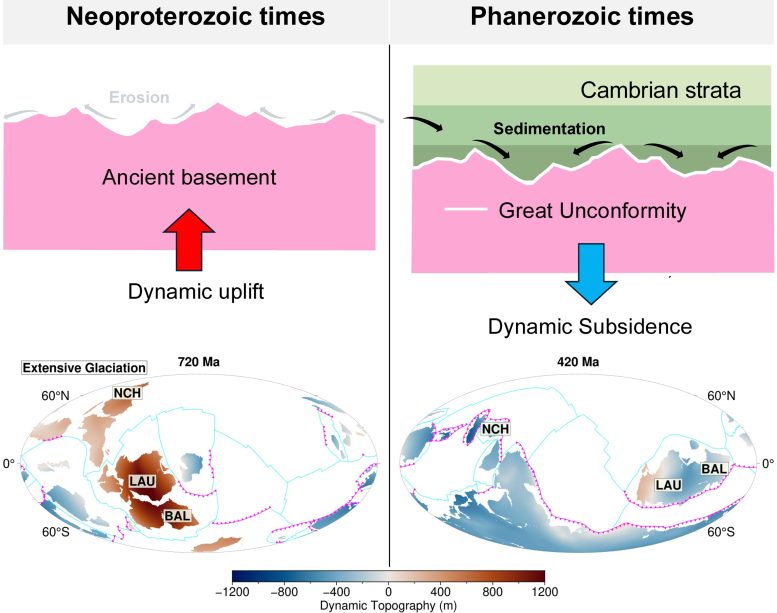
The modeled pattern matched the geography of the evidence. North America, northern Europe, and North China, where the Great Unconformity is especially well preserved and documented, all showed the prolonged rise followed by sinking that the researchers proposed.
“Sometimes what is missing can tell us more about the story of Earth than what we can see. A single, long period of uplift followed by a long period of sinking would have been the ideal recipe for removing the rock and preserving the worn surface,” Associate Professor Flament said.
“Many explanations for the Great Unconformity had been proposed, but few had been tested against how the Earth actually behaves over time. It is a thrill to be able to propose a solution to this geological puzzle.”
Reference: “The deep Earth origin of the Great Unconformity” by Santosh Dhungana, and Nicolas Flament, 4 November 2026, Nature.
DOI: 10.1038/s41586-026-11156-5
This study was funded by the Australian Research Council.
Never miss a breakthrough: Join the SciTechDaily newsletter.
Follow us on Google and Google News.