
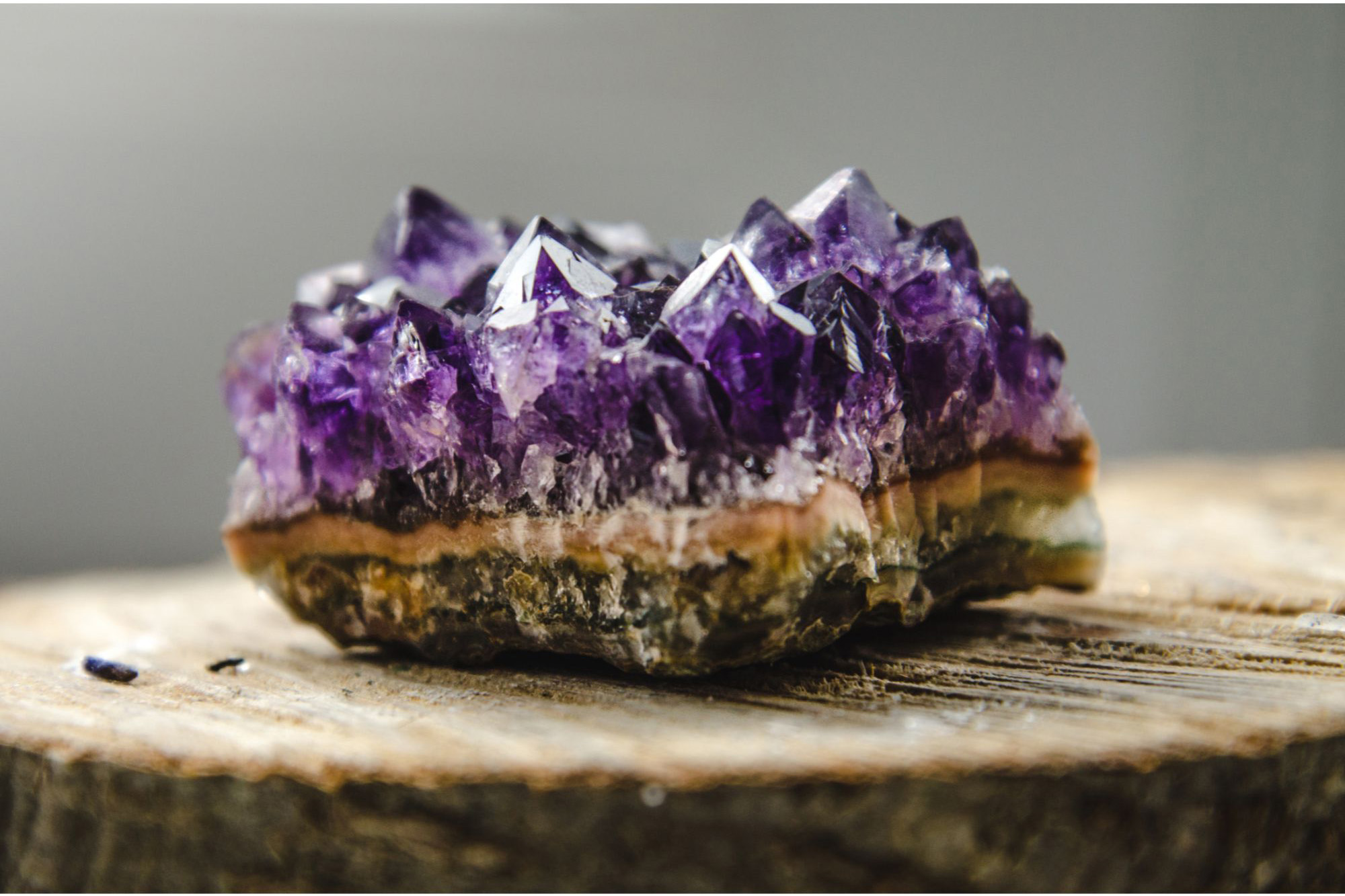
New research from the University of Göttingen reveals that amethyst geodes in Uruguay formed at low temperatures from groundwater-like fluids, proposing a new model for their formation based on extensive geological surveys and innovative analytical methods.
Amethyst, the violet variety of quartz, has been used as a gemstone for centuries and is a key economic resource in northern Uruguay. Geodes are hollow rock formations often with quartz crystals, such as amethyst, inside.
In Uruguay, amethyst geodes have been found in cooled lava flows dating back to the original breakup of the supercontinent Gondwana approximately 134 million years ago. However, their formation has remained a mystery.
Unraveling the Mystery of Amethyst Formation
Now, a team of researchers led by the University of Göttingen has used cutting-edge techniques to investigate the formation of amethyst geodes in northern Uruguay. The researchers discovered that the amethyst geodes formed at unexpectedly low crystallization temperatures of 15 to 60 °C. This finding, combined with their other results, enabled the researchers to propose a new model explaining their formation.

Advanced Research Techniques in Uruguay
The research, published in Mineralium Deposita, was conducted in the Los Catalanes District of Uruguay, where amethyst has been mined for over 150 years. The area is renowned for the deep violet color and high quality of its gems, as well as magnificent giant geodes sometimes over 5 m high. The deposits here have been recognized as one of the top 100 geological heritage sites in the world, highlighting their scientific and natural value. However, limited knowledge of how these geodes formed has made locating them challenging, relying largely on miners’ experience.
To address this, researchers conducted extensive geological surveys across more than 30 active mines, analyzing geode minerals, geode-hosted water, and groundwater. Using advanced techniques like nucleation-assisted microthermometry of initial one-phase fluid inclusion and triple-oxygen-isotope geochemistry, the team uncovered new insights into how these prized geodes formed. As well as finding that the amethyst geodes formed at unexpectedly low crystallization temperatures, the researchers also showed that the mineralizing fluids had low levels of salinity and proportion of isotopes consistent with water originating from the natural weather cycle, which probably came from groundwater held in nearby rocks.

Insights Into Amethyst Crystallization
“The precision and accuracy of these new techniques, allowed us to estimate with confidence the temperature and composition of the mineralizing fluids,” said Fiorella Arduin Rode, lead author and PhD researcher at Göttingen University’s Geoscience Centre. “Our findings support the idea that these amethysts crystallised at low temperatures from groundwater-like fluids.”

The study proposes a model where mineral phases like amethyst crystallize within volcanic cavities in a dark rock known as basalt, influenced by regional variations in temperature in the Earth’s crust. Arduin Rode adds, “Understanding the conditions for amethyst formation — such as the temperature and composition of the mineralising fluid, as well as the silica source, the timing of the mineralisation, and its relationship with the host rocks — is crucial for unravelling the process. This could significantly improve exploration techniques and lead to sustainable mining strategies in the future.”
Reference: “World-class amethyst-agate geodes from Los Catalanes, Northern Uruguay: genetic implications from fluid inclusions and stable isotopes” by Fiorella Arduin-Rode, Graciela Sosa, Alfons van den Kerkhof, Yves Krüger, David Bajnai, Andreas Pack, Tommaso Di Rocco, Pedro Oyhantçabal, Klaus Wemmer, Daniel Herwartz, Swea Klipsch, Bettina Wiegand, Siegfried Siegesmund and Mathias Hueck, 23 September 2024, Mineralium Deposita.
DOI: 10.1007/s00126-024-01310-2
Funding for this research was provided by Research Grants – Doctoral Programmes in Germany, 2021/22 – 57552340 – Deutscher Akademischer Austauschdienst (DAAD)
Never miss a breakthrough: Join the SciTechDaily newsletter.
Follow us on Google and Google News.
7 Comments
“… and lead to SUSTAINABLE mining strategies in the future.”
Just what does that mean? All mineral deposits are finite, and will eventually be exhausted. At one time, 90% of the world’s molybdenum came from about 1 square mile of a mountain top in Colorado, the Climax Mine. That was eventually closed when the grade of available ore became too low to be profitable to mine. Sometimes a mine will re-open by working what were the low-grade waste piles, if the price of the element(s) rises enough to once again become profitable. However, no mine will last forever. Eventually, the reserves will be exhausted.
That’s when you go back threw and find what else there is. Like when the gold rush happened other ones were overlooked like Platinum ect ect. Ehh??
The origin of Amethyst was discovered in the 1940’s when there was a shortage of quartz for military radios. Government scientists discovered it takes existing sources of quartz in the earth, granite, etc and putting it under at least 14,000 psi and 370 Celsius to dissolve and reform the many crystals you find across the earth. Amethyst is simply clear quartz with iron and other minerals giving it its color. This article is leaving out the third component, pressure! Under the right formula quartz can be made on average every 24 hours in a lab. Presently there are about thirty companies make it around the world. If you want to know how rocks are made including all the other gemstones consult the technologists they have to make money on their results. Geologists only have to theorize!
There is only one event in earths history to provide the necessary pressure for Amethyst to form and that is the Universal Flood. Yes that catastrophic event recorded by every ancient civilization that provided the approximately 5 miles of water pressure for quartz to dissolve and as pressure or temperature dropped would crystallize out similar to a sugar or salt experiment. To simple? Usually truth is!
Perfect
Your articles about how gem stones form are fascinating, even though most of the technical explanations are a bit difficult for me to understand. Great job!
I have one I found
Glad to know geologists study gemstones for their contribution to earth’s development. I have an amethyst geode, a small one. I had no idea geodes would be found with proportions like those pictured. As for sales price, a 3-1/2 foot violet geode offered for sale by the Lapidary Society, here in Bakersfield, was priced at $5,000.