

In a new paper, Jordan Jensen and Alexis Ault introduce a new forensic tool designed to enhance our understanding of how unconformities form.
Iron oxide minerals are found in rocks around the world. Some are magnetic, while others rust when exposed to water and oxygen. These properties offer valuable clues about the history and formation of the minerals.
Researchers at Utah State University have developed a new forensic tool to determine the timing of geochemical oxidation reactions in iron oxide minerals within the Earth’s crust. This tool could help scientists better understand how and when large, unexplained gaps in the geological record, known as “unconformities,” formed.
“A challenge for geoscientists is accurately constraining when rocks resided in the near-surface environment,” says Alexis Ault, associate professor in USU’s Department of Geosciences. “It’s tricky to pinpoint the timing of such processes, because the geologic evidence has often been erased.”
But a new thermochronological approach by Ault’s doctoral student Jordan Jensen may offer an accurate means of deciphering how and when mysterious time gaps form in the geological rock record.
Filling in the Missing Chapters of Geologic Time
Jensen and Ault report their findings in the March 4, 2025 online edition of Geology, a peer-reviewed journal of the Geological Society of America. Their research is supported by the National Science Foundation.
“Unconformities in the rock record are like missing chapters in the book of geologic time,” says Jensen, a USU Presidential Doctoral Research Fellow. “These gaps are the physical manifestation of past erosion events that removed evidence of past landscapes and environments.”
These events reflect significant changes in tectonics and climate over geologic time, he says.
“The most well-known example of an unconformity is ‘The Great Unconformity,’ which is a major geologic boundary found throughout North America that separates ancient igneous and metamorphic rocks from younger, often fossil-bearing rocks,” Jensen says. “This boundary can be viewed in many places, including Grand Canyon.”
In their paper, Jensen and Ault describe the use of uranium-thorium-helium – (U-Th)/He – analyses of martite to document the timing of unconformity development in deep time.
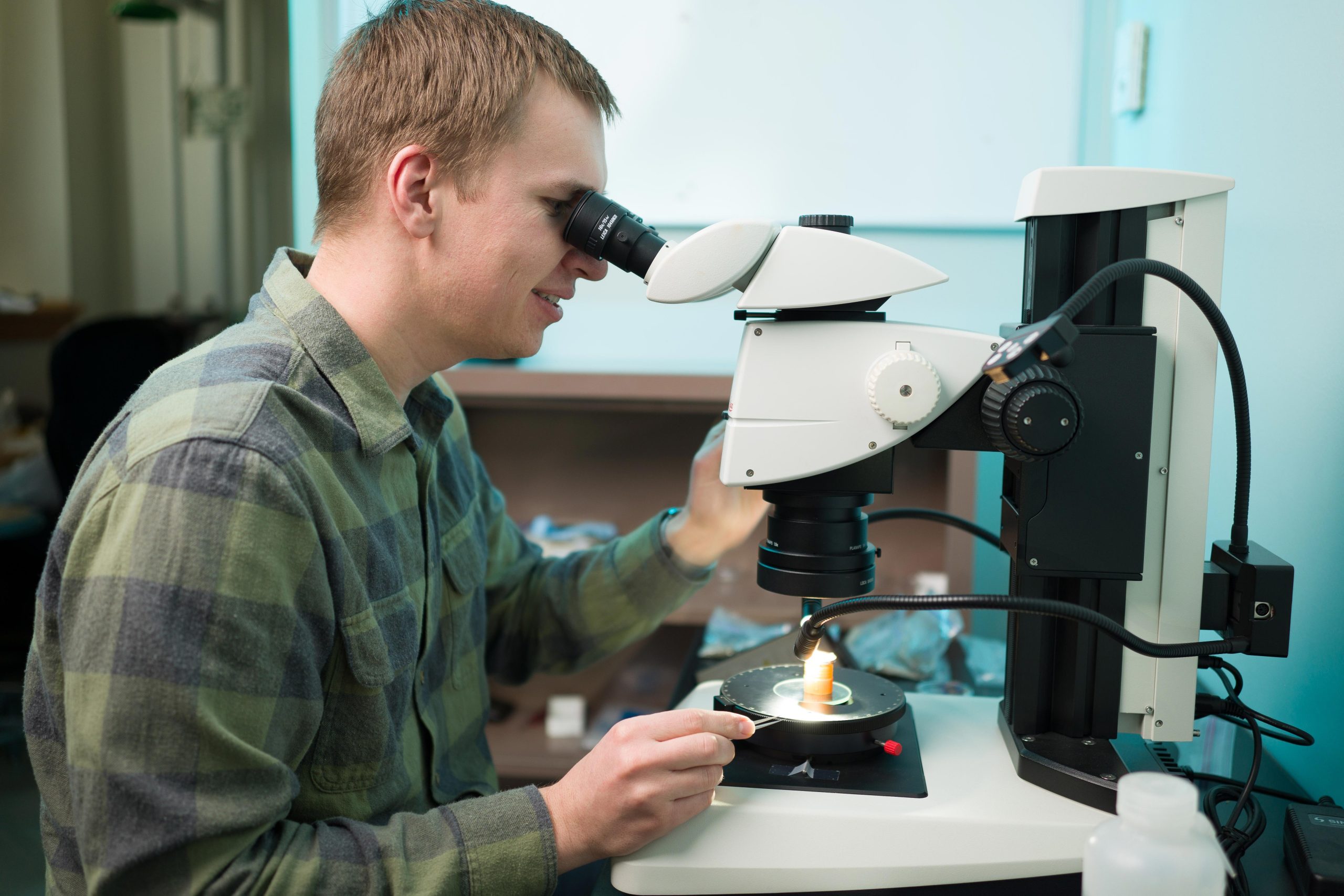
“Martite is an iron-oxide and my research group is known for using iron-oxide textures and (U-Th)/He analyses to fingerprint earthquakes and slow slip events in seismically active faults,” Ault says.
Martite occurs when the iron oxide mineral hematite masquerades as magnetite, another iron oxide known for its magnetic properties, says Jensen, who earned a bachelor’s degree from Utah State in 2016. He recalls his undergraduate chemistry professor saying, “Diamonds aren’t forever, but graphite is.”
“Like diamond and its conversion to graphite, magnetite is not stable at Earth’s surface and slowly transforms to hematite in a process similar to how iron metals rust when exposed to air,” he says. “Martite is often mistaken for magnetite, because its exterior still preserves the appearance of magnetite. It’s only when you take a close look with advanced tools like the scanning electron microscope at USU’s Microscopy Core Facility that you can determine the existence of tiny hematite crystals that replaced the original magnetite crystal.”
Evidence from Billion-Year-Old Rocks
Using martite samples obtained from a 1.7-billion-year-old rock situated below a major unconformity in the Colorado Range west of Denver, Jensen and Ault set to work applying their proposed approach.
“When magnetite is oxidized, the geologic clock is reset, so to speak, revealing when these rocks were pushed to the near-surface of the Earth,” Jensen says. “Using (U-Th)/He and electron backscatter diffraction analysis, we were able to date individual martite specimens as old as 1.04 billion years, which suggests the unconformity formed as early as 1.4 billion years ago.”
The USU scientists say there are disparate explanations for the origin of the Great Unconformity. Hypotheses include a sequence of global glaciation events, known collectively as “Snowball Earth,” which occurred during the Cryogenian period more than 635 million years ago.
“These tiny and resilient martite grains preserve the story of when these rocks were first exhumed to the Earth’s near surface, despite the many events like burial and mountain-building that could have destroyed the evidence,” Jensen says. “A subset of our analyzed grains suggests the erosion resulting in the Great Unconformity occurred much earlier than previously thought, predating Snowball Earth events by several hundred million years in this location.”
Because martitie is common in many rocks, he and Ault note their forensic tool can be applied throughout geologic time to investigate weathering, alternation, and erosion of Earth’s crust, along with the development of critical mineral deposits.
Reference: “Tracking ancient unconformity development with martite (U-Th)/He thermochronometry” by Jordan L. Jensen and Alexis K. Ault, 4 March 2025, Geology.
DOI: 10.1130/G53010.1
The study was funded by the U.S. National Science Foundation
Never miss a breakthrough: Join the SciTechDaily newsletter.
Follow us on Google and Google News.
1 Comment
Also useful for dating FeOx mineralisation? And maybe will throw more light on the cooling histories of magnetite- bearing igneous rocks
Nothing mysterious about unconformities; simply the limits to their age of formation.