
Close Menu
    Facebook X (Twitter) Instagram
    SciTechDaily
    • Biology
    • Chemistry
    • Earth
    • Health
    • Physics
    • Science
    • Space
    • Technology
    Facebook X (Twitter) Pinterest YouTube RSS
    SciTechDaily
    Home»Earth»Geologists Decode Earth’s 4.4-Billion-Year-Old “Missing” Crust
    Earth

    Geologists Decode Earth’s 4.4-Billion-Year-Old “Missing” Crust

    By Science China PressJuly 11, 2025No Comments4 Mins Read
    Facebook Twitter Pinterest Telegram LinkedIn WhatsApp Email Reddit
    Share
    Facebook Twitter LinkedIn Pinterest Telegram Email Reddit
    Artistic Reconstruction of Earth During the Hadean Eon
    An artistic reconstruction of Earth during the Hadean eon (~4.5 billion years ago). Intense volcanic activity, heat from accretion, and frequent impacts kept the young Earth in a molten state. This fiery landscape set the stage for the earliest formation of the crust and the eventual emergence of stable continents. Credit: Science China Press

    Researchers used zircons and AI to reconstruct Earth’s ancient crust, revealing possible tectonic processes from the planet’s earliest, rockless chapter.

    Researchers from the School of Earth Sciences at Zhejiang University, led by Professors Jia Liu and Qunke Xia, have made a significant breakthrough in exploring a long-lost chapter of Earth’s geological past. Their work, carried out by PhD students Denggang Lu, Zhikang Luan, Jingjun Zhou, and Tianting Lei, offers new insight into what the planet’s continental crust may have looked like during the Hadean eon. This ancient period, which began approximately 4.4 billion years ago, marks the earliest known era in Earth’s history.

    “The Hadean is a key period for understanding the origin of Earth’s continents,” said Prof. Jia Liu. “But rocks from this time are incredibly rare. So far, the only known samples are from the Acasta region in Canada and date to about 4.03 billion years ago.” Due to intense geological activity in Earth’s early days, most rocks from that time have been destroyed, leaving behind what scientists call a “missing chapter” in Earth’s story.
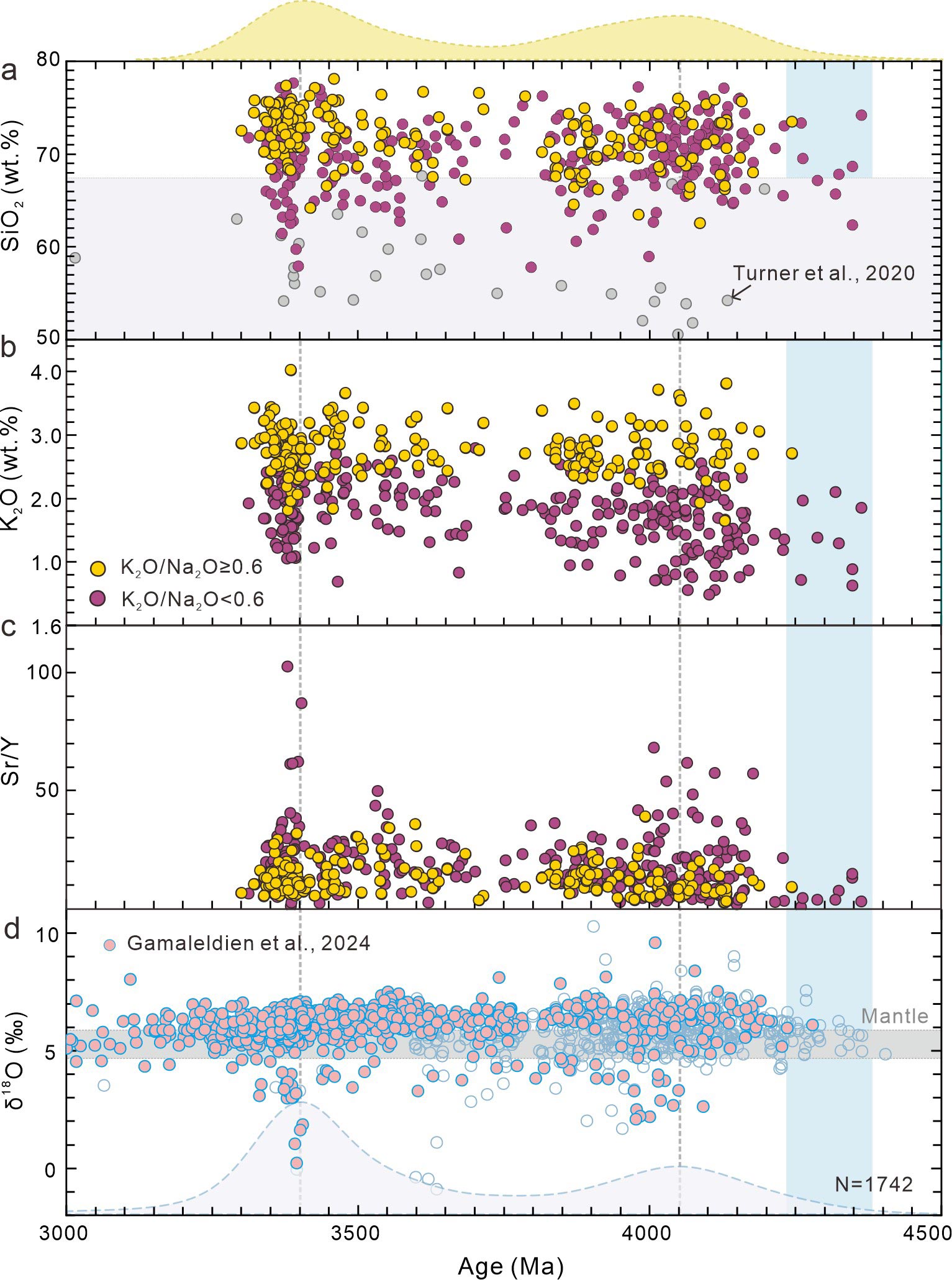
    Reconstructing the Rock Record of the Hadean Eon
    This figure shows the temporal evolution of the chemical composition of Earth’s earliest continental crust, recovered from zircon data from Jack Hills. Credit: Science China Press

    Although direct rock samples from this time are almost nonexistent, a remarkably tough mineral called zircon has managed to preserve valuable clues. Some zircon crystals date back more than 4.3 billion years and have been discovered in regions such as the Jack Hills in Australia. These tiny crystals hold geochemical signatures that reveal details about magma activity on the early Earth.

    “We don’t know what the actual rocks of the Hadean crust looked like, because we don’t have any—but zircons give us a window into that hidden world,” said PhD student Denggang Lu.

    Reconstructing Lost Crust Through AI

    To unlock that window, the team compiled the world’s most comprehensive geochemical database to date of igneous zircon and their host rocks—more than 14,000 zircons and 823 matched rock records. Using this database, they trained supervised machine learning models to find patterns between trace elements in zircons and the chemical makeup of their host rocks. This allowed them to predict what the “missing” rocks might have looked like. It’s as if Earth’s earliest rocks had been brought back to life—virtually passed through modern instruments and revealed with chemical details, just like real samples tested in the lab.

    “In an age of rapid AI development, using machine learning to uncover the relationship between zircons and their rocks is incredibly exciting,” said Prof. Liu. “It gives us a chance to push the known rock record back by nearly 400 million years and explore how the earliest crust may have evolved.”

    The study suggests that the Hadean crust was likely formed through convergent tectonics—similar to what happens during continental collisions—rather than deep oceanic subduction. This points to early forms of plate convergence on the early Earth, offering a new model for primordial crust formation and introducing an innovative approach to studying Earth’s most ancient and elusive rocks. The method not only expands the potential of zircon in early Earth studies but also provides a significant breakthrough in uncovering the planet’s “missing geological chapters.”

    Reference: “Earth’s Hadean crust formed via operation of convergent tectonics” by Denggang Lu, Jia Liu, Qunke Xia, Zhikang Luan, Jingjun Zhou, Tianting Lei, Lu Wang and Eero Hanski, 2 June 2025, National Science Review.
    DOI: 10.1093/nsr/nwaf230

    The study was funded by the National Natural Science Foundation of China.

    Never miss a breakthrough: Join the SciTechDaily newsletter.
    Follow us on Google and Google News.

    Earth Science Geochemistry Geology Popular Science China Press
    Share. Facebook Twitter Pinterest LinkedIn Email Reddit

    Related Articles

    Scientists Discover Earth’s Continents Are Slowly Being “Peeled” From Below

    Earth’s Lost Timeline: Rusty Rocks Reveal Billion-Year-Old Secrets

    Geologists Crack 134-Million-Year-Old Mystery of Amethyst Geode Formation

    The Secret Keepers of Earth’s History: Zircons Reveal Billion-Year Geological Mysteries

    600 Million-Year-Old Time Capsule – New Discoveries From the Himalayas Shed Light on Earth’s Past

    Popular Explanation Is Wrong – Researchers Discover New Clues Regarding the Origin of Earth’s Continents

    Scientists Reveal Diamond Cache Deep in Earth’s Interior

    Oxygen-Rich Iron Reservoirs Could Have Played a Crucial Role in the Creation of Life

    Arctic Sea Ice Loss is Impacting Atlantic Ocean Water Circulation System

    Leave A Reply Cancel Reply

    • Facebook
    • Twitter
    • Pinterest
    • YouTube

    Don't Miss a Discovery

    Subscribe for the Latest in Science & Tech!

    Trending News

    289-Million-Year-Old Reptile Mummy Reveals Origin of Human Breathing System

    New Brain Discovery Challenges Long-Held Theory of Teenage Brain Development

    Scientists Discover Plants “Scream” – We Just Couldn’t Hear Them Until Now

    Scientists Discover a Surprising Reason Intermittent Fasting Extends Life

    This Simple Fruit Wash Could Make Produce Safer and Last Days Longer

    Scientists Say Adding This Unusual Seafood to Your Diet Could Reverse Signs of Aging

    Scientists Say a Hidden Structure May Exist Inside Earth’s Core

    Doctors Surprised by the Power of a Simple Drug Against Colon Cancer

    Follow SciTechDaily
    • Facebook
    • Twitter
    • YouTube
    • Pinterest
    • Newsletter
    • RSS
    SciTech News
    • Biology News
    • Chemistry News
    • Earth News
    • Health News
    • Physics News
    • Science News
    • Space News
    • Technology News
    Recent Posts
    • Scientists Propose Radical New Way To Detect Alien Life – Without Traditional Biosignatures
    • Scientists Just Discovered Light Can Actually Slow Plant Growth
    • Scientists Finally Solved One of Water’s Biggest Mysteries
    • 7,000-Year-Old DNA Rewrites the Story of the “Neolithic Revolution”
    • Missing Medieval Relic of Legendary English King Found After Being Missing for 40 Years
    Copyright © 1998 - 2026 SciTechDaily. All Rights Reserved.
    • Science News
    • About
    • Contact
    • Editorial Board
    • Privacy Policy
    • Terms of Use

    Type above and press Enter to search. Press Esc to cancel.