

Armed with advanced technology, decades of expertise, and insights from an NSF-funded study, a multi-institution team of geoscientists offer innovative, updated perspectives of an iconic sedimentary record.
Anyone from the Boomer generation to Gen X, Millennials, Gen Z, or Gen Alpha who has studied geology has likely learned foundational insights from Edwin Dinwiddie McKee’s landmark studies of the Grand Canyon’s sedimentary record—even if they don’t immediately recognize his name.
The legendary scientist, who lived from 1906-1984, studied and documented the stratigraphy and sedimentation of Colorado Plateau geology, especially the Grand Canyon’s Cambrian Tonto Group, for more than 50 years. His time-tested tenets have influenced generations of geoscientists.
“The Tonto Group holds a treasure trove of sedimentary layers and fossils chronicling the Cambrian Explosion some 540 million years ago, when the first vertebrates and animals with hard shells rapidly proliferated and sea levels rose to envelop continents with emerging marine life,” says Carol Dehler, professor at Utah State University. “McKee marveled at this pivotal geologic period, yet had no knowledge of plate tectonics or global sea level change, and his ideas were often shunned by the scientific community of the time.”
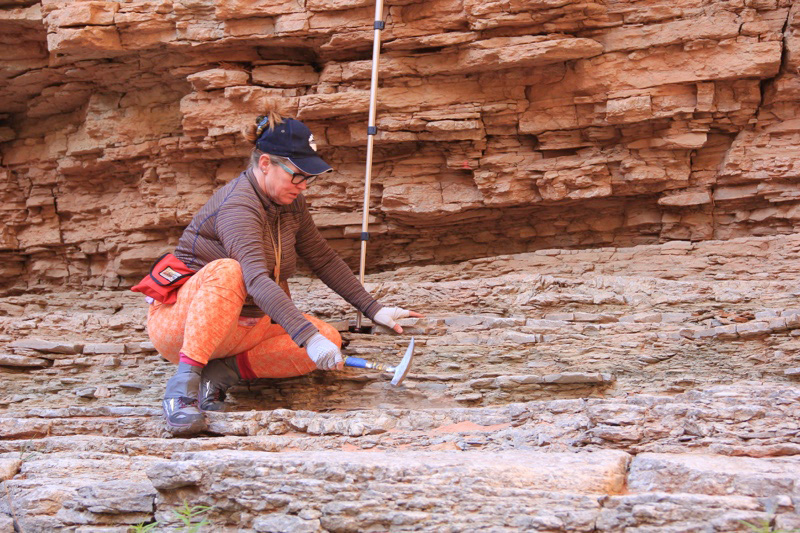
Yet, what if McKee could have fast-forwarded through time and availed himself of current-day stratigraphic, depositional and paleontological models, data, and technological muscle?
A Modern Reinterpretation of McKee’s Work
Dehler, with colleagues James Hagadorn of the Denver Museum of Nature & Science, Frederick Sundberg, Karl Karlstrom, and Laura Crossey of the University of New Mexico, Mark Schmitz of Boise State University, and Stephen Rowland of the University of Nevada, Las Vegas, along with their students and interns, have employed these tools to construct an updated and insightful framework of McKee’s foundational ideas. They report their efforts in a recent paper selected as the cover story of the November 2024 print issue of the Geological Society of America’s GSA Today.
“The Grand Canyon is an epic Rosetta Stone for geology,” says Hagadorn, Tim & Kathryn Ryan Curator of Geology at DMNS. “And we’re helping to further decode it. Because Grand Canyon rocks record global changes in climate and tectonics, our work helps us understand strata that were deposited worldwide during the Cambrian period.”
Uncovering Clues in the Tonto Group
Studying the Tonto Group, he says, is like being a detective at a crime scene.
“You can see clues and discern at least part of what happened,” Hagadorn says. “But determining how it happened and the sequence of events takes time and effort. Just like the scene of a crime, the rock record of the Grand Canyon is much more complicated than what we currently know and its story is still being written.”

“From the Tonto Group’s 500-meter-thick strata, we’re learning about sea-level rise and the effects of catastrophic tropical storms – probably more powerful than today’s devastating hurricanes – during a period of very hot temperatures when the Earth was ice-free,” she says.
Sea levels were so high during this time period, Dehler says, that rocks like the Tonto Group were deposited atop every continent on Earth, as seas bathed the continents in a complex mosaic of shallow marine, coastal, and terrestrial environments.
Further, she says, advanced chronological tools are revealing new information about the tempo of sedimentation, as well as how rapidly trilobites and other “disgusting, cockroach-looking creatures” diversified.
“Our findings are a reminder science is a process,” Hagadorn says. “Our work in the Grand Canyon, one of the world’s most well-known and beloved landscapes, connects people to this science in a very personal way.”
Reference: “The Cambrian of the Grand Canyon: Refinement of a Classic Stratigraphic Model” by Carol Dehler, Frederick Sundberg, Karl Karlstrom, Laura Crossey, Mark Schmitz, Stephen Rowland and James Hagadorn, 23 October 2024, GSA Today.
DOI: 10.1130/GSATG604A.1
The team’s research was supported by a National Science Foundation Division of Earth Sciences grant.
Never miss a breakthrough: Join the SciTechDaily newsletter.
Follow us on Google and Google News.
12 Comments
Your reports are my daily food:) it is exciting to read about our earth and the people that care of her and share their findings!
Thank you, thank you
Always enjoy your insights!
I’ve always considered trilobites cool and very interesting creatures, not “disgusting” at all. Of course opinions may differ. Fascinating article, very well written
Thank you so much for your insightful research & info about our earth‼️
It’s nectar from the gods like reading about the world
My hat is off to those who go to the ends of the Earth for science, rather than those who tuck in at RP’s Stage Stop before turning in at Motel 8.
What about the massive bent rocks in the canyon that could have only been laid down wet? Hmm. Seems to me this is all just another ploy to push their evolutionary agenda. Biblically, the canyon was formed by the flood thousands, not millions, of years ago. The proof is there, but folks just don’t seem to care. Shameful!
Dave.. Except at the very bottom the sediments are all flat-lying and the fossils record a steady upward trend in evolution. Those at the bottom are the most primitive and those at the top the most advanced. They are never mixed together nor do you find any of the more advanced at the bottom. The vertebrates came later. This is solid proof of evolution in just one geographical location. There were no people in the Bible to ever see the Grand Canyon., nor visit Australia where other Precambrian fossils are found. This paper just adds more confirmation to the basic understanding. A remaining problem is where all the sediments came from and where those went when the Canyon was formed.
There really is no point in anyone having an “evolutionary agenda”. I say this as a life scientist and life-long comparative religion student who happens to be a Jehovah’s Witness. I never, in good conscience, could have become a Witness if they still regarded the age of this planet per the fossil record as being some lying nefarious plot cooked up by apostates!
Deep faith in the Creator of all things is perfectly compatible with our planet’s undeniable history that is eons old. Scripture is six thousand years old…People have been on the planet for a million years give or take. The Holy Bible is not primarily a history book or science text, but a blueprint for reunification with your God.
Please don’t continue down the path of conflating outdated religious doctrine with your personal journey of walking ever closer to your Maker.
An added benefit is that with all the time we save once we quit fighting over doctrine, we have more energy to devote to NOT being angry and judgmental. Take it from one who found out the hard way!
A clear indication that civilization was jump started in Asia.
They don’t want to see it😢
Interesting, thanks! But I don’t appreciate the unnecessary sensationalist bylines such as “rewriting textbooks” and similar. Please try to avoid these.