
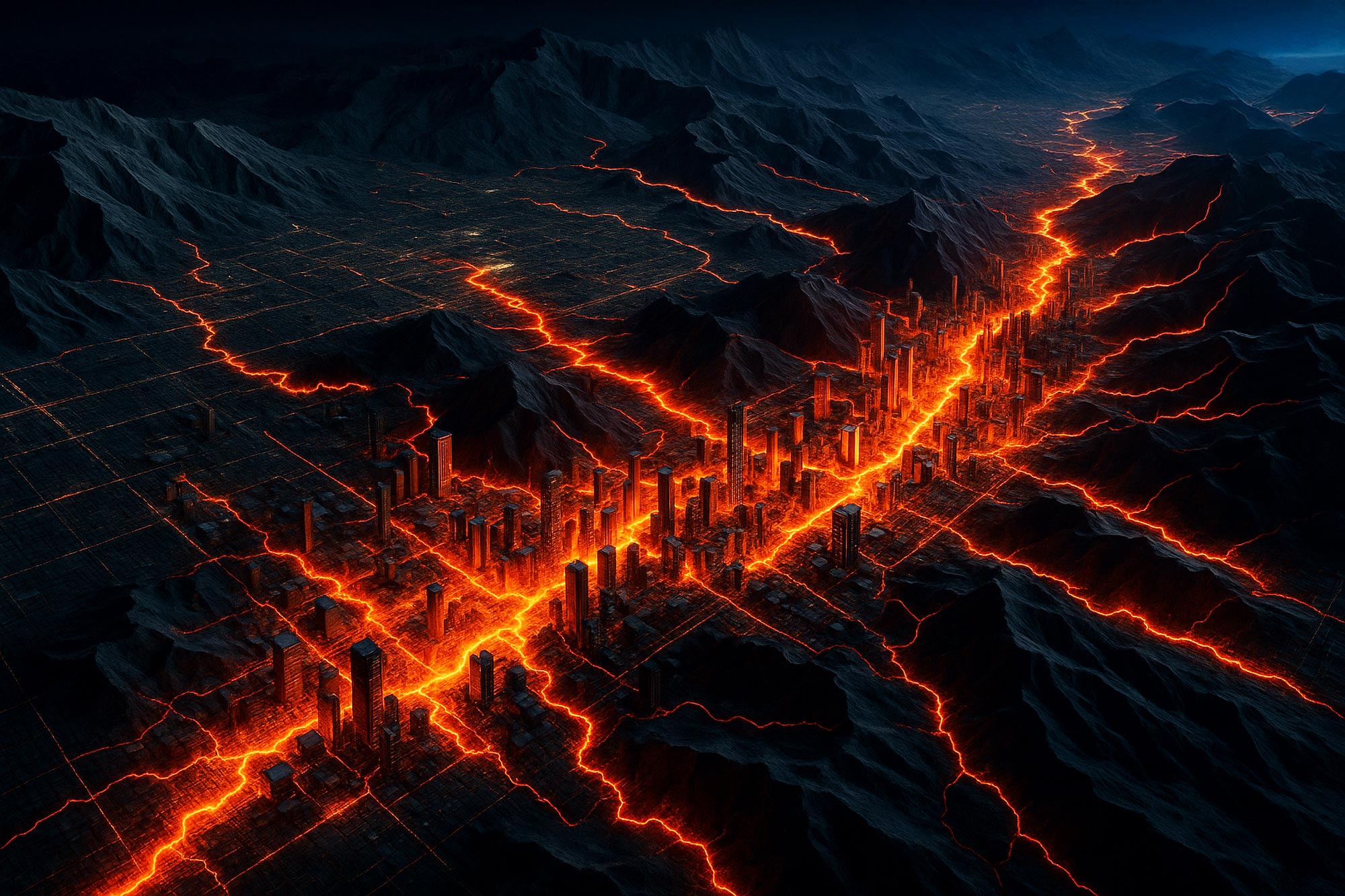
Fault zones are often wide, branching networks rather than narrow lines, requiring a shift to 3D models for better earthquake prediction and hazard analysis, while narrow creep zones highlight potential errors in interpreting past seismic events.
At the Seismological Society of America’s Annual Meeting, researchers tackled a deceptively simple question: How wide are faults?
Christie Rowe of the Nevada Seismological Laboratory at the University of Nevada, Reno, and Alex Hatem of the U.S. Geological Survey analyzed global data from individual earthquakes to find a more complete answer, one that accounts for both surface ruptures and deeper fault movements, including creeping sections.
Their findings, based on recent earthquake observations from regions like Turkey and California, reveal that earthquakes often involve not just a single fault strand but a complex web of branching faults. As a result, fault zones can span hundreds of meters in width, far wider than traditionally assumed.
“So that suggests that significant parts of the broad array of fractures that develops over many earthquakes can be activated in a single earthquake,” said Rowe, who noted that this width sometimes roughly corresponds to the width of Alquist-Priolo zones established for safe building in California.
“We want to know how this might change things like the shaking patterns that you would expect, or how much radiated energy you get from an earthquake,” Rowe explained. “Because it’s not the same if you have slip distributed on many strands as when it is all on one strand of the fault.”
Shaking Patterns and Energy Release
At the same time, the researchers found that the width of creep zones at these earthquakes are much narrower, both near the surface and 10-25 kilometers deep in the earth. The creep zones, between 2 and 10 meters wide, “may be the most localized behavior a fault does,” Rowe said.
The study emphasizes the importance of thinking of faults in a more three-dimensional manner, said Rowe.
“As a geologist, it’s always kind of been a cognitive disconnect for me when I talk to earthquake modelers who have these two-dimensional features that they model earthquakes on,” she said. “Because the sheer resistance, the strength or the friction, comes from a volume of rock that’s deforming during an earthquake or in between earthquakes. So the size of that volume controls the strength of the fault in some really tangible ways.”
Data Sources and Analytical Approach
The researchers used a variety of data in their study, including rupture maps, creeping zone width from surveys of slowly shifting monuments along faults and satellite observations, the locations of earthquake aftershocks, low velocity damage zone widths, and the zones delineated by certain types of rock such as pseudotachylyte, ultramylonite and mylonite that are a signature of creep and deformation.
The findings also have implications for how scientists study past earthquakes to calculate earthquake recurrence intervals on faults, Rowe noted.
Slip rates and recurrence intervals can be constrained using localized measurements, but it can be difficult to disentangle the slip that occurred during an earthquake and aseismic slip that occurred after the event. The 2014 Napa, California earthquake is a good example of this phenomenon, said Rowe, noting that almost half of the slip measured after that event occurred slowly after the earthquake.
But if the Napa earthquake occurred thousands of years ago and researchers came across its traces in the rock record, “you would just see a bigger earthquake. You might lump all of that slip as a single event,” Rowe said.
Creep isn’t always accounted for in calculating recurrence intervals, “so finding out that creep zones are quite narrow means that we should be aware that we could be convolving creep with seismic slip when we look at those paleoseismic records,” she added.
Meeting: 2025 Seismological Society of America
Never miss a breakthrough: Join the SciTechDaily newsletter.
Follow us on Google and Google News.
6 Comments
fear mongering, lol
Having experienced an earthquake, even a mild one, believe me there’s a lot to fear.
Some folks think they are scientist and know better. Fear mongering nope, unless one is a scientist one has know idea except to spread lies of suppose fear mongering comment. Let’s hope they never have experience such, but then again maybe one should experience such destruction first hand.
As a teenager I was a participant in the 1964 9.2 Good Friday Earthquake in Anchorage AK. In 25 yrs. as a hard rock, underground mining Geologist I followed many faults, usually horizontally, for 100s, sometimes 1000s of feet looking for ore. Faults pinch and swell. A fault with 100s of feet of separation can be 1/4″ wide, but quickly swell to 25′ wide. The host rock can influence the width of a fault, changes in strike can influence the width of a fault, as can changes in dip.
[I am old school, from when there was ‘the trace of a fault’: the intersection of the plane of a fault & the surface – now its a fault line]
My first Eartquake experience was in Washington State, then Louisa Virginia now in Cherry Valley, California I’ve experienced five more. These weren’t very strong but certainly caught my attention. If you don’t like living around Earthquakes or even hurricanes and tornadoes then move. These are totally natural phenomena. The real storms are in man’s thinking.
Our experience of science for the most part is too often delivered as undisputable facts, It is refreshing to see so many pieces of research that openly embrace that the more we discover, we realise how little we know.