
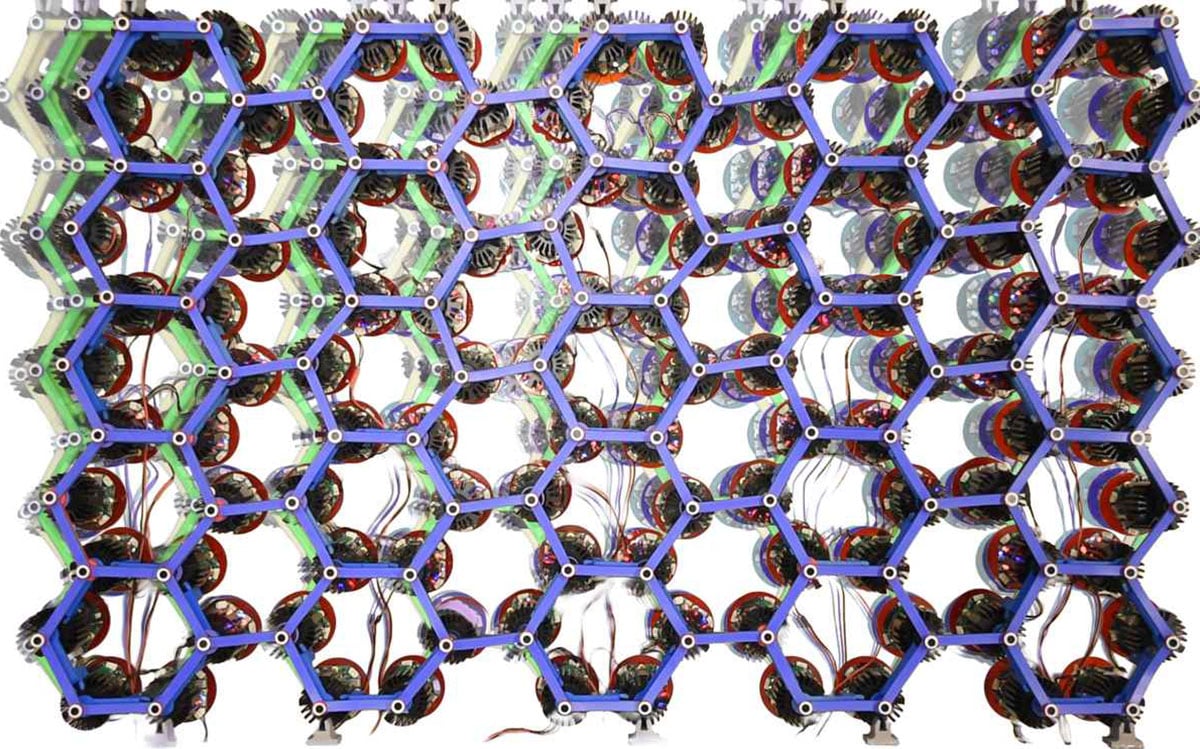
Physicists studying active matter — materials that can use their own internal energy to respond to forces — have uncovered surprising behaviors that challenge conventional ideas in mechanics.
Materials that bend, snap, crawl, or even dig on their own may sound like science fiction, but physicists are now building systems that can do exactly that.
Researchers from the universities of Amsterdam, New South Wales, and Cambridge are exploring a strange category of materials known as active matter. Unlike ordinary materials, active matter can draw on internal energy to respond dynamically to outside forces. Their latest experiments reveal behaviors that challenge some of the most established rules in mechanics and could eventually help shape the next generation of soft robotics and adaptive machines.
Most materials people encounter every day are passive. Steel beams, rubber bands, glass, and concrete only move or deform when something external pushes, stretches, or compresses them.
Active matter works differently. These systems continuously consume energy and convert it into motion or mechanical changes. Nature is full of examples. Schools of fish move in coordinated waves, bird flocks shift direction almost instantly, and living cells reorganize themselves without any central controller. 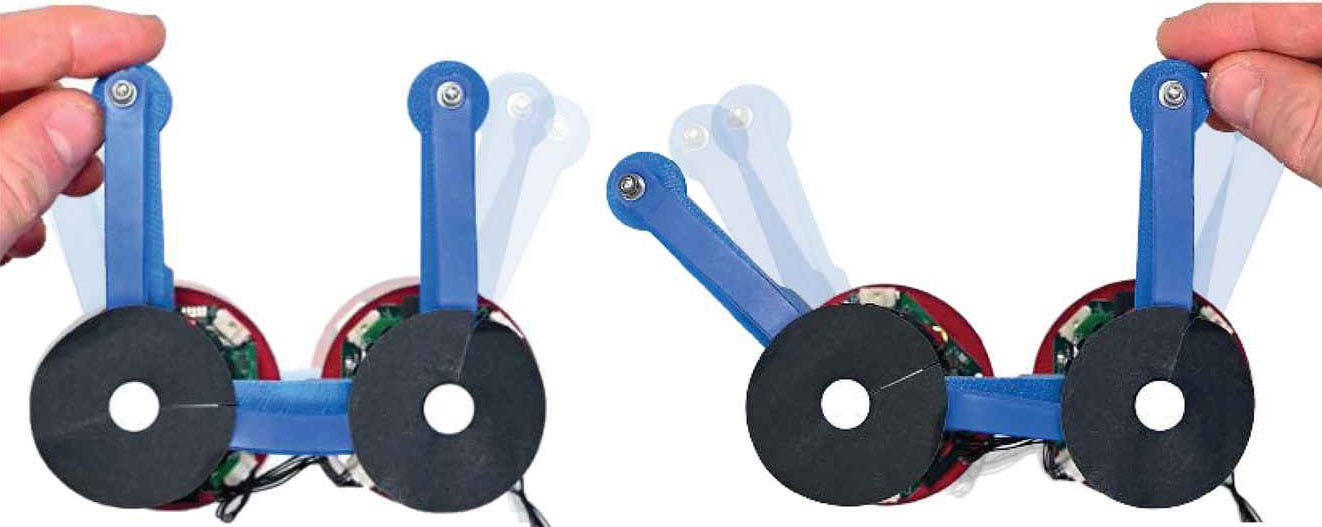
The building blocks of the new materials are rods connected by small motors that make the material active. The interactions are non-reciprocal: when pressed from one side the system reacts in a different way than when pressed from the other side. Credit: Image by the authors.
Constructing Active Materials in the Lab
Active matter is not limited to biology. Scientists can also create it in laboratories using relatively simple components.
Over the past several years, researchers from Amsterdam, Cambridge, and New South Wales have developed active materials made from rods, rubber bands, and tiny motors. These systems display unusual and potentially useful behaviors. Two recent studies from the team have been accepted for publication.
One example begins with a simple comparison. If you compress a paper ticket between your fingers, it buckles in one direction. Push the bent section inward, and it suddenly snaps to the opposite side. Because the ticket is inactive matter, this buckling and snapping only happens once under external pressure.
When Materials Begin to Move on Their Own
The researchers found that active materials behave very differently during the same process.
To create an active version of the system, the team linked rods together into a chain and placed small motors at the joints. These motors created non-reciprocal interactions, meaning one rod could respond differently to motion depending on which neighboring rod caused it.
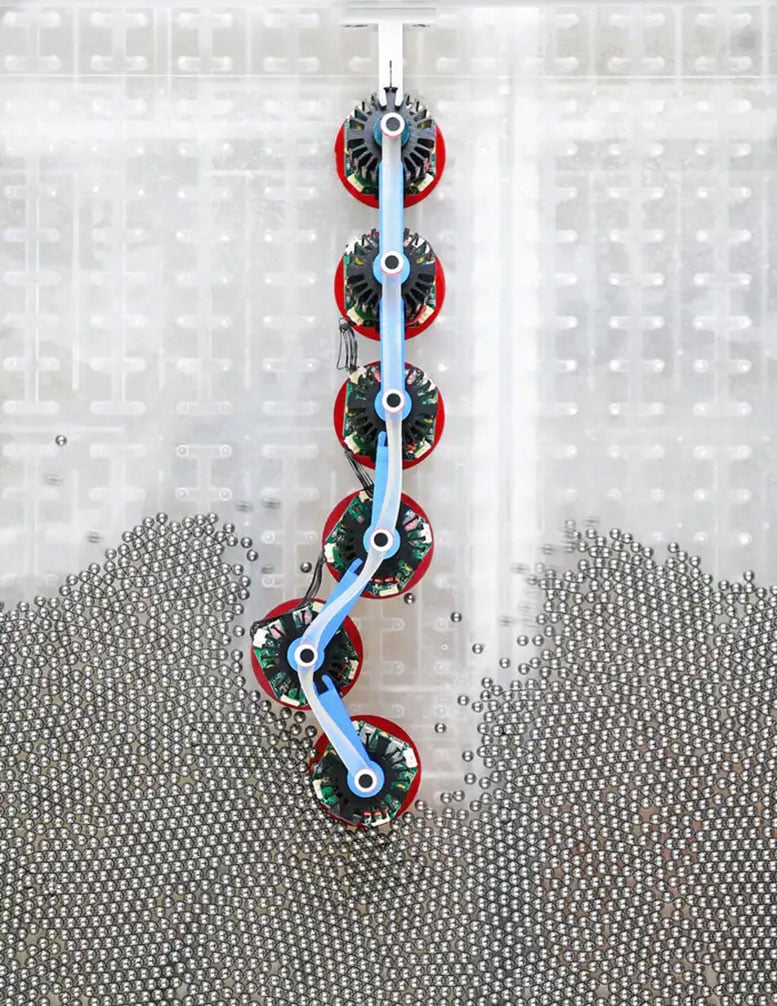
Instead of buckling and snapping only once, the active chains repeated the motion continuously and produced oscillations. The researchers say the usual “critical point” where snapping occurs became what is known as a “critical exceptional point.” In practical terms, this allowed the chains to move in ways resembling crawling, walking, or digging.
The findings were published in the Proceedings of the National Academy of Sciences by joint first authors Sami Al-Izzi from the University of New South Wales and Yao Du from the University of Amsterdam. An image of one of the buckling chains was selected as the journal’s cover art.
According to the researchers, the work could help lead to autonomous materials with multiple functions, especially for flexible soft robots that can operate without centralized control systems.
Challenging a Fundamental Mechanical Principle
Engineers often rely on Le Chatelier’s Principle, which broadly suggests that behavior at small scales should translate to larger structures. For example, making individual parts of a structure stiffer usually makes the entire structure stiffer as well.
The team found that active matter does not always follow this rule.
Using a two-dimensional lattice made from motors and rods, the researchers discovered that increasing the activity of the individual building blocks could actually make the overall structure less active. They measured how the elasticity of the larger structure changed depending on the properties of its microscopic components.
The Importance of Percolation
The researchers determined that large-scale behavior depends on how active microscopic components spread throughout the material, a process known as percolation.
They compared the effect to water moving through coffee grounds. If the grounds are packed too tightly, water cannot pass through efficiently. In the same way, a high concentration of less active components can block elastic responses from spreading through the material, even when other regions remain highly active.
The second study, led by first author Jack Binysh from the research group of Corentin Coulais at the University of Amsterdam, was accepted for publication in Physical Review X.
The researchers believe the breakdown of Le Chatelier’s Principle in active matter could have important implications for scientists studying systems such as biophysical gels, epithelial monolayers, and neuromorphic networks. The findings may also influence future research in physics, soft matter science, mechanical engineering, life sciences, and robotics.
References:
“Nonreciprocal buckling makes active filaments polyfunctional” by Sami C. Al-Izzi, Yao Du, Jonas Veenstra, Richard G. Morris, Anton Souslov, Andreas Carlson, Corentin Coulais and Jack Binysh, 13 March 2026, Proceedings of the National Academy of Sciences.
DOI: 10.1073/pnas.2531723123
“More is Less in Unpercolated Active Solids” by Jack Binysh, Guido Baardink, Jonas Veenstra, Corentin Coulais and Anton Souslov, 13 April 2026, Physical Review X.
DOI: 10.1103/flhb-kjyd
Never miss a breakthrough: Join the SciTechDaily newsletter.
Follow us on Google and Google News.
1 Comment
The present concept of interaction between bodies need modification. Speed and internal energy of a body are interchangeable. For example, when speed of Earth increases during its orbiting, there will be corresponding change in its internal energy, and so it’s temperature. The expansion of the universe is due to internal energy of its individual units (gravitationally bound super clusters) changing to speed. The clusters thus get cooled, and eventually the universe becomes very cold. Then the reverse process starts, and the universe starts contracting.