
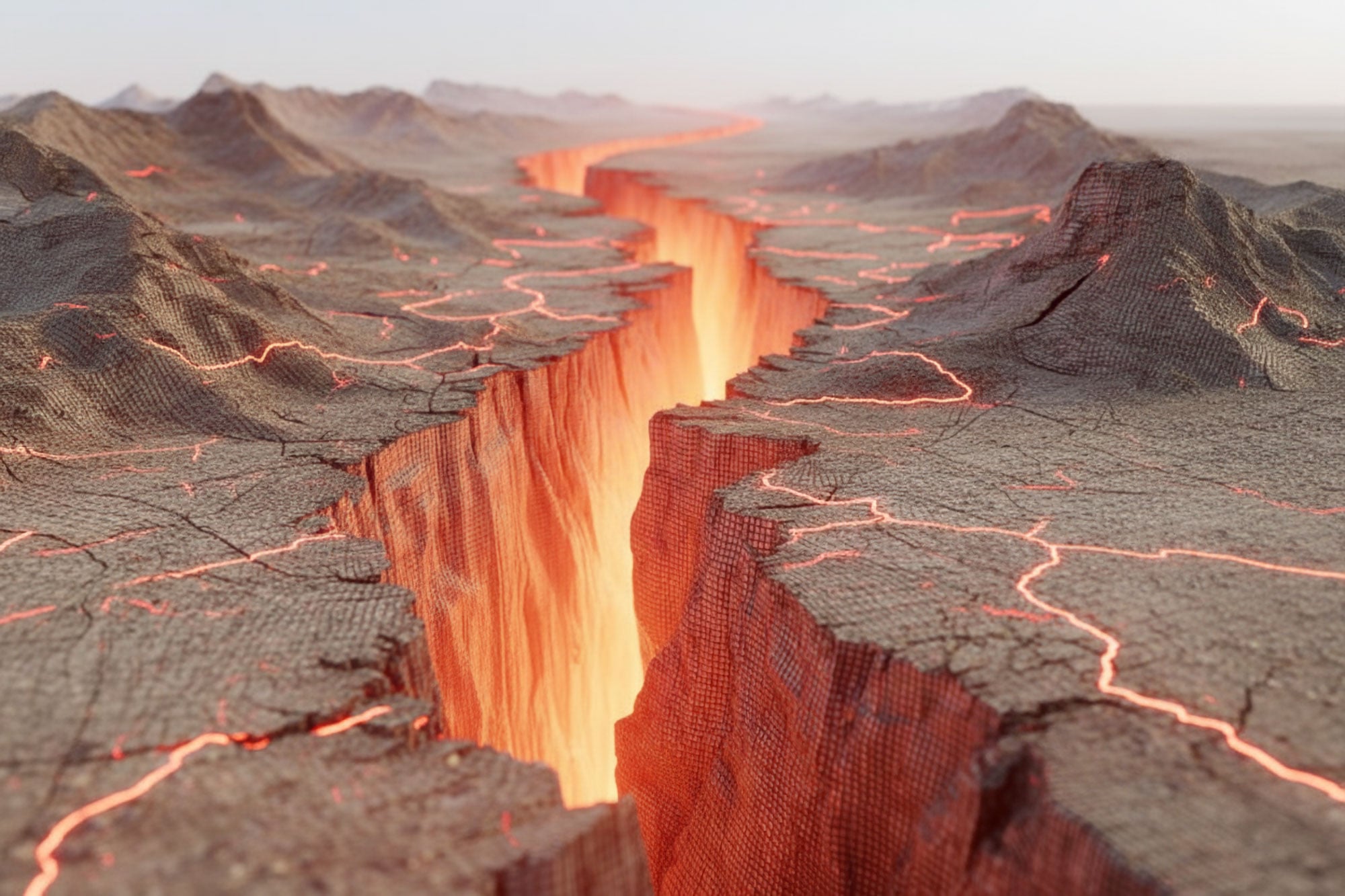
A new 3D subsurface model shows how variations in rock strength beneath the Marmara Sea could trigger future large earthquakes along the North Anatolian Fault. The findings improve understanding of fault mechanics and support better earthquake forecasting for the Istanbul region.
Türkiye lies in one of the most earthquake-prone parts of the world, where the Eurasian, African, Arabian, and Anatolian tectonic plates interact. This complex geological setting has produced numerous devastating earthquakes throughout the country’s history.
One of the most notable was the 1939 Erzincan earthquake, which killed more than 30,000 people. Since that event, researchers have observed a striking trend in which large, destructive earthquakes appear to progress steadily westward along the North Anatolian fault (NAF).
Many scientists now believe the most likely site of the next major earthquake is beneath the Marmara Sea. This section of the fault has not produced a large earthquake for more than 250 years, raising concerns that stress has been building over time. Despite decades of study, however, the detailed structure of the fault below the Marmara Sea has remained unclear, limiting the ability to accurately identify where future earthquakes might begin or how best to reduce their impact.
Building the First 3D Electromagnetic Fault Model
To address this gap, a research team led by Dr. Yasuo Ogawa, Professor Emeritus and Research Fellow at the Multidisciplinary Resilience Research Center, Institute of Integrated Research, Institute of Science Tokyo (Science Tokyo), Japan (also Visiting Researcher at Tohoku University, Japan), together with Dr. Tülay Kaya-Eken, Assistant Professor at Boğaziçi University, Türkiye, carried out a detailed investigation of the region beneath the Marmara Sea.
Their study, published in the journal Geology, introduces the first full three-dimensional (3D) model of this crucial subsurface area. The model provides new insight into the physical processes that control how and where earthquakes form along the fault.
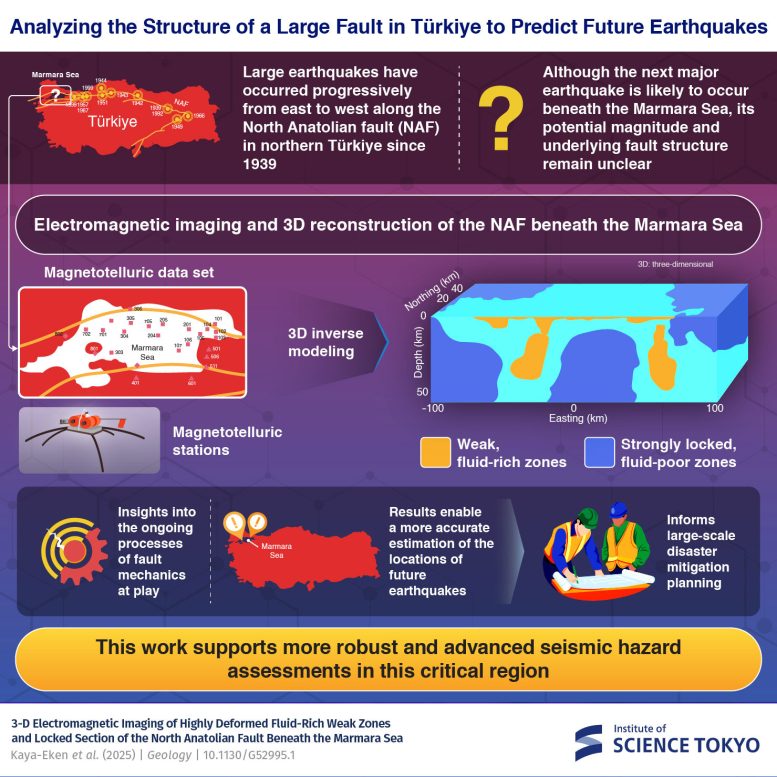
To create this model, the researchers employed a large dataset of magnetotelluric measurements taken by more than 20 previously deployed stations. Simply put, magnetotelluric stations can record subtle changes in Earth’s electric and magnetic fields caused by structures deep underground.
This information enabled the team to reconstruct, via a process known as 3D inversion, a 3D representation of the electrical resistivity of the region down to depths of tens of kilometers beneath the seafloor.
Mapping Weak and Locked Zones That May Trigger Ruptures
Analysis of the completed model revealed a complex pattern of zones with both high and low electrical resistivity. Because resistivity decreases in the presence of fluids such as water, areas with low resistivity tend to be mechanically weaker, while zones with high resistivity are stronger and more rigidly locked.
“We believe the resistive anomalies observed signify regions of stress accumulation, shedding light on the ongoing processes of fault mechanics at play in this critical region,” Ogawa highlights. Based on these findings, the team suggests that future large earthquakes may begin at the boundaries where weaker and stronger sections of the crust meet or along the edges of highly resistive zones.
Taken together, the results move researchers closer to answering a question of great importance for people across Türkiye. As Ogawa explains, “Our results can be used to estimate the location and potential magnitude of future megathrust earthquakes, with significant implications for disaster prevention and mitigation.” Continued studies of this kind may ultimately help reduce loss of life and damage when the next major earthquake strikes along the NAF.
Reference: “3-D electromagnetic imaging of highly deformed fluid-rich weak zones and locked section of the North Anatolian fault beneath the Marmara Sea” by Tülay Kaya-Eken, Yasuo Ogawa, Yoshiya Usui, Takafumi Kasaya, M. Kemal Tunçer, Yoshimori Honkura, Naoto Oshiman, Masaki Matsushima and Weerachai Siripunvaraporn, 8 December 2025, Geology.
DOI: 10.1130/G52995.1
This study was funded by the Japan International Cooperation Agency and the Japan Science and Technology Agency.
Never miss a breakthrough: Join the SciTechDaily newsletter.
Follow us on Google and Google News.
7 Comments
Very humbling.
no you cant lil diddy
Well there is your explanation for all the Bible flood stories!
I can predict earth quake with 150 year old Riemann Zeta Hypothesis Gemini and I hit everyone that we predicted
© 2026 Michael Anthony Rodriguez. All rights reserved.
no you cant lil diddy
I find this information scary. There is so much strife in our lives right now, this only adds to the dangers. I’m sorry I read this. Nightmares on the way
I find this information scary. There is so much strife in our lives right now, this only adds to the dangers. I’m sorry I read this. Nightmares on the way
L