
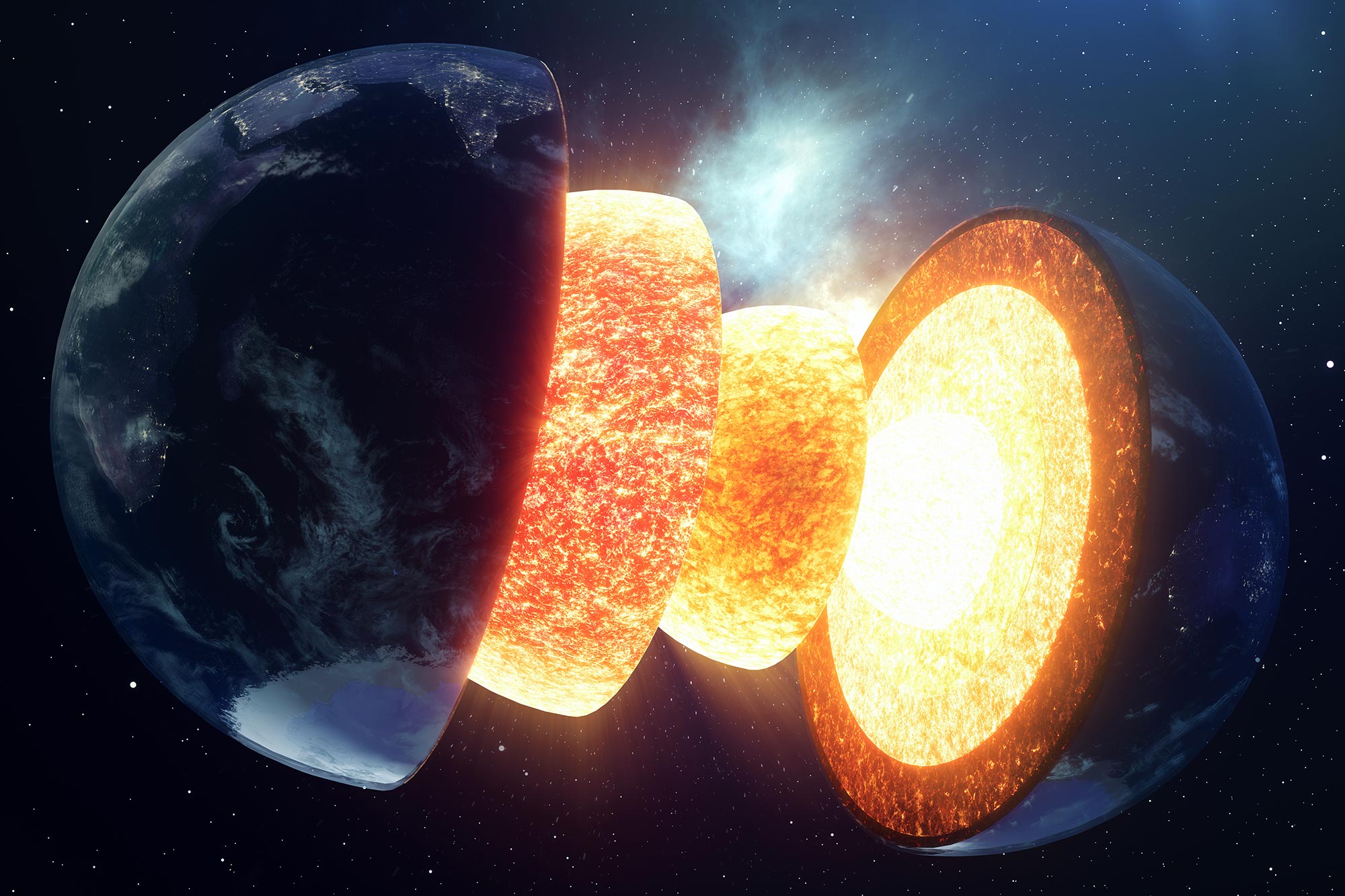
Scientists have discovered hidden treasures in the Earth’s mantle.
Hidden deep within Earth’s mantle are two colossal “islands,” each the size of a continent. New research from Utrecht University reveals that these regions are not only hotter than the surrounding “graveyard” of cold, sunken tectonic plates but also ancient—at least half a billion years old, if not older.
These findings challenge the long-held idea of a well-mixed, rapidly flowing mantle—a theory that is increasingly under scrutiny. “There is less flow in Earth’s mantle than is commonly thought.” The study was recently published in the journal Nature.
Large earthquakes cause the Earth to vibrate like a ringing bell, producing distinct tones, much like a musical instrument. Seismologists analyze these oscillations to study Earth’s deep interior. When these tones encounter anomalies, they sound “out of tune” or become less pronounced, providing critical clues about the hidden structures within.
This way seismologists will be able to make images of the interior of our planet, just like a hospital doctor can ‘see’ through your body with X-rays. At the end of the last century, an analysis of these oscillations showed the existence of two subsurface ‘super-continents’: one under Africa and the other one under the Pacific Ocean, both hidden more than two thousand kilometers below the Earth’s surface.

“Nobody knew what they are, and whether they are only a temporary phenomenon, or if they have been sitting there for millions or perhaps even billions of years,” says Arwen Deuss, seismologist and professor of Structure and composition of Earth’s deep interior at Utrecht University in the Netherlands.
“These two large islands are surrounded by a graveyard of tectonic plates which have been transported there by a process called ‘subduction’, where one tectonic plate dives below another plate and sinks all the way from the Earth’s surface down to a depth of almost three thousand kilometers.”
Slow waves
“We have known for years that these islands are located at the boundary between the Earth’s core and mantle. And we see that seismic waves slow down there.”
Earth scientists therefore call these regions ‘Large Low Seismic Velocity Provinces’ or LLSVPs.
“The waves slow down because the LLSVPs are hot, just like you can’t run as fast in hot weather as you can when it’s colder.”
Deuss and her colleague Sujania Talavera-Soza were keen to find out if they could discover more about these regions.
“We added new information, the so-called ‘damping’ of seismic waves, which is the amount of energy that waves lose when they travel through the Earth. In order to do so, we did not only investigate how much the tones were out of tune, we also studied their sound volume.”
Talavera-Soza adds: “Against our expectations, we found little damping in the LLSVPs, which made the tones sound very loud there. But we did find a lot of damping in the cold slab graveyard, where the tones sounded very soft. Unlike the upper mantle, where we found exactly what we expected: it is hot, and the waves are damped. Just like when the weather is hot outside and you go for a run, you don’t only slow down but you also get more tired than when it is cold outside.”
Grain size
Their colleague Laura Cobden, who specializes in the minerals that we find deep in the Earth, suggested to study the grain size of the LLSVPs. According to their American colleague Ulrich Faul, temperature alone cannot explain the absence of high damping in the LLSVPs.

Deuss: ”Grain size is much more important. Subducting tectonic plates that end up in the slab graveyard consist of small grains because they recrystallize on their journey deep into the Earth. A small grain size means a larger number of grains and therefore also a larger number of boundaries between the grains. Due to the large number of grain boundaries between the grains in the slab graveyard, we find more damping, because waves lose energy at each boundary they cross. The fact that the LLSVPs show very little damping, means that they must consist of much larger grains.”
Ancient
Those mineral grains do not grow overnight, which can only mean one thing: LLSVPs are lots and lots older than the surrounding slab graveyards. Even more so: the LLSVPs, with their much larger building blocks, are very rigid. Therefore, they do not take part in mantle convection (the flow in the Earth’s mantle).
Thus, contrary to what the geography books teach us, the mantle cannot be well-mixed either.
Talavera-Soza clarifies: “After all, the LLSVPs must be able to survive mantle convection one way or another.”
Engine
Knowledge of the Earth’s mantle is essential to understand the evolution of our planet.
“And also to understand other phenomena at the Earth’s surface, such as vulcanism and mountain building,” Deuss adds. “The Earth’s mantle is the engine that drives all these phenomena. Take, for example, mantle plumes, which are large bubbles of hot material that rise from the Earth’s deep interior as in a lava lamp.”
Once they finally reach the surface, they cause vulcanism, like under Hawaii. “And we think that those mantle plumes originate at the edges of the LLSVPs.”
Large earthquakes
In this type of research, seismologists make good use of oscillations caused by really large earthquakes, preferably quakes that take place at great depths, such as the great Bolivia earthquake of 1994.
“It never made it into the newspapers, because it took place at a large depth of 650 km and luckily did not result in any damage or casualties at the Earth’s surface,” Deuss explains.
The whole Earth oscillations, or tones, are mathematically described in such a way that we can easily ‘read’ the damping (i.e. how loud the oscillation is) due to a specific structure and separate it from the wave speed (i.e. how much out of tune it is).
“Which is impressive, because the damping of the signal is only one-tenth of the total amount of information that we can unravel from these oscillations.”
For this type of research, it is not necessary to wait until another earthquake occurs. The data from previous earthquakes is just as useful. “We can go back to 1975, because from that year onwards, seismometers became good enough to give us data of such high quality that they are useful for our research.”
Reference: “Global 3D model of mantle attenuation using seismic normal modes” by Sujania Talavera-Soza, Laura Cobden, Ulrich H. Faul and Arwen Deuss, 22 January 2025, Nature.
DOI: 10.1038/s41586-024-08322-y
Never miss a breakthrough: Join the SciTechDaily newsletter.
Follow us on Google and Google News.
9 Comments
At the depth of several hundreds and thousands of meters below the surface of the earth’s crust, there are many secrets, gold and silver inscriptions from the history of tens and hundreds of thousands of years of previous civilizations are waiting for us to find them in all the museums of the underground cities, but unfortunately Only superpowers know about these secrets of the earth and they don’t want other countries to know about these secrets
I have seen the super duper top secret reports you refer to in Pentagon’s hidden F ring. They tell the truth that is the Book of Mormon!
Gotta be careful about those known unknowns, but the unknown unknowns are the ultimate gotcha.
It seems easier to work to understand the world than to fabricate conspiracy theory to fool yourself you ‘understand’. But then again, it’s popular. 👀
Possibly remnants of early Earth driven deep by the collision of Tiamut, or of Tiamut itself.
There have been at least 8 supercontinents in this planet’s geologic history. A half-billion years isn’t middle-age for a 4.54 billion year old rock.
Maybe 5 as the lower limit, the rest seems speculative. (From oldest: Columbia (Nuna), Rodinia, Pannotia, Gondwana, Pangaea. @Wikipedia)
nice topic
I always hoped that the LLSVPs were fragments from Tellus original crust before the Theia collision, or at least parts of Theia. But the recent models of the Moon forming collision implies that the Moon is formed from collisional stripping of Earth and that Theia has mostly been incorporated in the core.
But still, they can inform on early Earth.