
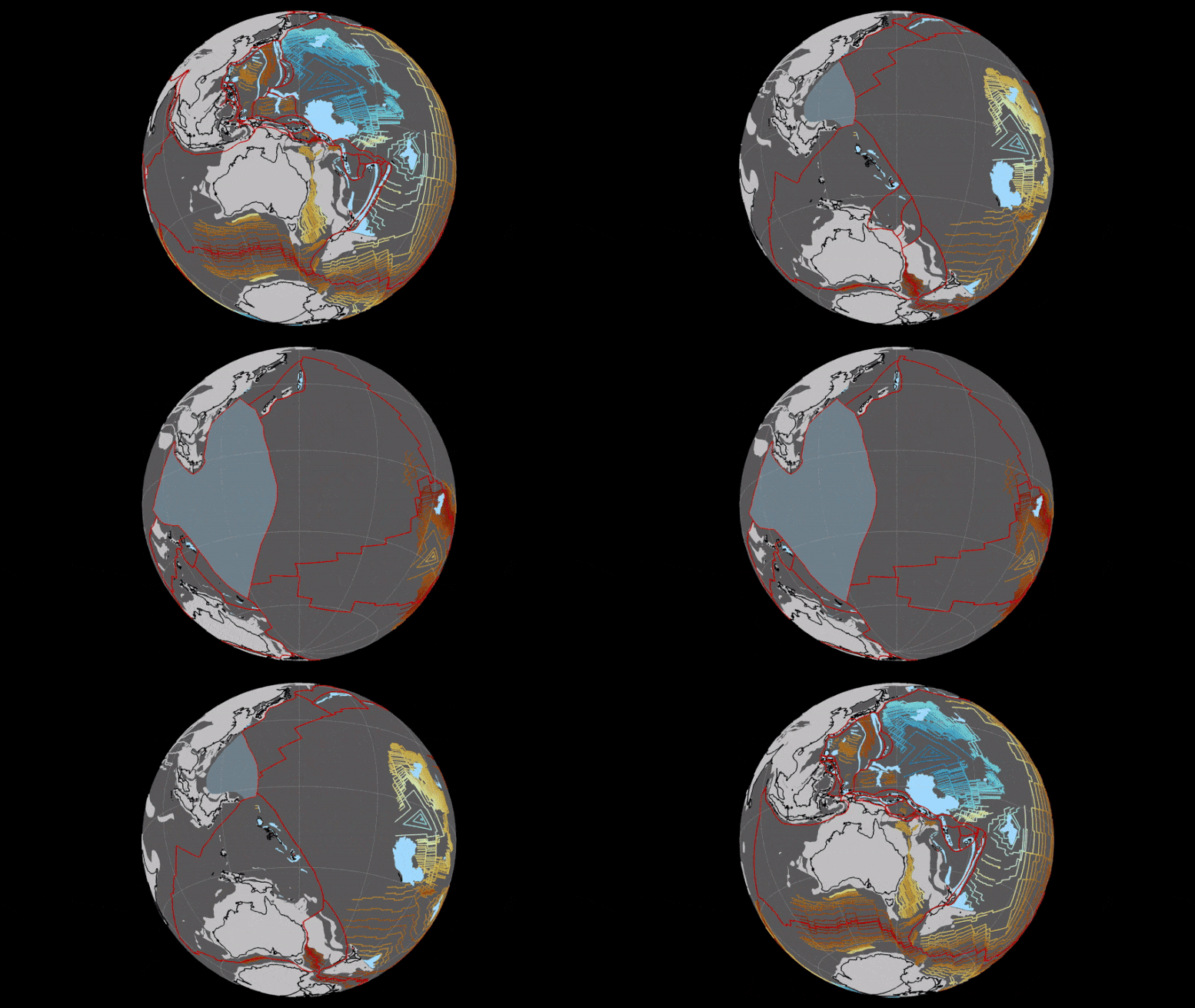
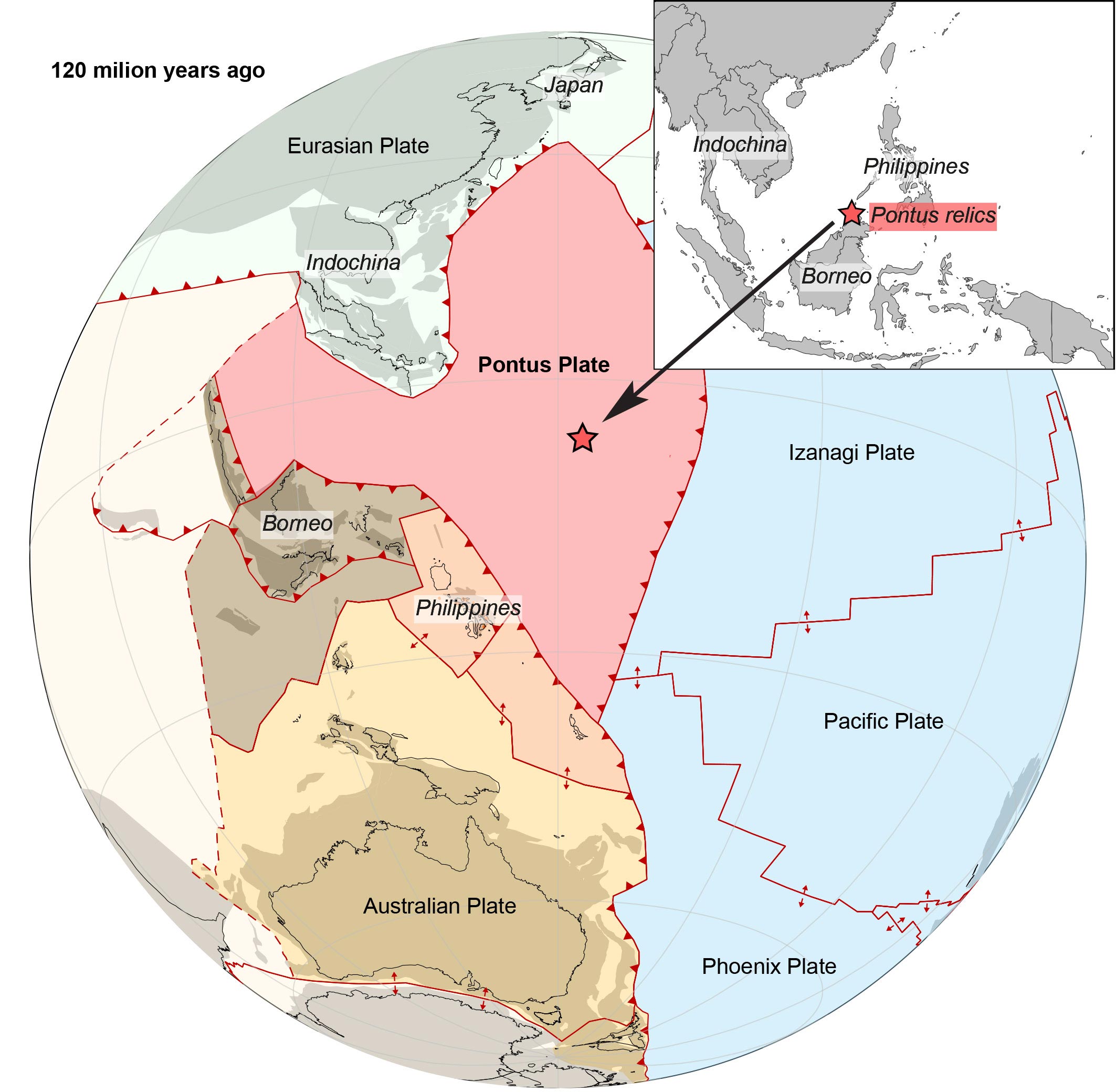
Utrecht University geologist Suzanna van de Lagemaat has reconstructed a massive and previously unknown tectonic plate that was once one-quarter the size of the Pacific Ocean. Her colleagues in Utrecht had predicted its existence over 10 years ago based on fragments of old tectonic plates found deep in the Earth’s mantle. Van de Lagemaat reconstructed lost plates through field research and detailed investigations of the mountain belts of Japan, Borneo, the Philippines, New Guinea, and New Zealand. To her surprise, she found that oceanic remnants on northern Borneo must have belonged to the long-suspected plate, which scientists have named Pontus. She has now reconstructed the entire plate in its full glory.
Understanding the movements of the tectonic plates that make up the Earth’s rigid outer shell is essential to understanding the planet’s geological history. The movements of these plates strongly influenced how the planet’s paleogeography and climate have changed over time, and even where to find rare metals. But large oceanic plates from the geological past have since disappeared into the earth’s mantle by means of subduction. They have left behind only fragments of rock hidden in mountain belts. Van de Lagemaat studied the planet’s most complicated plate tectonic region: the area around the Philippines.
“The Philippines is located at a complex junction of different plate systems. The region almost entirely consists of oceanic crust, but some pieces are raised above sea level, and show rocks of very different ages.”
Reconstruction Process
Using geological data, Van de Lagemaat first reconstructed the movements of the current plates in the region between Japan and New Zealand. That revealed how large the area was of plates that must have disappeared in the current western Pacific region.
“We also conducted fieldwork on northern Borneo, where we found the most important piece of the puzzle. We thought we were dealing with relics of a lost plate that we already knew about. But our magnetic lab research on those rocks indicated that our finds were originally from much farther north, and had to be remnants of a different, previously unknown plate.” But the important realization was yet to come.
“11 years ago, we thought that the remnants of Pontus might lie in northern Japan, but we’d since refuted that theory”, explains Douwe van Hinsbergen, Van de Lagemaat’s PhD supervisor. “It was only after Suzanna had systematically reconstructed half of the ‘Ring of Fire’ mountain belts from Japan, through New Guinea, to New Zealand that the proposed Pontus plate revealed itself, and it included the rocks we studied on Borneo.”
Traces of the Pontus Plate
The relics of Pontus are not only located on northern Borneo, but also on Palawan, an island in the Western Philippines, and in the South China Sea. Van de Lagemaat’s research also showed that a single coherent plate tectonic system stretched from southern Japan to New Zealand, and it must have existed for at least 150 million years. That is also a new discovery in the field.
Seismic Signals and Plate Detection
The previous predictions of the existence of Pontus were made possible because a subducted plate leaves behind traces when it ‘sinks’ into the earth’s mantle: zones in the mantle with anomalous temperatures or compositions.
These anomalies can be observed when seismographs pick up signals from earthquakes. Earthquakes send waves through the Earth’s interior, and when they travel through an anomaly, such as a fragment from an old plate, the anomaly produces a disruption of the signal.
Geologists can trace these disruptions to the existence of phenomena in the mantle, such as fragments of tectonic plates. That allows them to look 300 million years into the past; older plate fragments have ‘dissolved’ at the boundary between the mantle and the core.
The study from 11 years ago showed that a large subduction zone must have run through the western paleo-Pacific Ocean, which separated the known Pacific plates in the east from the hypothetical Pontus plate in the west. This hypothesis has now been independently demonstrated by Van de Lagemaat’s research.
Reference: “Plate tectonic cross-roads: Reconstructing the Panthalassa-Neotethys Junction Region from Philippine Sea Plate and Australasian oceans and orogens” by Suzanna H.A. van de Lagemaat and Douwe J.J. van Hinsbergen, 29 September 2023, Gondwana Research.
DOI: 10.1016/j.gr.2023.09.013
Never miss a breakthrough: Join the SciTechDaily newsletter.
Follow us on Google and Google News.
1 Comment
What was the mechanism of growth of the Pontus Plate that allowed it to grow so large, and yet not survive as a stable craton?