
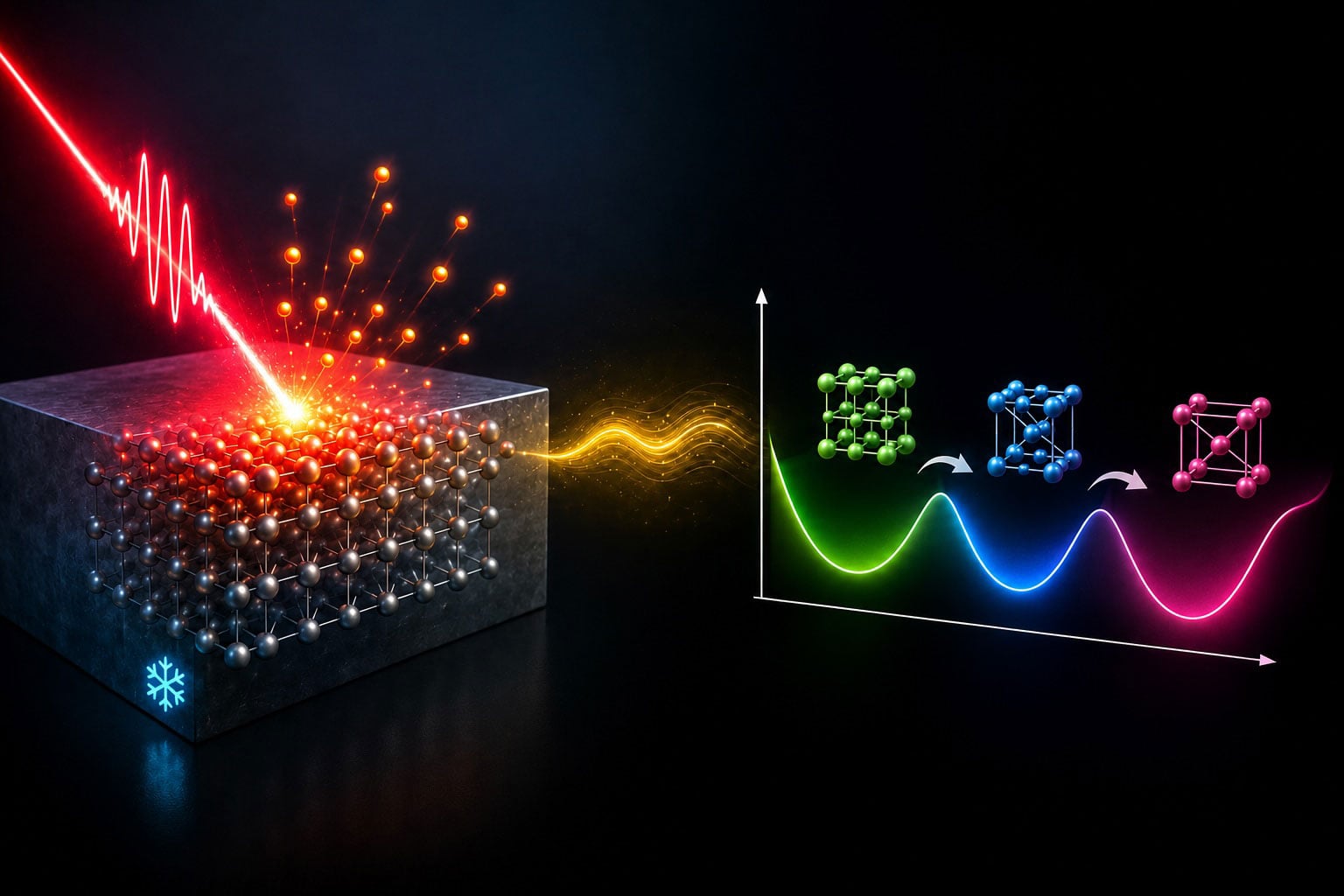
Simulations of 17 elemental metals have revealed unexpected structural changes on ultrafast timescales.
Powerful laser pulses could transform the crystal structure of a metal without first heating its atoms. New research suggests that rapidly exciting electrons can make entirely different atomic arrangements energetically favorable, revealing an alternative way to control the structure and properties of metals.
In a study published in Physical Review Materials, researchers led by Dr. Sam Azadi modeled 17 elemental metals exposed to extreme electronic temperatures. Nearly all were predicted to undergo one or more solid-to-solid phase transitions driven by electronic excitation, potentially within a fraction of a picosecond (one trillionth of a second).
How Hot Electrons Can Reshape Metals
When an intense laser pulse strikes a metal, its electrons absorb energy far more rapidly than its atoms. This creates a temporary state in which the electrons reach extremely high temperatures while the atomic lattice remains relatively cold.
Under these conditions, a phenomenon known as electronic entropy can determine which crystal structure is most stable. Electronic entropy describes how electrons are distributed among available energy states. As electronic temperatures rise, changes in this distribution can alter the relative stability of competing crystal structures without requiring conventional heating of the atomic lattice.
“Our results suggest that electronic entropy should be regarded as a thermodynamic control parameter in its own right. Just as external pressure can transform one crystal structure into another, strong electronic excitation can reshape the free-energy landscape and create entirely new phases of matter,” said Dr. Sam Azadi, Research Associate in Theoretical Physics.
Extreme Temperatures Favor Less Dense Structures
Using advanced computer simulations, the researchers calculated how increasing electronic temperatures affect the free energy of metals, a thermodynamic quantity that helps determine which structures are most stable. They identified transitions involving several common crystal arrangements, including hexagonal close-packed (hcp), face-centered cubic (fcc), and body-centered cubic (bcc) structures.
In general, hotter electrons favored crystal structures with lower densities. The researchers attributed this tendency to electronic thermal pressure, which arises as electrons gain energy.
Some metals, however, displayed more complex behavior. Differences in the distribution of electronic states near the Fermi level, an important energy reference in metals, can influence which atomic arrangements become favorable under intense excitation.
Controlling Matter in Trillionths of a Second
The predicted transitions occur on femtosecond to picosecond timescales, making them potential targets for experiments using ultrafast X-ray or electron diffraction. These techniques could allow scientists to track changes in atomic arrangements immediately after laser excitation and test the theoretical predictions.
If confirmed experimentally, the findings could enable researchers to use carefully controlled laser pulses to temporarily switch metals between crystal structures, accessing material properties that are difficult to achieve under ordinary conditions. Such capabilities could have applications in ultrafast electronics, high-energy physics, and advanced manufacturing.
Reference: “Electronic-entropy-driven solid-solid phase transitions in elemental metals” by S. Azadi, S. M. Vinko, A. Principi, T. D. Kühne and M. S. Bahramy, 9 April 2026, Physical Review Materials.
DOI: 10.1103/nzv9-dskm
Never miss a breakthrough: Join the SciTechDaily newsletter.
Follow us on Google and Google News.