
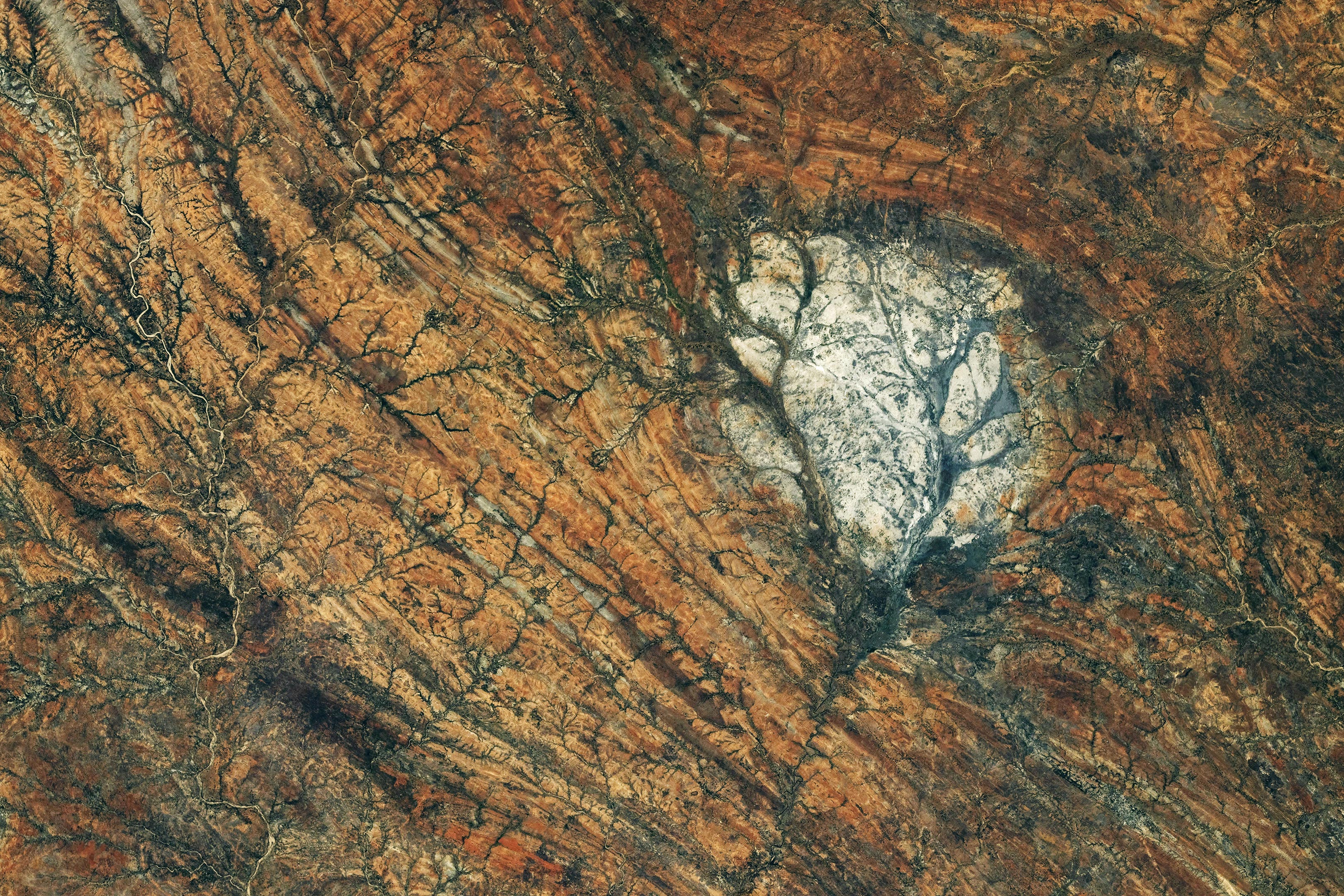
A NASA astronaut captured a stunning 600-million-year-old rock formation in Madagascar that shares a surprising geological connection with the Moon.
A striking patch of bright rock in southern Madagascar has an unexpected connection to the Moon. Surrounded by rocks that were twisted and stretched by ancient geological forces, the formation contains anorthosite, the same type of rock that makes up much of the Moon’s bright highlands.
Viewed from space, the unusual formation stands out against Madagascar’s dry, rugged landscape. Anorthosite is an igneous rock found in abundance on the Moon, where it forms the highly reflective regions known as the lunar highlands. These pale regions are so prominent that they can be distinguished from Earth without a telescope.
Although closely associated with the Moon, anorthosite is also found in several places on Earth, including eastern Canada, Scandinavia, southern India, and Madagascar. In southern Madagascar, it forms a distinctive, roughly circular feature that is particularly noticeable in photographs taken from orbit.
NASA Astronaut Captures Ancient Moon-Like Rock Formation
On August 28, 2026, an astronaut aboard the International Space Station photographed the Saririaky anorthosite massif, a large body of rock exposed at Earth’s surface.
Anorthosite forms when magma cools and solidifies beneath the ground, allowing relatively large mineral crystals to develop. Rocks produced through this process are known as intrusive igneous rocks.
Scientists believe the Saririaky massif originated during the late Precambrian, making it at least 600 million years old. Today, the exposed formation extends across approximately 100 square kilometers (40 square miles).
The surrounding landscape provides evidence of the enormous geological forces that have acted on the region since the rock formed. Researchers have identified the massif within a ductile shear zone, an area where rocks were gradually stretched and distorted under intense heat and pressure.
These conditions caused the surrounding rocks to undergo metamorphism, changing their structure and producing long, roughly parallel patterns that extend from north to south.
Ancient Continental Collisions Reshaped Madagascar
Geologists suspect that this dramatic transformation occurred during the assembly of Gondwana, the enormous supercontinent that once united landmasses now separated by oceans.
As portions of present-day Africa, India, Madagascar, Australia, and Antarctica collided, tremendous pressure deformed the rocks caught between them. The resulting geological structures preserve evidence of those ancient continental movements.
Some researchers have suggested that a second anorthosite massif, located approximately 60 kilometers (40 miles) north of Saririaky within the same shear zone, may once have been connected to it.
According to this hypothesis, the immense forces associated with continental collision stretched and separated the original rock body. This process can produce a structure known as boudinage, in which a relatively resistant layer of rock is pulled apart into distinct segments as the surrounding material deforms.
How Earth’s Moon-Like Rocks Reveal Lunar History
Beyond their importance to understanding Earth’s geological past, anorthosite formations also provide scientists with valuable opportunities to investigate the Moon’s earliest history.
The Moon’s anorthosite rocks are more than 4 billion years old. Scientists believe they formed when the young Moon was covered by a vast ocean of molten rock. As this magma cooled, anorthosite crystallized and became a major component of the Moon’s outer crust.
Samples collected by Apollo astronauts have given researchers direct evidence of these ancient lunar materials. However, because the available Moon rocks are limited, scientists also examine similar formations on Earth to better understand their composition and formation.
One especially useful comparison comes from the Beartooth Mountains in Montana, where anorthosite closely resembles its lunar counterpart in chemical composition.
By examining these terrestrial formations, researchers can gain additional insights into the processes that shaped the Moon billions of years ago. Madagascar’s ancient anorthosite also illustrates how Earth’s own geological history has transformed rocks that share important characteristics with those found on our closest celestial neighbor.
Astronaut photograph ISS075-E-85249 was taken on August 28, 2026, using a Nikon Z9 digital camera equipped with a 400-millimeter lens. The image was captured by an astronaut from the Expedition 75 crew and supplied by the ISS Crew Earth Observations Facility and the Earth Science and Remote Sensing Unit at NASA Johnson Space Center. It has been cropped, adjusted to enhance contrast, and processed to remove lens artifacts.
Never miss a breakthrough: Join the SciTechDaily newsletter.
Follow us on Google and Google News.