
Close Menu
    Facebook X (Twitter) Instagram
    SciTechDaily
    • Biology
    • Chemistry
    • Earth
    • Health
    • Physics
    • Science
    • Space
    • Technology
    Facebook X (Twitter) Pinterest YouTube RSS
    SciTechDaily
    Home»Biology»Microbe Stays Forever Young by Rejuvenating Every Time It Reproduces
    Biology

    Microbe Stays Forever Young by Rejuvenating Every Time It Reproduces

    By Max Planck InstituteSeptember 16, 2013No Comments2 Mins Read
    Facebook Twitter Pinterest Telegram LinkedIn WhatsApp Email Reddit
    Share
    Facebook Twitter LinkedIn Pinterest Telegram Email Reddit
    Microbe Stays Forever Young by Rejuvenating Every Time it Reproduces
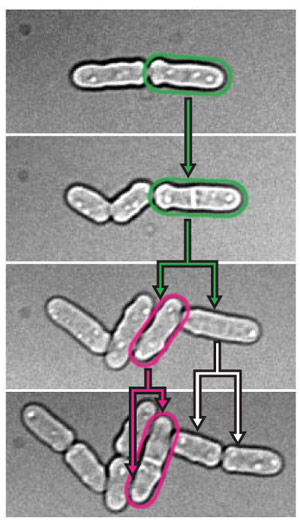
    Three generations of yeast cells from the mother cell (green) via two daughters (red) to four granddaughter cells. Credit: MPI f. Molecular Cell Biology and Genetics

    Scientists at the Max Planck Institute have discovered a microbe that is rejuvenated every time it reproduces.

    While aging remains an inevitable fact of life, Max Planck researchers have discovered a microbe that stays forever young by rejuvenating every time it reproduces. The findings provide fundamental insights into the mechanisms of aging.

    In general, even symmetrically dividing microbes do not split into two exactly identical halves. Detailed investigations revealed that there are mechanisms in place that ensure that one half receives older, often defective, cell material, whereas the other half is equipped with new fully functional material. So microbes produce offspring that is younger than the parent – like is the case with humans.

    The research team showed that, unlike other species, the yeast Schizosaccheromyces pombe is immune to aging when reproducing under favorable growth conditions. When the yeast is treated well, it reproduces by splitting into two halves that both inherit their fair share of old cell material. As both cells get only half of the damaged material, they are both younger than before. “The yeast is rejuvenated a bit every time it reproduces,” explains Iva Tolic-Norrelykke, research group leader at the Max Planck Institute of Molecular Cell Biology and Genetics in Dresden and lead investigator on the project.

    Once subjected to negative influences like chemicals or heat, the yeast cells started splitting into a younger and an older half just like other cells. While the older cells eventually died, their offspring survived long enough to reproduce even in the harsh environments. The findings highlight S. pombe as an interesting organism that could potentially serve as a model of certain non-aging types of cells in humans, such as germ cells, stem cells, and cancer cells.

    Reference: “Fission Yeast Does Not Age under Favorable Conditions, but Does So after Stress” by Miguel Coelho, Aygül Dereli, Anett Haese, Sebastian Kühn, Liliana Malinovska, Morgan E. DeSantis, James Shorter, Simon Alberti, Thilo Gross and Iva M. Tolić-Nørrelykke, 12 September 2013, Current Biology.
    DOI: 10.1016/j.cub.2013.07.084


    Never miss a breakthrough: Join the SciTechDaily newsletter.
    Follow us on Google and Google News.

    Cell Biology Max Planck Institute Microbes Microbiology
    Share. Facebook Twitter Pinterest LinkedIn Email Reddit

    Related Articles

    Breaking Biochemical Rules: Mysterious Ocean Microbes Offer New Hope Against Global Warming

    “Unprecedented” New Form of Symbiosis Discovered

    Microbiota in Pregnant Women Looks Like Those of People with Diabetes

    Plants Choose and Make Use of the Bacteria They Allow into Their Roots

    Ajuba Regulates Stem Cell Activity in the Heart

    Hybridization Leads to New Pathogen Species

    Oxygen Depletion and Acidification Accelerate Coral Death

    Marine Worm Thrives on Steady Diet of Deadly Poisons

    DNA Jumps Directly From the Cell’s Chloroplasts Into Its Nucleus

    Leave A Reply Cancel Reply

    • Facebook
    • Twitter
    • Pinterest
    • YouTube

    Don't Miss a Discovery

    Subscribe for the Latest in Science & Tech!

    Trending News

    What if Time Isn’t Fundamental? Physicists Just Tested the Idea in the Lab

    Scientists Say We’ve Been Wrong About the Aging Brain

    68 Quadrillion Miles: Scientists Map Earth’s Vast Hidden Fungal Network for the First Time

    Hidden Damage From Youth May Explode Into Disease Later in Life

    Climate Models May Be Wrong About How Trees Store Carbon

    Scientists Discover Brain-Protecting Peptide That Could Change Parkinson’s Treatment

    This Copper Drug Clears Alzheimer’s Brain Toxins and Boosts Memory

    Adults Over 65 Lost Massive Amounts of Weight With Ozempic

    Follow SciTechDaily
    • Facebook
    • Twitter
    • YouTube
    • Pinterest
    • Newsletter
    • RSS
    SciTech News
    • Biology News
    • Chemistry News
    • Earth News
    • Health News
    • Physics News
    • Science News
    • Space News
    • Technology News
    Recent Posts
    • Scientists Discover a Gene That Boosts Youth – but It Comes With a Cost
    • A Decade-Long Physics Mystery May Finally Be Solved
    • AI Cracks the Secrets of How the Universe’s Heaviest Elements Are Forged
    • After 50 Years, Astronomers Finally Found What the Milky Way’s Black Hole Was Hiding
    • Scientists Discover Immune Cells That Can Fight Both Measles and Nipah
    Copyright © 1998 - 2026 SciTechDaily. All Rights Reserved.
    • Science News
    • About
    • Contact
    • Editorial Board
    • Privacy Policy
    • Terms of Use

    Type above and press Enter to search. Press Esc to cancel.