
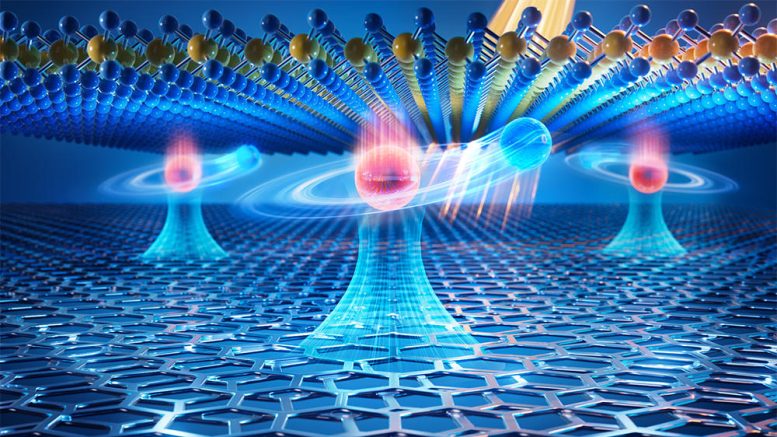
Scientists have observed Rydberg moiré excitons in monolayer WSe₂ near twisted bilayer graphene, marking a breakthrough in exciton trapping and manipulation. This advancement paves the way for future quantum technologies.
The Rydberg state is prevalent across various physical mediums such as atoms, molecules, and solid materials. Rydberg excitons, which are highly energized, Coulomb-bound electron-hole pair states, were initially identified in the 1950s within the semiconductor material, Cu2O.
In a study published in Science, Dr. Xu Yang and his colleagues from the Institute of Physics (IOP) of the Chinese Academy of Sciences (CAS), in collaboration with researchers led by Dr. Yuan Shengjun of Wuhan University, have reported observing Rydberg moiré excitons, which are moiré-trapped Rydberg excitons in the monolayer semiconductor WSe2 adjacent to small-angle twisted bilayer graphene (TBG).
The solid-state nature of Rydberg excitons, combined with their large dipole moments, strong mutual interactions, and greatly enhanced interactions with the surroundings, holds promise for a wide range of applications in sensing, quantum optics, and quantum simulation. However, researchers have not fully exploited the potential of Rydberg excitons. One of the main obstacles lies in the difficulty of efficiently trapping and manipulating Rydberg excitons. The rise of two-dimensional (2D) moiré superlattices with highly tunable periodic potentials provides a possible way forward.
Trapping and Manipulating Rydberg Excitons
In recent years, Dr. Xu Yang and his collaborators have worked on exploring the application of Rydberg excitons in 2D semiconducting transition metal dichalcogenides (such as WSe2). They have developed a new Rydberg sensing technique that exploits the sensitivity of Rydberg excitons to the dielectric environment to detect the exotic phases in a nearby 2D electronic system.
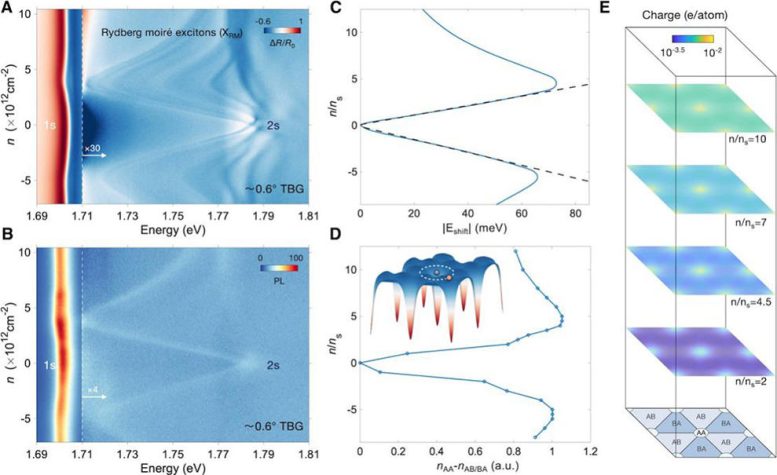
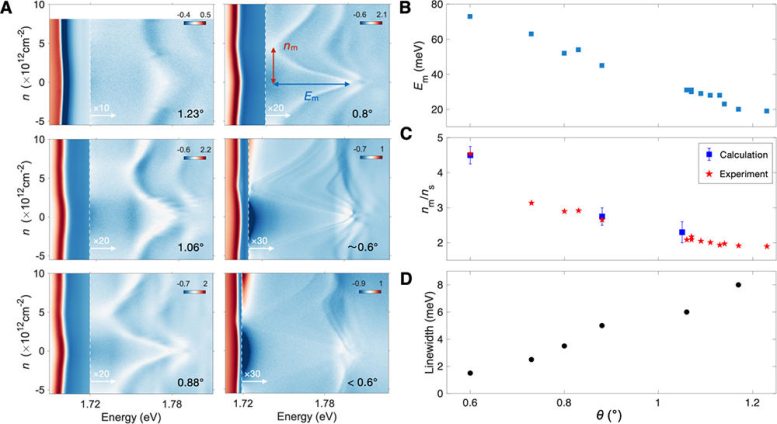
In this study, using low-temperature optical spectroscopy measurements, the researchers first found the Rydberg moiré excitons manifesting as multiple energy splittings, a pronounced red shift, and a narrowed linewidth in the reflectance spectra.
Using numerical calculations performed by the group from Wuhan University, the researchers attributed these observations to the spatially varying charge distribution in TBG, which creates a periodic potential landscape (so-called moiré potential) for interacting with Rydberg excitons.
The strong confinement of Rydberg excitons is achieved by the largely unequal interlayer interactions of the constituent electron and hole of a Rydberg exciton due to the spatially accumulated charges centered in the AA-stacked regions of TBG. The Rydberg moiré excitons thus realize electron–hole separation and exhibit the character of long-lived charge-transfer excitons.
A Novel Approach to Rydberg Exciton Control
The researchers demonstrated a novel method of manipulating Rydberg excitons, which is difficult to achieve in bulk semiconductors. The long-wavelength (tens of nm) moiré superlattice in this study serves as an analog to the optical lattices created by a standing-wave laser beam or arrays of optical tweezers that are used for Rydberg atom trapping.
In addition, tunable moiré wavelengths, in-situ electrostatic gating, and a longer lifetime all ensure great controllability of the system, with a strong light–matter interaction for convenient optical excitation and readout.
This study may provide new opportunities for realizing the next step in Rydberg–Rydberg interactions and coherent control of Rydberg states, with potential applications in quantum information processing and quantum computation.
Reference: “Observation of Rydberg moiré excitons” by Qianying Hu, Zhen Zhan, Huiying Cui, Yalei Zhang, Feng Jin, Xuan Zhao, Mingjie Zhang, Zhichuan Wang, Qingming Zhang, Kenji Watanabe, Takashi Taniguchi, Xuewei Cao, Wu-Ming Liu, Fengcheng Wu, Shengjun Yuan and Yang Xu, 29 June 2023, Science.
DOI: 10.1126/science.adh1506
Never miss a breakthrough: Join the SciTechDaily newsletter.
Follow us on Google and Google News.
1 Comment
Gravitation is the source of all things. According to the topological vortex gravitational field theory, the correct understanding of the interaction between 2D spatiotemporal matter is the key to exploring and studying Rydberg moiré excitons.