
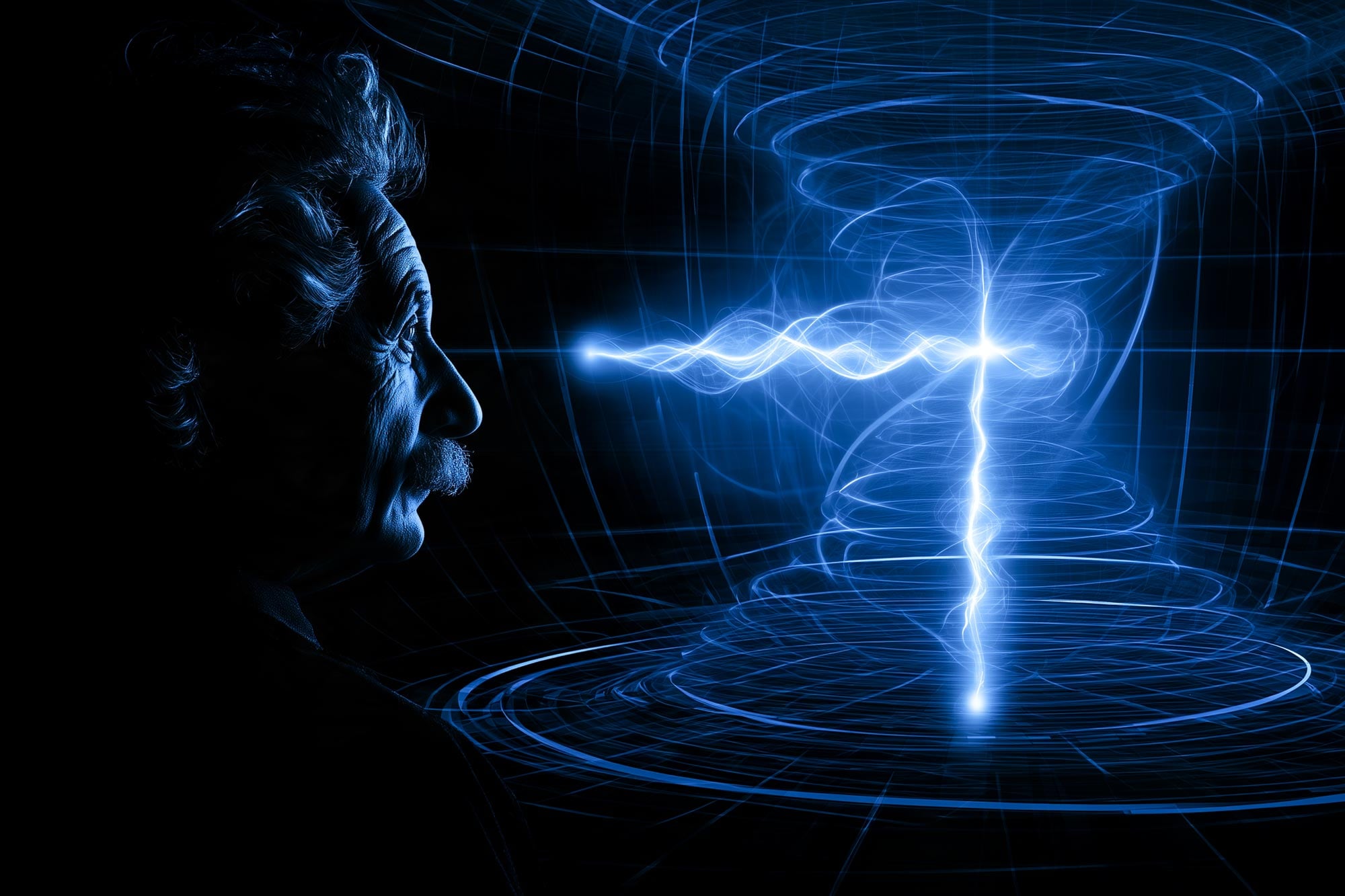
An experiment comparing falling and stationary rubidium atomic waves found a quantum phase difference consistent with Einstein’s equivalence principle.
A rubidium atom can behave as a wave that researchers can split between two paths. This allows the same atom to effectively follow both paths at once, without being broken into pieces. Physicists have now used that property to hold one part of the wave still while letting the other fall under gravity, then bring them back together to check a prediction rooted in Einstein’s theory of gravity.
When the two parts of the wave reunited, the researchers measured a difference in their quantum phase, which describes where a wave is in its cycle. That difference matched the prediction obtained by applying Einstein’s equivalence principle to a quantum object. The principle says that, for an observer falling freely, gravity’s effects should locally disappear.
The researchers describe the result as the first direct measurement of the predicted quantum phase of a freely falling object. Earlier experiments have used quantum particles to measure gravity, but this experiment specifically compared a freely falling atomic wave with one held stationary.
The study was led by Ben-Gurion University of the Negev, the University of Ulm, and the University of Oxford, with Nobel Prize-winning physicist Professor Sir Roger Penrose among its coauthors. It was published September 2 in Science Advances.
One atomic wave, two different paths
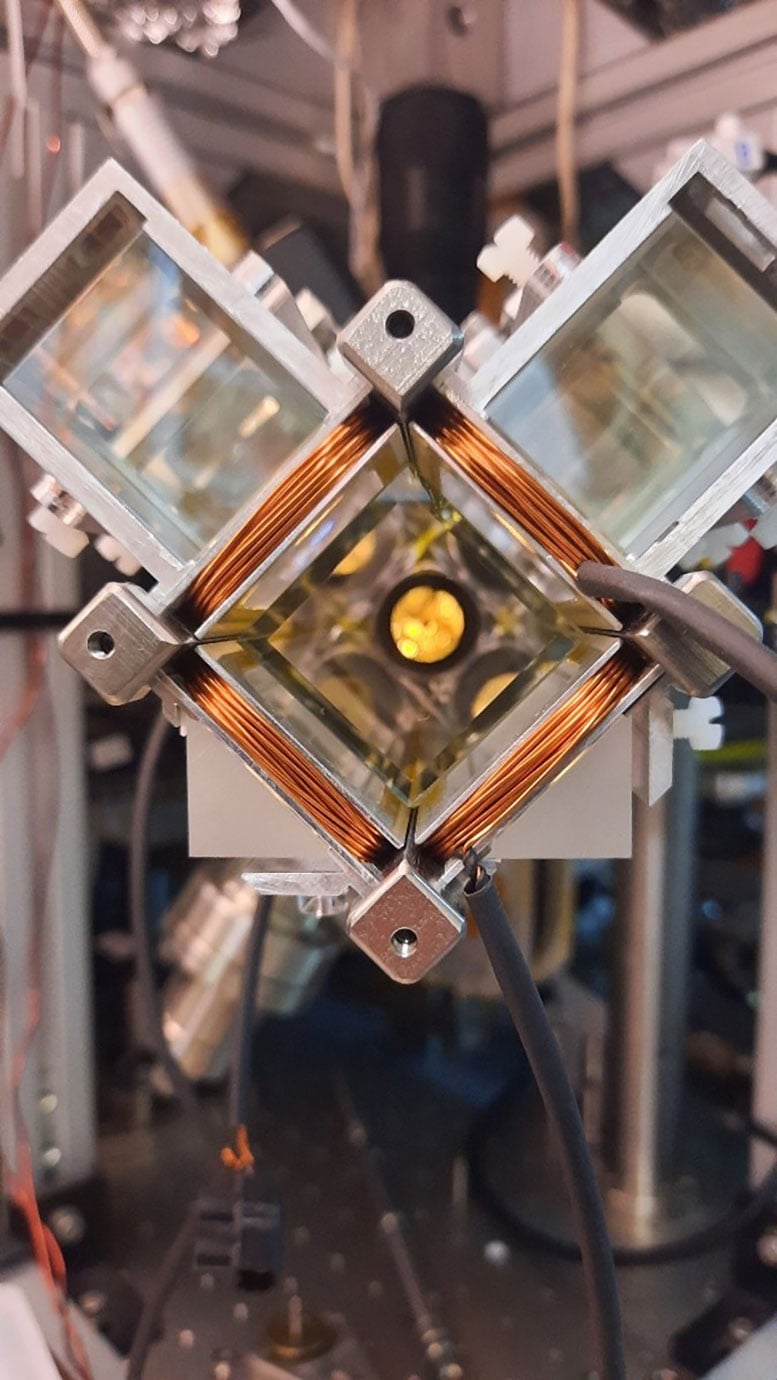
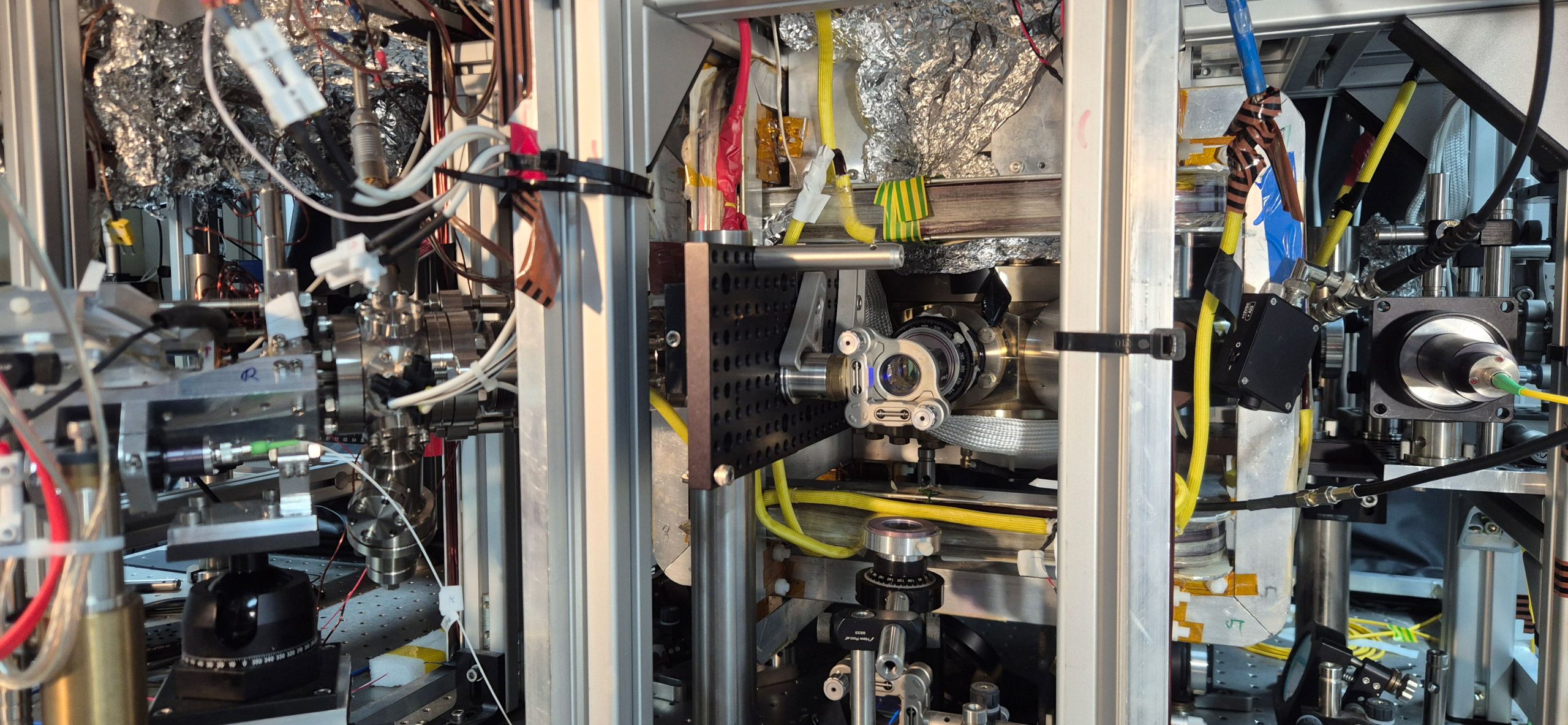
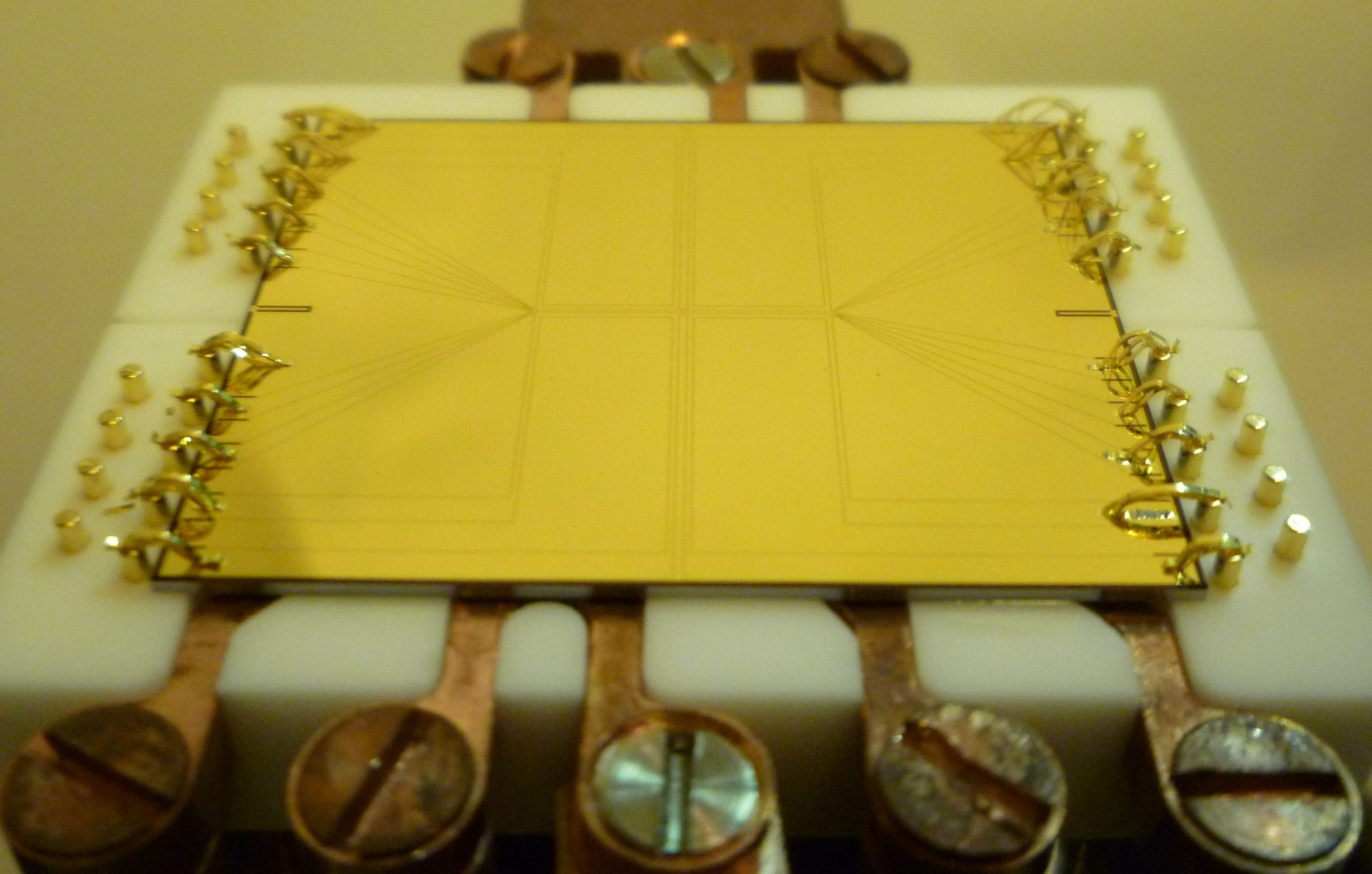
The comparison required an apparatus called the Quantum Galileo Interferometer, built to separate and reunite atomic waves. At Ben-Gurion University, the experimental team, including PhD student Or Dobkowski, worked with clouds of rubidium atoms cooled to just above absolute zero near the surface of a specially designed atom chip.
Microwave pulses placed the atoms in a quantum superposition, a state that effectively allowed each atom to take two paths at once. Tiny electrical wires on the chip generated precisely controlled magnetic fields, allowing the researchers to manipulate the two parts of the atomic wave differently.
For the part they wanted to keep still, the team applied an upward magnetic force that exactly balanced gravity’s downward pull. This held that part stationary relative to the laboratory and Earth.
The other part received a carefully controlled upward push from a magnetic pulse. The researchers then switched it into a state almost unaffected by the magnetic field, leaving it to move freely under gravity. Like a ball tossed into the air, it followed a path that rose and then fell.
At the end of the fall, another magnetic pulse brought the two parts back together. Their waves interfered, combining in a pattern that revealed the phase difference accumulated along the two paths. This gave the team a way to compare what happened to the freely falling wave with what happened to the stationary one.
Falling atomic waves match Einstein’s prediction
Einstein’s equivalence principle offers a way to understand that comparison. Someone inside a freely falling elevator would experience weightlessness because they and the elevator would fall together. Although the principle has passed extremely precise tests with ordinary matter, testing it with objects that behave as waves and can follow multiple paths presented a different experimental challenge.
The agreement between the measured phase and the prediction shows that the principle remains consistent with quantum mechanics under the conditions tested.
Study coauthor Professor Vlatko Vedral, of Oxford’s Department of Physics, said, “We have no consistent theory telling us why quantum physics should fail. This experiment pushes quantum mechanics into one of its most intriguing frontiers, gravity, and shows that, once again, its predictions hold.”
For more than a century, quantum mechanics and Einstein’s theory of gravity have provided highly successful descriptions of nature at very different scales. Quantum mechanics describes atoms and other tiny objects, while Einstein’s theory explains falling bodies and how gravity shapes the universe. Physicists still lack a complete understanding of how the two fit together.
Lead author Professor Ron Folman, of Ben-Gurion University of the Negev, said, “This is a unique paper, in the sense that it combines a hard experiment with a far-reaching theoretical interpretation, about one of the most fundamental questions in physics: How can gravity (described by Einstein’s theory of relativity) and quantum theory, be unified into one understanding of the universe? These two pillars of modern physics have so far eluded all attempts at a unified theoretical framework, but this complex experiment gives more hints as to how such a unification may be achieved.”
Penrose’s proposal awaits a heavier test
The experiment does not provide that unified theory or establish that gravity itself is quantum. It also leaves open a proposal by Penrose that quantum mechanics could break down when sufficiently massive objects remain in quantum superpositions for long enough.
The rubidium experiment reached neither the masses nor the timescales needed to test Penrose’s proposal. The team hopes to extend the technique to much heavier objects, including nanodiamonds, to investigate that possibility. An experiment pursuing that goal is already underway in the same group at Ben-Gurion University.
Reference: “Observation of the quantum phase of free fall and the consistency with the equivalence principle” by Or Dobkowski, Barak Trok, Peter Skakunenko, Yonathan Japha, David Groswasser, Maxim Efremov, Chiara Marletto, Ivette Fuentes Guridi, Roger Penrose, Vlatko Vedral, Wolfgang P. Schleich and Ron Folman, 2 September 2026, Science Advances.
DOI: 10.1126/sciadv.aec8045
This work was funded, in part, by the Israel Science Foundation (grants no. 856/18, 1314/19, 3515/20, and 3470/21) and the German-Israeli DIP project (Hybrid devices: FO 703/2-1) supported by the DFG. This work has been supported by the “Table-top experiments for fundamental physics” program, sponsored by the Gordon and Betty Moore Foundation, Simons Foundation, Alfred P. Sloan Foundation, and John Templeton Foundation. I.F.G. thanks an anonymous US philanthropist, J. Moussouris, J. Westergren, and the Emmy Network for support and research funding.
Never miss a breakthrough: Join the SciTechDaily newsletter.
Follow us on Google and Google News.