
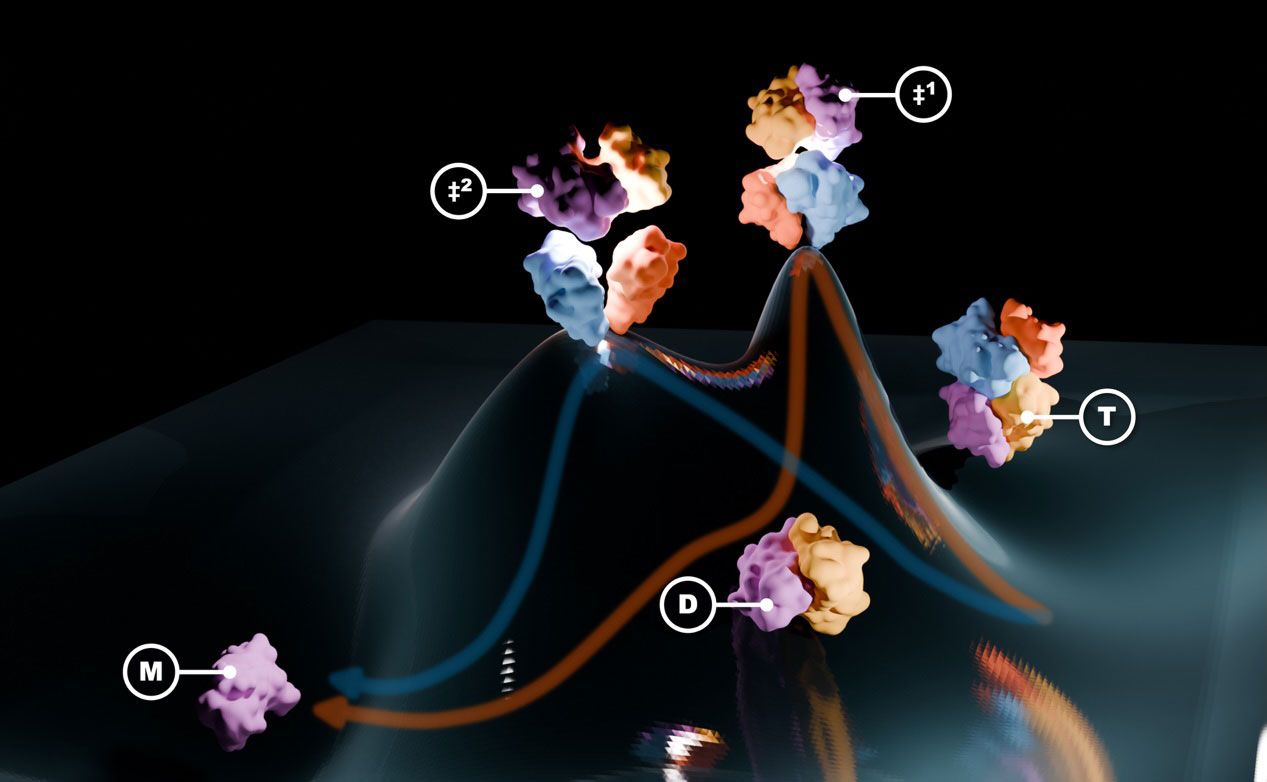
Researchers have found that acidic conditions may trigger an overlooked molecular process, offering new clues about how certain disease-causing protein mutations behave.
Scientists have discovered that a protein responsible for a potentially fatal disease can unravel through a previously unknown molecular pathway. The finding, reported by researchers at Scripps Research, could help explain why certain rare inherited forms of transthyretin amyloid disease (ATTR) behave differently and raises questions about how well existing treatments address them.
ATTR develops when the protein transthyretin (TTR) loses its normal structure, misfolds, and accumulates in organs, particularly the heart and nervous system. TTR ordinarily transports vitamin A and the thyroid hormone thyroxine through the blood, cerebrospinal fluid, and eye. Its structure consists of four protein units that can separate into pairs and eventually individual units capable of forming harmful aggregates.
Scientists Discover a Second Pathway for Protein Unfolding
Until now, research had largely focused on this stepwise breakdown of TTR. The new study, published September 8, 2026, in the Proceedings of the National Academy of Sciences, demonstrates that some forms of the protein can unfold through a more direct pathway that bypasses the intermediate pairs.
To identify this alternative route, researchers examined more than 100 TTR variants, measuring their unfolding rates under different acidity levels and concentrations of urea, a chemical used to destabilize proteins. They combined these experiments with cryogenic electron microscopy and previously published X-ray crystal structures. The alternative pathway was particularly accessible in certain inherited variants associated with amyloid deposits in the brain.
Acidic Conditions and Genetic Mutations Influence the Process
The newly identified pathway becomes more favorable in acidic environments, including those inside lysosomes. These cellular compartments break down and recycle proteins, suggesting that the alternative unfolding process may serve a normal biological function.
“This route probably evolved so TTR can be degraded, which is important, but can also have side effects,” says co-author Martin Gruebele, a professor emeritus of chemistry at the University of Illinois Urbana-Champaign.
For the most common forms of ATTR, this pathway appears too slow under normal physiological conditions to compete with the established route. Certain disease-associated mutations, however, make it more accessible even at the acidity levels normally found in blood. Researchers have not yet established whether this alternative unfolding process directly contributes to harmful protein aggregation in patients.
What the Discovery Could Mean for ATTR Treatments
One of the most widely used ATTR treatments, tafamidis, works by stabilizing TTR’s four-unit structure, slowing its disassembly and subsequent aggregation. The discovery of another unfolding pathway raises the possibility that some rare hereditary variants may require different therapeutic approaches, although the implications for treatment effectiveness remain uncertain.
“We need to understand whether this alternative pathway can lead to TTR aggregation in the cerebrospinal fluid, which could potentially translate into worse outcomes for patients carrying these rare mutations who take the current medications,” says senior author Jeffery Kelly, the H. Lutcher Brown Endowed Chair at Scripps Research who co-developed tafamidis.
“More research is needed, but this opens up a new direction in the field of drugs targeting specific amyloidosis pathways,” says Gruebele. “At least we have one of several possible smoking guns to look at.”
Beyond ATTR, the experiments provide evidence that a protein composed of multiple subunits can follow distinct unfolding pathways in solution. Although scientists have long proposed that proteins can fold and unfold through multiple routes, experimentally demonstrating this behavior has been challenging.
“Transthyretin is the first oligomeric protein for which pathway multiplicity has been shown in solution, and without mechanical pulling,” says Marcus Jäger, the study’s first author.
Reference: “Transthyretin can denature by an alternative pathway” by Marcus Jäger, Jan-Hannes Schäfer, Gabriel C. Lander, Evan T. Powers, Martin Gruebele and Jeffery W. Kelly, 8 September 2026, Proceedings of the National Academy of Sciences.
DOI: 10.1073/pnas.2536532123
This work was supported by the National Institutes of Health (grant R01 DK046335) and a postdoctoral fellowship from the German Research Foundation (Project No.: 556478029).
Never miss a breakthrough: Join the SciTechDaily newsletter.
Follow us on Google and Google News.