
Close Menu
    Facebook X (Twitter) Instagram
    SciTechDaily
    • Biology
    • Chemistry
    • Earth
    • Health
    • Physics
    • Science
    • Space
    • Technology
    Facebook X (Twitter) Pinterest YouTube RSS
    SciTechDaily
    Home»Biology»Scientists Discover Gene Critical for a Healthy Brain
    Biology

    Scientists Discover Gene Critical for a Healthy Brain

    By Chris Melvin, University of BathApril 16, 2018No Comments3 Mins Read
    Facebook Twitter Pinterest Telegram LinkedIn WhatsApp Email Reddit
    Share
    Facebook Twitter LinkedIn Pinterest Telegram Email Reddit
    Scientists Discover Gene Critical for Healthy Brain
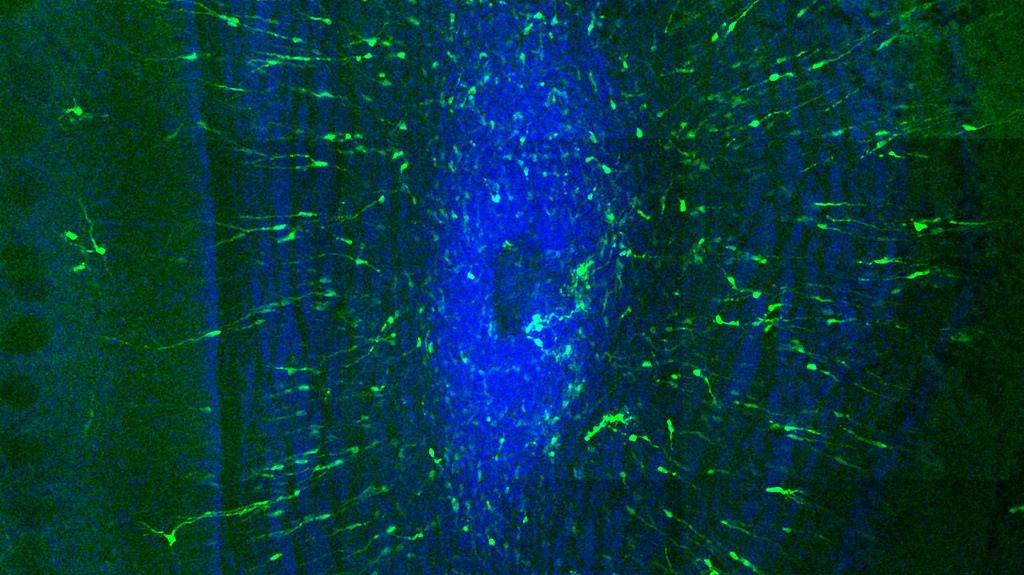
    A cross section of the mouse olfactory bulb. Green is electroporated neuroblasts born in the sub-ventricular zone that migrated into the olfactory bulb. Blue is a DAPI nuclear counterstain. Credit: Francis Szele

    New research has shown how an unusual gene is needed for brain development in young mice.

    Since the human genome was first sequenced in 2001, scientists have puzzled over swathes of our DNA that despite apparently lacking function are made into ribonucleic acid (RNA) by the cell. Why make RNA at all when it is not then used to make proteins, which perform fundamental biological tasks? Perhaps these so-called non-coding RNAs perform critical, but as yet unknown, tasks?

    Scientists from the Universities of Bath, Oxford, and Edinburgh have now identified one such non-coding RNA, called Paupar, which influences how healthy brains develop during early life. They have shown that Paupar orchestrates proteins that control neurodevelopment.

    They studied KAP1, a gene that codes for an essential protein associated with several fundamental processes in neurodevelopment. The KAP1 protein acts as a regulator for several other genes which allow the brain to grow healthily and develop several types of brain cells.

    Using molecular biology techniques they discovered that Paupar can act as a switch, modulating how KAP1 acts by binding to it– thus influencing the development of healthy brains in mice. It is the first time that a non-coding RNA has been shown to bind to KAP1.

    The research is published in The EMBO Journal.

    Dr. Keith Vance, from the University of Bath Department of Biology & Biochemistry led the research. He said: “It is now clear that the genome expresses many non-coding RNAs that are not made into protein. Despite this, there are a lot of controversies regarding their function. Some groups argue that these non-coding RNAs are a result of transcriptional noise with no apparent use whilst others think that the vast majority of them must be doing something important.”

    “We have shown here good evidence that one of these genes, called Paupar, is important for the development of the brain.”

    “It’s a young field, but I think it’s clear we have to reassess the central dogma of molecular biology that DNA is transcribed to RNA that codes for a protein. We’re now seeing that some RNAs can go off and do something themselves.”

    “Our findings also help us understand the essential role of KAP1, which is something we’re really interested in as we look at the development of the central nervous system.”

    This research was funded by the Biotechnology and Biological Sciences Research Council (BBSRC) and the Medical Research Council (MRC).

    Reference: “The long non‐coding RNA Paupar promotes KAP1‐dependent chromatin changes and regulates olfactory bulb neurogenesis” by Ioanna Pavlaki, Farah Alammari, Bin Sun, Neil Clark, Tamara Sirey, Sheena Lee, Dan J Woodcock, Chris P Ponting, Francis G Szele and Keith W Vance, 16 April 2018, The EMBO Journal.
    DOI: 10.15252/embj.201798219

    Never miss a breakthrough: Join the SciTechDaily newsletter.
    Follow us on Google and Google News.

    Brain Genetics Molecular Biology Neurology RNA University of Bath
    Share. Facebook Twitter Pinterest LinkedIn Email Reddit

    Related Articles

    Scientists Use CRISPR to Target Gene Messages Involved in Early Development

    We Are Mutating SARS-CoV-2 – The COVID-19 Virus – But It Is Evolving Back

    New Insight on CLOCK Gene May Hold Answers to Human Brain Evolution

    Scientists Discover a Gene for Brain Size

    Gene Linking Brain Structure to Intelligence Identified

    Penn State Researchers Discover the Origins of Genomic “Dark Matter”

    Key Differences in Seemingly Synonymous Parts of the Genetic Code

    Reaction to Placebo Effect May Be Genetic

    Atomic Level Splicing Further Establishes RNA’s Chemical and Structural Complexity

    Leave A Reply Cancel Reply

    • Facebook
    • Twitter
    • Pinterest
    • YouTube

    Don't Miss a Discovery

    Subscribe for the Latest in Science & Tech!

    Trending News

    The Universe Is Expanding Too Fast and Scientists Can’t Explain Why

    “Like Liquid Metal”: Scientists Create Strange Shape-Shifting Material

    Early Warning Signals of Esophageal Cancer May Be Hiding in Plain Sight

    Common Blood Pressure Drug Shows Surprising Power Against Deadly Antibiotic-Resistant Superbug

    Scientists Uncover Dangerous Connection Between Serotonin and Heart Valve Disease

    Scientists Discover a “Protector” Protein That Could Help Reverse Hair Loss

    Bone-Strengthening Discovery Could Reverse Osteoporosis

    Scientists Uncover Hidden Trigger Behind Stem Cell Aging

    Follow SciTechDaily
    • Facebook
    • Twitter
    • YouTube
    • Pinterest
    • Newsletter
    • RSS
    SciTech News
    • Biology News
    • Chemistry News
    • Earth News
    • Health News
    • Physics News
    • Science News
    • Space News
    • Technology News
    Recent Posts
    • Scientists Overcome Major Quantum Bottleneck, Potentially Transforming Teleportation and Computing
    • Quantum Physics’ Strangest Problem May Hold the Key to Time Itself
    • Scientists Create “Liquid Gears” That Spin Without Touching
    • The Simple Habit That Could Help Prevent Cancer
    • Forgotten Medicinal Plant Shows Promise in Fighting Dangerous Superbugs
    Copyright © 1998 - 2026 SciTechDaily. All Rights Reserved.
    • Science News
    • About
    • Contact
    • Editorial Board
    • Privacy Policy
    • Terms of Use

    Type above and press Enter to search. Press Esc to cancel.