
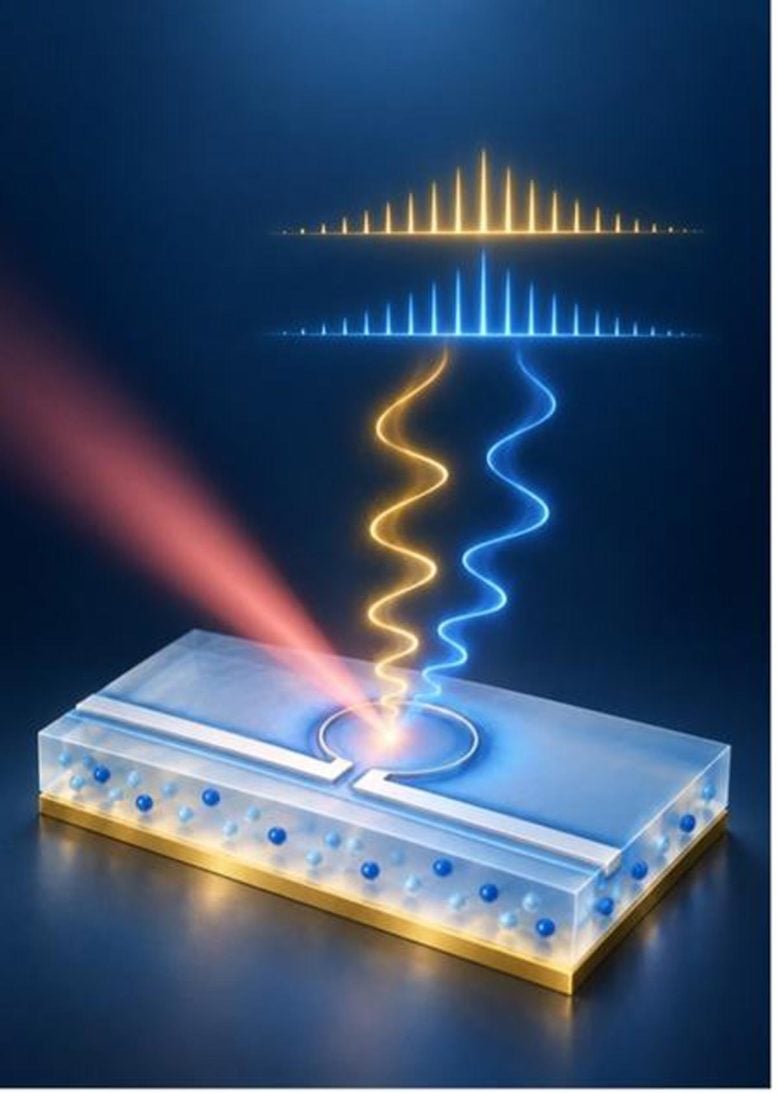
Caltech scientists aimed a laser at a crystal and watched billions of atoms fall into step, firing bursts of microwaves and infrared light in perfect sync.
In early 2024, researchers in Andrei Faraon’s Caltech lab discovered that a laser could make billions of atoms inside a crystal emit regularly spaced pulses of light. A tiny superconducting circuit trapped the microwaves the atoms emitted, creating a shared field that brought the atoms into sync.
“Remarkably, the atoms were flashing in two very different kinds of light at once, microwaves and infrared light, in perfect step with each other. That had not been observed before,” says Andrei Faraon (BS ’04), Caltech’s William L. Valentine Professor of Applied Physics and Electrical Engineering and the Fletcher Jones Foundation Director of the Kavli Nanoscience Institute.
Faraon’s team and Stanford University researchers led by Joonhee Choi traced the rhythm to a quantum phenomenon called superradiance. They used it to create a frequency comb, a light source with evenly spaced frequencies that serve as the ticks on a ruler. Frequency combs help atomic clocks keep precise time, let scientists measure distances and track ultrafast events, and identify chemicals by the light they absorb. The new comb generates both microwave and optical signals, a combination that could help connect quantum devices.
What Made the Crystal Pulse?
The team embedded billions of ytterbium ions, or charged atoms, in a yttrium orthovanadate crystal beneath a thin layer of superconducting material that trapped microwaves. A laser energized the ions, and the microwave field they generated enabled them to influence one another and synchronize. At first, they emitted microwaves steadily. Once the laser power crossed a threshold, the steady emission gave way to regularly spaced pulses.
Scientists have known about superradiance for more than 50 years. In this process, a shared electromagnetic field synchronizes atoms so they emit light together. Earlier experiments had produced a single flash or a steady beam. In the crystal, the ions settled into a rhythm and flashed repeatedly.

“Imagine a crowd suddenly starting to clap in perfect rhythm without anyone leading them. That’s essentially what these atoms are doing when they produce repeated flashes of light, and it’s remarkable that they can organize themselves this way,” says Choi, a Stanford assistant professor and former Caltech postdoctoral scholar.
How the Atoms Could Keep Frequencies Steady
In a conventional laser, light bouncing between mirrors prompts excited atoms to release energy in step with the passing light. The spacing between the mirrors helps set the frequency, so even a tiny shift can change it. With superradiance, the atoms themselves can set the emission frequency.
“Other mode-locked frequency combs depend on bouncing light off mirrors in a cavity, and those cavity lengths can fluctuate due to things like temperature,” says Tian Xie (PhD ’25), lead author of the Nature paper. “Because superradiance comes from atom–atom interference, it’s absolutely frequency-stable, and therefore it can, in principle, be a much better platform than previous frequency combs.” Xie completed the work as a graduate student in Faraon’s lab and is now a postdoctoral researcher at Stanford.
The team wants to use the laser to control how the ions pulse, “so that the atoms become a kind of programmable light source,” Faraon says. “Being able to tune each emission strength, pulse separation, and emission format would be very useful to suit each specific application,” he says.
A Possible Link Between Quantum Devices
Superconducting quantum computers use microwave signals, which easily lose their quantum information outside the ultracold conditions near absolute zero (about minus 460 degrees Fahrenheit). Infrared light can carry information over long distances through fiber optic cables. For a superconducting circuit to use that connection, its microwave signals would need to be converted into optical signals.
Ytterbium ions can interact with both. Each ion has three energy levels relevant to the experiment. The smaller gap between a pair of levels matches the energy of a microwave photon, while a larger gap matches the energy of an infrared photon.
“Whenever these ions generate a microwave field, there is a process that naturally generates a corresponding optical field at the same time,” Xie says. “That’s why in the experiment, you send a laser light to pump the atoms, and you see two emissions coming out at very different frequencies.” The paired emissions suggest the ions could one day link superconducting circuits to optical fibers.
Reference: “Observation of tunable superradiant frequency combs” by Tian Xie, Rikuto Fukumori, Wai-Keong Mok, Jiahui Li, Joonhee Choi and Andrei Faraon, 18 November 2026, Nature.
DOI: 10.1038/s41586-026-11289-7
The work was primarily funded by the Office of Naval Research with additional support from the Institute of Quantum Information and Matter (IQIM), the US Department of Energy, the Co-design Center for Quantum Advantage, and the Gordon and Betty Moore Foundation Experimental Physics Investigators. Individual researchers were supported by the Air Force Office of Scientific Research, the Terman Faculty Fellowship at Stanford University, the Quad Fellowship, and the Eddleman Fellowship.
Never miss a breakthrough: Join the SciTechDaily newsletter.
Follow us on Google and Google News.