

Laboratory research suggests that nearby proteins can reshape enzymes, offering clues to how the physical environment inside our cells may help regulate the chemistry of life.
In laboratory droplets designed to mimic conditions inside cells, enzymes worked faster as the liquid became more crowded with proteins, up to a point. Active enzymes also helped nearby molecules move more freely through the liquid.
Many of the chemical reactions that keep cells alive occur in the cytoplasm, where proteins and other molecules can gather into compartments without an enclosing membrane. Researchers from the Okinawa Institute of Science and Technology (OIST), in collaboration with the Max Planck Institute for Dynamics and Self-Organization (MPI-DS) and RIKEN, studied how enzymes interact with these crowded environments.
“What’s fascinating is that we can connect interactions between individual atoms to the movement of molecules across an entire droplet. Events at the smallest scales can shape, and be shaped by, the physical behavior of a much larger system,” says senior author Professor Paola Laurino, who leads the Protein Engineering and Evolution Unit at OIST.
The unexpected benefits of molecular crowding
The OIST researchers prepared tiny droplets containing different concentrations of a protein called bovine serum albumin (BSA). In separate experiments, they introduced two enzymes, lactate dehydrogenase (LDH) and alcohol dehydrogenase (ADH), along with their substrates, the molecules upon which the enzymes act.
Enzyme activity increased as more BSA was added to the droplets. Only at very high protein concentrations did crowding begin to interfere with the reactions.
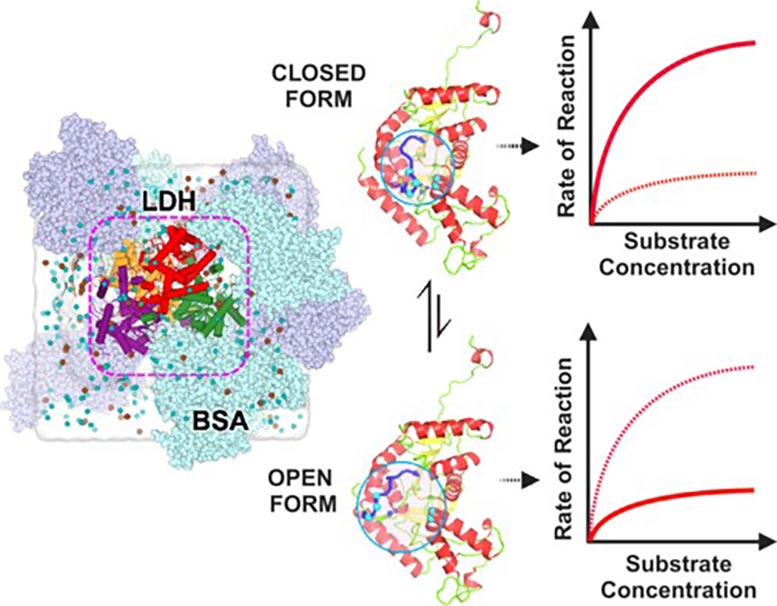
“This initial increase in enzymatic activity seemed counter-intuitive, as you’d typically expect any level of crowding to impair movement of the enzymes and substrates and increase the liquid’s viscosity, therefore slowing down the reaction from the start,” explains Laurino.
Active enzymes keep molecules moving
Laurino and her team also used fluorescent tracers to examine how enzyme activity affected the movement of molecules within the droplets. Both BSA proteins and fluorescent nanoparticles moved more freely in the presence of active enzymes. Droplets containing modified, inactive enzymes were more viscous, and molecules moved more slowly through them.
“Similarly, we found that higher concentrations of the enzymes or their substrates in the droplets also increased mobility,” says Professor Ramin Golestanian, director of the Department of Living Matter Physics at MPI-DS.
The researchers used fluorescent markers to track the movement of nanoparticles in the droplet. Credit: Dindo et al., 2026, 10.1038/s41467-026-77666-y.
Changing shapes and microscopic currents
Molecular dynamics (MD) simulations conducted by researchers at RIKEN suggested that crowding helped accelerate reactions by changing the shape of the enzymes. The simulations showed that the active site, the region where substrates bind and react, was open under dilute conditions and closed as the concentration of surrounding proteins increased.
“When closed, the energy barrier required was much lower, allowing the reaction to happen more readily,” explains Laurino. “To detect such a change in these simulations by MD was really surprising to us.”
Researchers at MPI-DS developed a theoretical model to explain the increased movement within the droplets. They proposed that enzyme activity creates differences in chemical concentrations throughout the liquid, generating tiny flows.
“These flows allow the molecules to move more freely and mix within the droplet, highlighting how enzyme activity can potentially lead to physical effects across larger scales,” says Golestanian.
Laurino plans to investigate whether these interactions also occur in complexes where several enzymes operate in close proximity. Her team will also conduct experiments in living bacterial cells to determine whether the findings hold under more complex biological conditions.
Reference: “Enzymes can activate and mobilize dense biomolecular condensates across scales” by Mirco Dindo, Jakob Metson, Weitong Ren, Michalis Chatzittofi, Kiyoshi Yagi, Alessandro Bevilacqua, Erika Fukuhara, Yuji Sugita, Ramin Golestanian and Paola Laurino, 30 October 2026, Nature Communications.
DOI: 10.1038/s41467-026-77666-y
Funding: Okinawa Institute of Science and Technology Graduate University, Japan Society for the Promotion of Science, Ministry of Education, Culture, Sports, Science and Technology Japan, RIKEN
Never miss a breakthrough: Join the SciTechDaily newsletter.
Follow us on Google and Google News.