
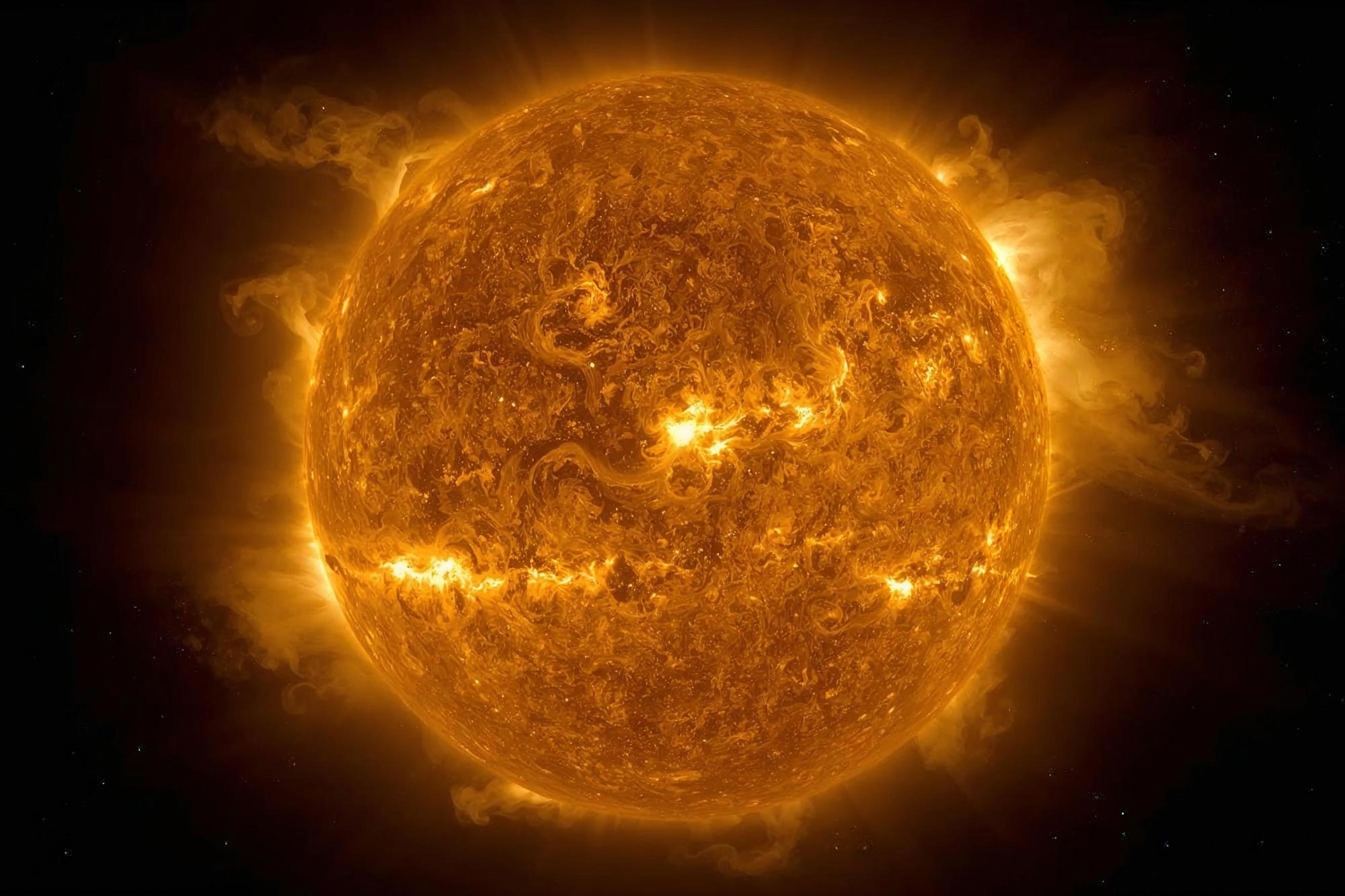
Some of the oldest rocks in the solar system hinted that astronomers were undercounting the Sun’s silver. A fresh look at sunlight suggests they were right.
Researchers at Uppsala University estimate that silver is 55 percent more abundant in the Sun than previous calculations indicated.
The revised estimate brings the Sun much closer to the silver abundance found in primitive meteorites. Both preserve material from the same cloud of gas and dust that gave rise to the solar system 4.6 billion years ago.
How Sunlight Reveals Silver
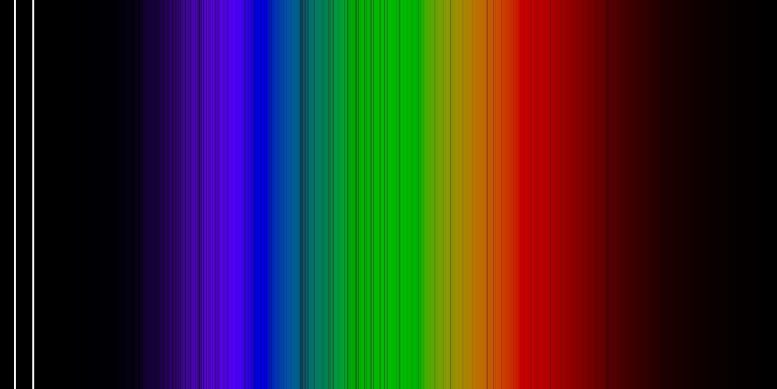
Silver atoms in the Sun’s atmosphere absorb light at specific wavelengths, leaving dark lines in the spectrum. The pattern identifies silver, but estimating how much is there requires a model that predicts how strongly those atoms absorb light.
The team modeled the motion of the Sun’s outer layers and used more detailed calculations of how silver atoms interact with light and other particles. The model accounts for how radiation changes the energy states of silver atoms, which affects the strength of the lines astronomers use to measure the element’s abundance.
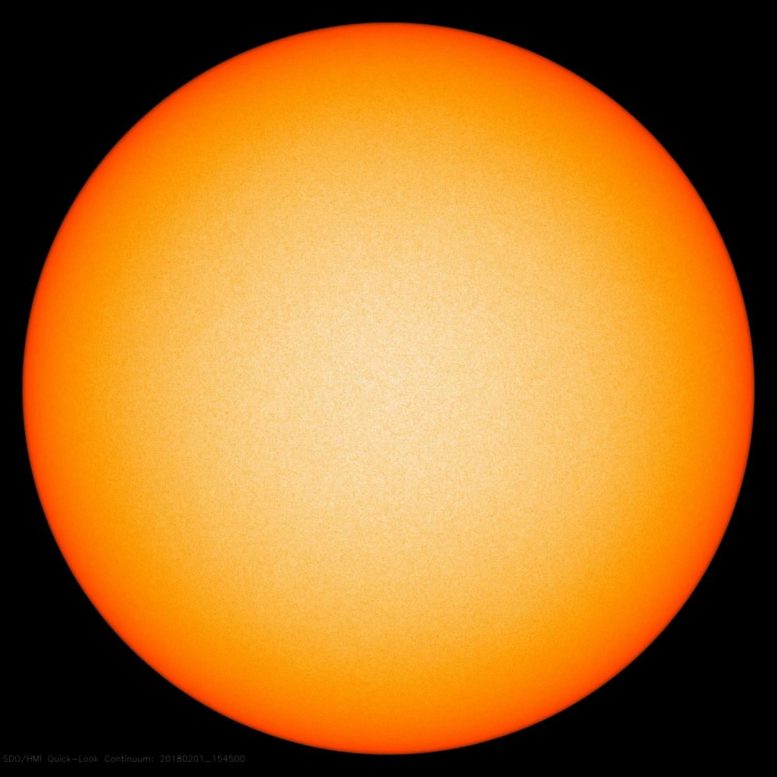
“With our new model, we were able to interpret the spectral lines used to determine the solar silver abundance more accurately,” says Sema Caliskan, who conducted the research during her PhD studies at Uppsala University.
Tracing Silver Across the Milky Way
Hydrogen and helium make up nearly all of the Sun. Heavier elements such as carbon, iron, and silver account for just 1.5 percent of its mass. Many of these elements form inside stars or during stellar explosions, then become part of later generations of stars and planets. Measuring their abundance helps astronomers reconstruct how the Milky Way’s chemistry changed over time.
“The new knowledge about the Sun’s composition is important for the understanding of other stars, planets, and cosmic material, because the Sun is one of astronomy’s key reference points,” says Caliskan.
The team plans to apply the same method to other stars. “By studying the light of stars of different types and ages, we hope to understand where silver is formed in the universe, and how it has been distributed throughout the Milky Way over time,” says Caliskan.
Reference: “Ag I model atom and the 3D non-LTE solar silver abundance” by S. Caliskan, A. M. Amarsi, P. Jönsson, N. Grevesse and B. K. Sahoo, 17 July 2026, Astronomy & Astrophysics.
DOI: 10.1051/0004-6361/202659578
This study was funded by the Swedish Research Counsil, KVA Kungliga vetenskapsakademien, and ANRF India.
Never miss a breakthrough: Join the SciTechDaily newsletter.
Follow us on Google and Google News.