
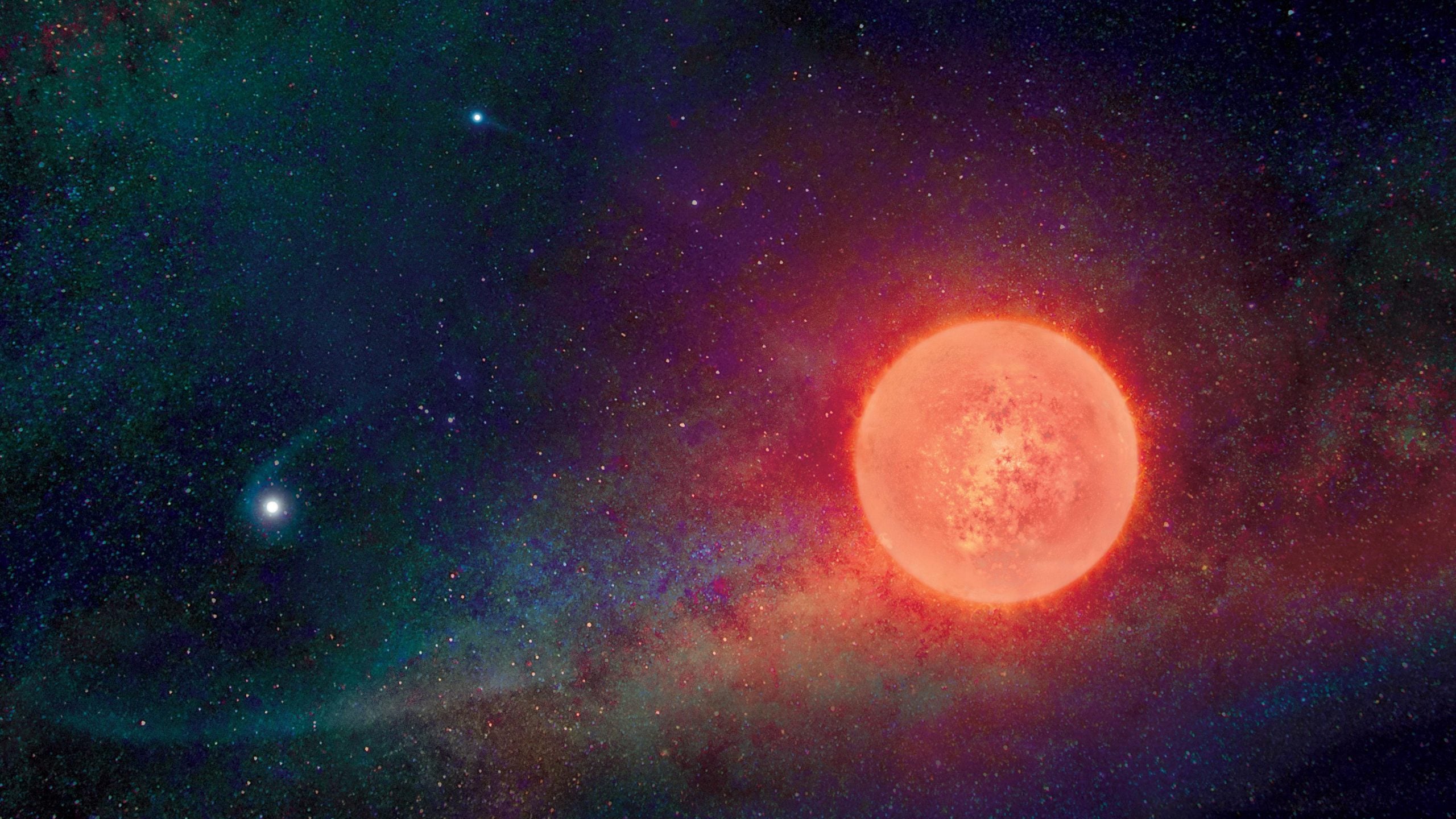
A red dwarf still circles the burned-out core of a star that could once have swallowed it, and their orbit is wider than astronomers expected.
A planet too faint to see can still give itself away by making the star it orbits wobble. Astronomers looking for planets around a dim red star 28 light-years from Earth measured a wobble more than a thousand times larger than they expected. Following that motion revealed a family of three stars, two of which had already run out of fuel.
“We were actually looking for planets,” said lead author Étienne Artigau, a researcher at Université de Montréal’s Trottier Institute for Research on Exoplanets (IREx). “Instead, we found something much more surprising.”

A strong pull from a faint companion
The star they were watching was a red dwarf, a star much dimmer than the Sun. At the Canada-France-Hawaii Telescope on Maunakea, Hawaiʻi, a planet-hunting instrument called SPIRou (SPectropolarimètre InfraROUge) picked up a change of nearly 16 kilometers (10 miles) per second in the star’s speed. After several years of follow-up observations, the team knew that whatever was tugging on the red dwarf had more than half the Sun’s mass.
“The unusual combination of high mass and very low brightness left only one plausible explanation: it was the remnant of a dead star,” said Charles-Antoine Parent, an undergraduate student at Université Laval and co-author of the study. “The most likely explanation was a white dwarf, although a neutron star or even a black hole couldn’t be ruled out.”
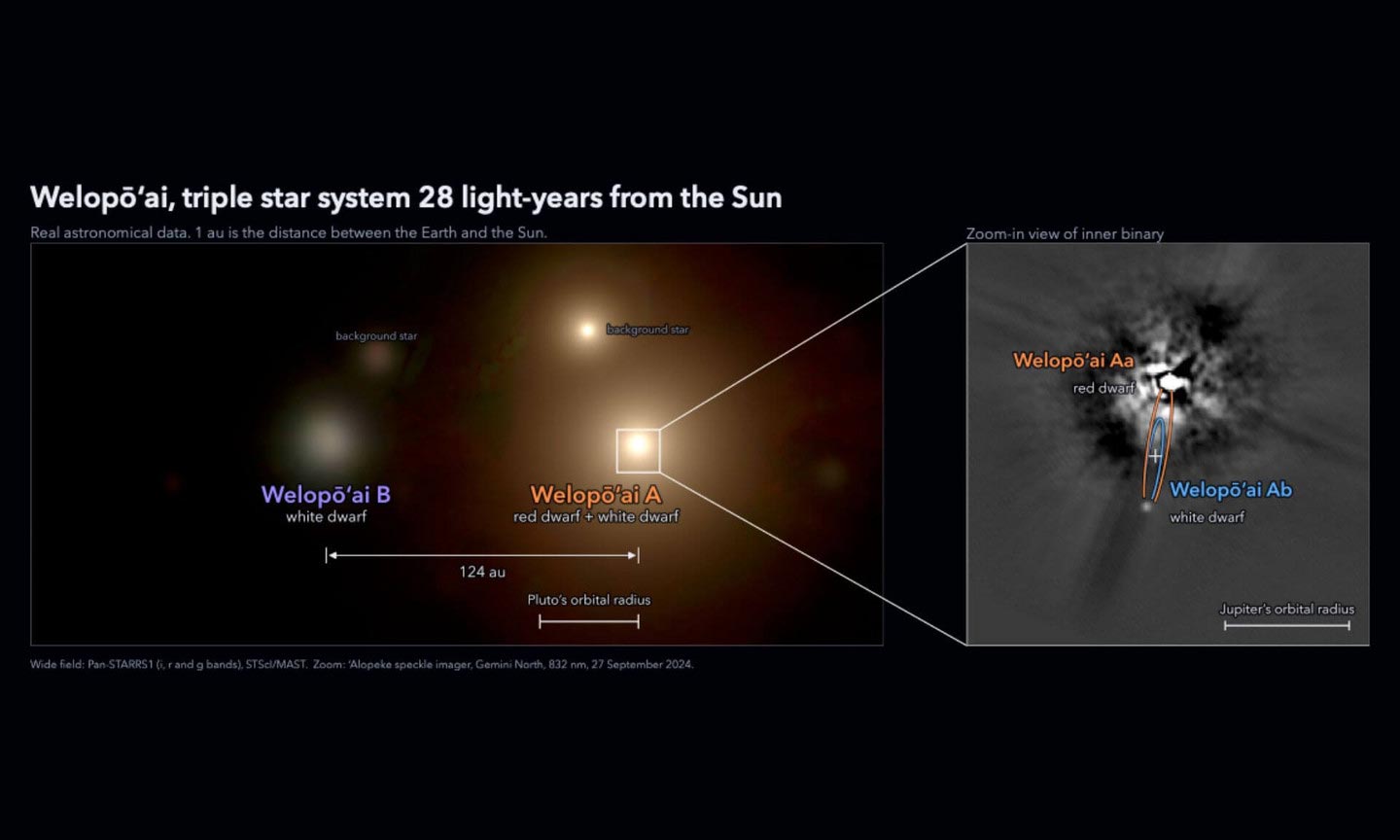
The team finally saw the faint companion with Gemini North, another telescope on Maunakea. High-resolution images from its ʻAlopeke instrument showed a white dwarf orbiting the red dwarf. A white dwarf is the extremely dense core a star leaves behind after it runs out of fuel. Most stars, including the Sun, will end their lives this way.
Astronomers already knew about a white dwarf much farther out. That outer star circles both the red dwarf and its newly spotted companion. No other trio like this one, named Welopōʻai, is known within 100 light-years of Earth.

The red dwarf’s unexpectedly wide orbit
Before it became a white dwarf, the red dwarf’s closer neighbor was about 40 percent more massive than the Sun. As it aged, it swelled into a giant several hundred times its original size. The red dwarf would have been close enough for the expanding giant to affect it. In similar systems, a giant can swallow its companion, and the two stars can even merge. Welopōʻai’s red dwarf appears to have survived. It now circles the remnant in a stable orbit, farther away than astronomers would expect given how close the two once were.
“This system should not exist,” said Patrick Dufour, a professor at Université de Montréal who studies white dwarfs and co-authored the paper. “We have no clean explanation for how it got here. That is the question driving our next observations.”
The team wants to find out whether the pull of all three stars on one another could explain the inner pair’s orbit. The researchers also measured the inner white dwarf’s mass with an uncertainty of less than 1 percent. Astronomers rarely get such a precise mass for a white dwarf, and it gives them a way to test predictions about how stars age and how matter behaves when packed so tightly together. The international team, led by IREx, reported its in Astronomy & Astrophysics.
The simulation illustrates how gravitational interactions between its three stars could influence their orbits over time. The sonification translates the stars’ orbital motions into sound, so you can hear the system’s changing rhythms. Credit: Heidi White (UMONTREAL/IREx). Simulation data: Alexandre Correia, University of Coimbra
Family and orbit in one Hawaiian name
Welopōʻai got its name through A Hua He Inoa (“To Call Forth a Name”), a program of the ʻImiloa Astronomy Center of Hawaiʻi. The name joins welo, an inherited or family trait, with pōʻai, an orbit or circular path. Together they evoke a “path of family traits.”
“Discoveries like this remind us that our own cosmic neighborhood still contains remarkable surprises,” Artigau said. “Even when we’re searching for planets, our Universe often has something completely unexpected waiting for us.”
Reference: “Welopō‘ai: A peculiar triple system 8 pc from the Sun” by Étienne Artigau, Charles-Antoine Parent, Atanas K. Stefanov, Érika Le Bourdais, Souleymane Ouedraogo, Alexandrine L’Heureux, Patrick Dufour, René Doyon, Neil J. Cook, Charles Cadieux, Clémence Fontanive, Luc Arnold, Jean-François Donati, Matthias R. Schreiber, Ryan Cloutier, Xavier Delfosse, Céline Reylé, Thierry Forveille, Tianqi Cang, Claire Moutou and Alexandre C. M. Correia, 19 November 2026, Astronomy & Astrophysics.
DOI: 10.1051/0004-6361/202661214
Never miss a breakthrough: Join the SciTechDaily newsletter.
Follow us on Google and Google News.