
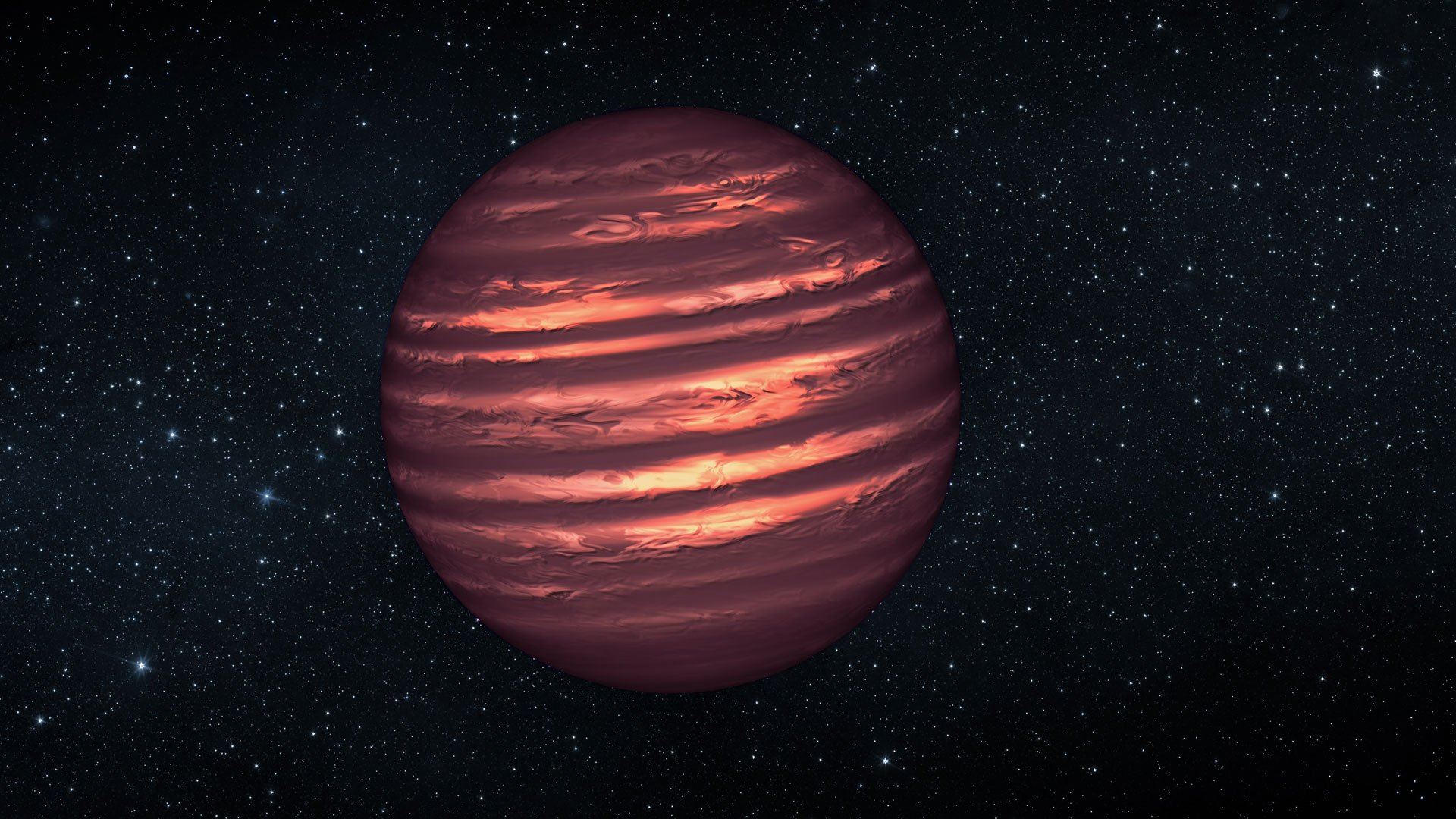
Planetary scientists wondered if bands of winds or swirling storms dominated the atmospheres of brown dwarfs. University of Arizona-led research has solved the mystery.
A University of Arizona-led research team has found bands and stripes on the brown dwarf closest to Earth, hinting at the processes churning the brown dwarf’s atmosphere from within.
Brown dwarfs are mysterious celestial objects that are not quite stars and not quite planets. They are about the size of Jupiter but typically dozens of times more massive. Still, they are less massive than the smallest stars, so their cores do not have enough pressure to fuse atoms the way stars do. They are hot when they form and gradually cool, glowing faintly and dimming slowly throughout their lives, making them hard to find. No telescope can clearly see the atmospheres of these objects.
“We wondered, do brown dwarfs look like Jupiter, with its regular belts and bands shaped by large, parallel, longitudinal jets, or will they be dominated by an ever-changing pattern of gigantic storms known as vortices like those found on Jupiter’s poles?” said UArizona researcher Daniel Apai, an associate professor in the Department of Astronomy and Steward Observatory and the Lunar and Planetary Laboratory.
Apai is lead author of a new study published on January 7, 2021, in The Astrophysical Journal that seeks to answer that question using a novel technique.
Study Reveals Wind Patterns
He and his team found that brown dwarfs look strikingly similar to Jupiter. The patterns in the atmospheres reveal high-speed winds running parallel to the brown drawfs’ equators. These winds are mixing the atmospheres, redistributing heat that emerges from the brown dwarfs’ hot interiors. Also, like Jupiter, vortices dominate the polar regions.
Some atmospheric models predicted this atmospheric pattern, Apai said, including models by the late Adam Showman, a UArizona Lunar and Planetary Laboratory professor and a leader in brown dwarf atmosphere models.
“Wind patterns and large-scale atmospheric circulation often have profound effects on planetary atmospheres, from Earth’s climate to Jupiter’s appearance, and now we know that such large-scale atmospheric jets also shape brown dwarf atmospheres,” said Apai, whose co-authors on the paper include the Astronomical Observatory of Padua’s Luigi Bedin and Domenico Nardiello, who is also affiliated with Laboratoire d’Astrophysique de Marseille in France.
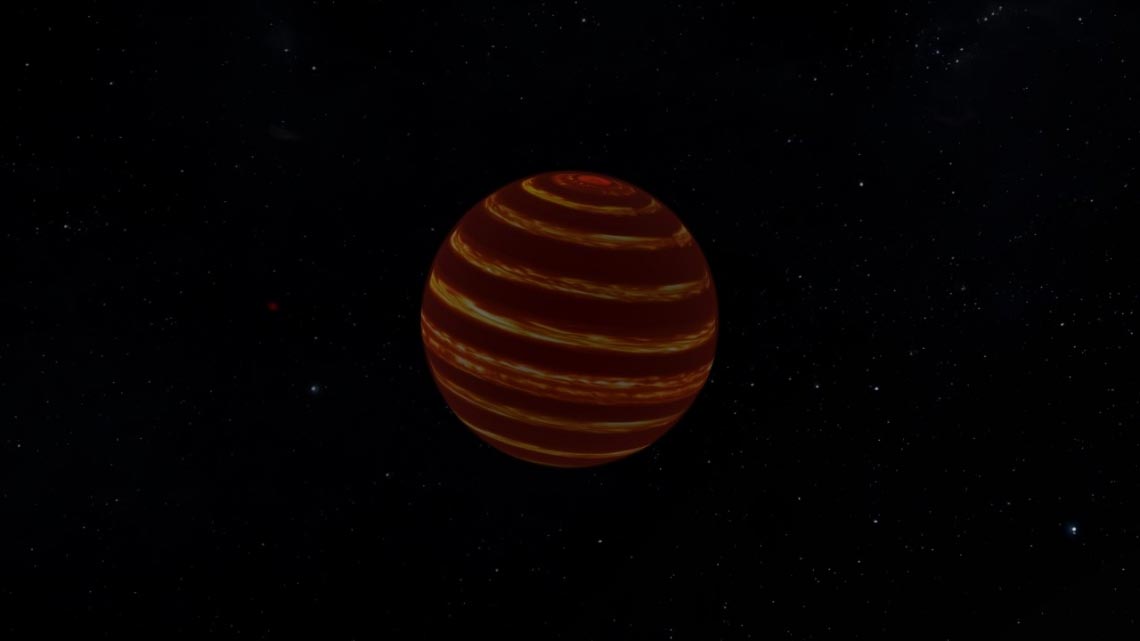
“Knowing how the winds blow and redistribute heat in one of the best-studied and closest brown dwarfs helps us to understand the climates, temperature extremes, and evolution of brown dwarfs in general,” Apai said.
Apai’s group at UArizona is a world leader in mapping the atmospheres of brown dwarfs and planets outside of our solar system using space telescopes and a new method.
The team used NASA’s Transiting Exoplanet Survey Satellite, or TESS, space telescope to study the two brown dwarfs closest to Earth. At only 6 1/2 light-years away, the brown dwarfs are called Luhman 16 A and B. While both are about the same size as Jupiter, they are both more dense and therefore contain more mass. Luhman 16 A is about 34 times more massive than Jupiter, and Luhman 16 B – which was the main subject of Apai’s study – is about 28 times more massive than Jupiter and about 1,500 degrees Fahrenheit (830 degrees Celsius) hotter.
“The TESS space telescope, although designed to hunt for extrasolar planets, also provided this incredibly rich and exciting dataset on the closest brown dwarf to us,” Apai said. “With advanced algorithms developed by members of our team, we were able to obtain very precise measurements of the brightness changes as the two brown dwarfs rotated. The brown dwarfs get brighter whenever brighter atmospheric regions turn into the visible hemisphere and darker when these rotate out of view.”
A New Way to Map Distant Atmospheres
Since the space telescope provides extremely precise measurements and it is not interrupted by daylight, the team collected more rotations than ever before, providing the most detailed view of a brown dwarf’s atmospheric circulation.
“No telescope is large enough to provide detailed images of planets or brown dwarfs,” Apai said. “But by measuring how the brightness of these rotating objects changes over time, it is possible to create crude maps of their atmospheres – a technique that, in the future, could also be used to map Earthlike planets in other solar systems that might otherwise be hard to see.”
The researchers’ results show that there is a lot of similarity between the atmospheric circulation of solar system planets and brown dwarfs. As a result, brown dwarfs can serve as more massive analogs of giant planets existing outside of our solar system in future studies.
“Our study provides a template for future studies of similar objects on how to explore – and even map – the atmospheres of brown dwarfs and giant extrasolar planets without the need for telescopes powerful enough to resolve them visually,” Apai said.
Apai’s team hopes to further explore the clouds, storm systems and circulation zones present in brown dwarfs and extrasolar planets to deepen our understanding of atmospheres beyond the solar system.
Reference: “TESS Observations of the Luhman 16 AB Brown Dwarf System: Rotational Periods, Lightcurve Evolution, and Zonal Circulation” by Dániel Apai, Domenico Nardiello and Luigi R. Bedin, 7 January 2021, The Astrophysical Journal.
DOI: 10.3847/1538-4357/abcb97
Never miss a breakthrough: Join the SciTechDaily newsletter.
Follow us on Google and Google News.