
Life around white dwarfs likely evolves after the star’s death, as earlier stellar winds would strip atmospheres unless shielded by extreme magnetospheres.
Any life identified on planets orbiting white dwarf stars almost certainly evolved after the star’s death, says a new study led by the University of Warwick that reveals the consequences of the intense and furious stellar winds that will batter a planet as its star is dying. The research is published in Monthly Notices of the Royal Astronomical Society, and lead author Dr. Dimitri Veras presented it today (July 21, 2021) at the online National Astronomy Meeting (NAM 2021).
The research provides new insight for astronomers searching for signs of life around these dead stars by examining the impact that their winds will have on orbiting planets during the star’s transition to the white dwarf stage. The study concludes that it is nearly impossible for life to survive cataclysmic stellar evolution unless the planet has an intensely strong magnetic field — or magnetosphere — that can shield it from the worst effects.
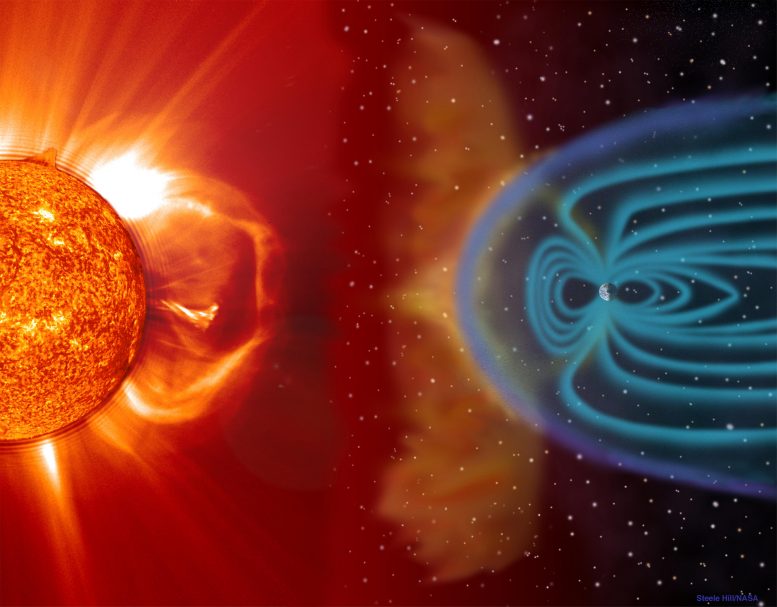
In the case of Earth, solar wind particles can erode the protective layers of the atmosphere that shield humans from harmful ultraviolet radiation. The terrestrial magnetosphere acts like a shield to divert those particles away through its magnetic field. Not all planets have a magnetosphere, but Earth’s is generated by its iron core, which rotates like a dynamo to create its magnetic field.
“We know that the solar wind in the past eroded the Martian atmosphere, which, unlike Earth, does not have a large-scale magnetosphere. What we were not expecting to find is that the solar wind in the future could be as damaging even to those planets that are protected by a magnetic field,” says Dr. Aline Vidotto of Trinity College Dublin, the co-author of the study.
When Stars Turn Deadly: Red Giant Winds
All stars eventually run out of available hydrogen that fuels the nuclear fusion in their cores. In the Sun the core will then contract and heat up, driving an enormous expansion of the outer atmosphere of the star into a ‘red giant’. The Sun will then stretch to a diameter of tens of millions of kilometers, swallowing the inner planets, possibly including the Earth. At the same time the loss of mass in the star means it has a weaker gravitational pull, so the remaining planets move further away.
During the red giant phase, the solar wind will be far stronger than today, and it will fluctuate dramatically. Veras and Vidotto modeled the winds from 11 different types of stars, with masses ranging from one to seven times the mass of our Sun.
Their model demonstrated how the density and speed of the stellar wind, combined with an expanding planetary orbit, conspires to alternatively shrink and expand the magnetosphere of a planet over time. For any planet to maintain its magnetosphere throughout all stages of stellar evolution, its magnetic field needs to be at least one hundred times stronger than Jupiter’s current magnetic field.
The process of stellar evolution also results in a shift in a star’s habitable zone, which is the distance that would allow a planet to be the right temperature to support liquid water. In our solar system, the habitable zone would move from about 150 million km from the Sun — where Earth is currently positioned — up to 6 billion km, or beyond Neptune. Although an orbiting planet would also change position during the giant branch phases, the scientists found that the habitable zone moves outward more quickly than the planet, posing additional challenges to any existing life hoping to survive the process.
Life After Death: The White Dwarf Era
Eventually, the red giant sheds its entire outer atmosphere, leaving behind the dense hot white dwarf remnant. These do not emit stellar winds, so once the star reaches this stage the danger to surviving planets has passed.
Dr. Veras said: “This study demonstrates the difficulty of a planet maintaining its protective magnetosphere throughout the entirety of the giant branch phases of stellar evolution.”
“One conclusion is that life on a planet in the habitable zone around a white dwarf would almost certainly develop during the white dwarf phase unless that life was able to withstand multiple extreme and sudden changes in its environment.”
Future missions like the James Webb Space Telescope due to be launched later this year should reveal more about planets that orbit white dwarf stars, including whether planets within their habitable zones show biomarkers that indicate the presence of life, so the study provides valuable context to any potential discoveries.
So far no terrestrial planet that could support life around a white dwarf has been found, but two known gas giants are close enough to their star’s habitable zone to suggest that such a planet could exist. These planets likely moved in closer to the white dwarf as a result of interactions with other planets further out.
Dr. Veras adds: “These examples show that giant planets can approach very close to the habitable zone. The habitable zone for a white dwarf is very close to the star because they emit much less light than a Sun-like star. However, white dwarfs are also very steady stars as they have no winds. A planet that’s parked in the white dwarf habitable zone could remain there for billions of years, allowing time for life to develop provided that the conditions are suitable.”
Meeting: Royal Astronomical Society National Astronomy Meeting
Never miss a breakthrough: Join the SciTechDaily newsletter.
Follow us on Google and Google News.
7 Comments
Seems a tiny-bit sensationalized; how about a note that this is NOT expected to happen for a couple of million years?
An argument for long-term planetary engineering (moving your world around).
Heck with it, then. I’m driving a stolen Corvette into the Grand Canyon!!
HA! Ha-ha-ha ha-ha, ha haw-ha haw-ha, ha-ha ha-ha-ha-haw! YEAH!
You know the rest, right? Oh good! That saves so much time. I gotta go steal a Corvette.
The white dwarf remnant no longer generating solar winds adds another problem for life not mentioned in the study:
Gamma radiation from the neutron stars within the galaxy is now greatly mitigated by the helioshphere extending to 100AU and this protection will be gone.
Completely unhindered till hitting the planet’s magnetic field and ionizing its atmosphere can DNA adapt to the increased damage?
To predict the survivability of life the effect of this gamma radiation should be calculated.
The Sun still has 5B years to go before it finally dies, but it will be 2B years before it starts to get uncomfortable, not millions of years.
Family is tge most important
Hate to break it to all you big brain space autists, but a man named Ben behind the suspicious observer team who run the you tube channel ‘space Weather news’ has been telling you all exactly that for years and received endless flak for doing so…
Not the first time he has proven your so called unbiased, biased scientific opinions as arrogance and hueberus’s…
Might be time to start giving the man some credit and listening to what he has to say before it’s too late 😉