
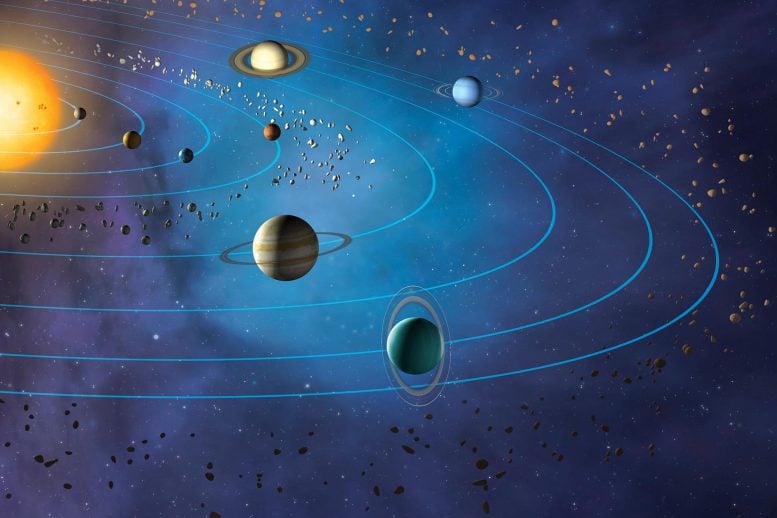
Research shows planet engulfment occurs in up to one-third of Sun-like stars, making stable systems like ours rare.
How common is our Solar System? Less common than we might think.
A significant fraction of planetary systems around Sun-like stars have had a very dynamic past, culminating with the fall of planets into the central star.
A new study involving Monash University astrophysicists sheds light on the scarcity of our Solar System, which has preserved its planets and kept them on nearly circular orbits, an arrangement conducive to life flourishing on Earth.
The research, published recently in Nature Astronomy and led by Dr. Lorenzo Spina at the National Institute for Astrophysics based in Italy, broadens our knowledge on the possible evolutionary paths of planetary systems, according to study co-author Parth Sharma, an Honours student at the Monash University School of Physics and Astronomy.
“Regardless of the technology at our disposal, with millions of nearby Sun-like stars, the search for planets similar to our Earth will always look like the proverbial ‘needle in a haystack’,” said Parth.
“However, our results open the future possibility of using chemical abundances to better identify stars that are likely to host Solar System analogs,” he said.
“These findings represent a significant breakthrough in stellar astrophysics and exoplanet exploration.
“The research refines search parameters for future investigation of potential planetary engulfment events, probes the origins of chemically weird stars, and tells us much about the evolution of solar systems, and planets, like our own.”
Binary Stars Reveal Chemical Mysteries
Stellar members of binary systems are formed from the same material; therefore, they should be chemically identical. However, recent high-precision studies have unveiled chemical differences between the two members of binary pairs composed of Sun-like stars.
The very existence of these chemically inhomogeneous binaries represents one of the most contradictory examples in stellar astrophysics and a source of tension between theory and observations.
“It was still unclear whether the abundance variations are the result of chemical inhomogeneities in the protostellar gas clouds, or if they are due to planet engulfment events occurring after the star has formed,” said Parth.
The research team undertook a statistical study on 107 binary systems composed of Sun-like stars to provide — for the first time — unambiguous evidence in favor of the planet engulfment scenario.
Planet Engulfment Found in 20–35% of Sun-Like Stars
They also established that planet engulfment events occurred in stars similar to our own Sun with a probability ranging between 20% and 35%.
“This implies that a significant fraction of planetary systems undergo very dynamical evolutionary paths that can critically and disastrously modify their architectures, unlike our Solar System which has preserved its planets on nearly circular orbits,” said Parth.
For more on this research, see A Quarter of Stars Like Our Sun Eat Their Own Planets.
Reference: “Chemical evidence for planetary ingestion in a quarter of Sun-like stars” by Lorenzo Spina, Parth Sharma, Jorge Meléndez, Megan Bedell, Andrew R. Casey, Marília Carlos, Elena Franciosini and Antonella Vallenari, 30 August 2021, Nature Astronomy.
DOI: 10.1038/s41550-021-01451-8
Never miss a breakthrough: Join the SciTechDaily newsletter.
Follow us on Google and Google News.
3 Comments
… an odd one, though…
Considering that our technology has only recently allowed us to find any extra-solar planets at all, it should come as no surprise that we haven’t yet found another system like ours.
Parth acknowledges this when he states “Regardless of the technology at our disposal, with millions of nearby Sun-like stars, the search for planets similar to our Earth will always look like the proverbial ‘needle in a haystack’,”
And yet, even with that in mind, he had to go on with the totally unsupported statement “systems like ours may be rare”. We haven’t even fully catalogued 1% of 1% of 1% of 1% of 1% of 1% of the stars we can see in the Milky Way so how in the Universe can anyone seriously make such a conjecture with a straight face?
Lately there have been a lot of “scientists” making grandiose claims based on such small amounts of data as to border on the insignificant. And while Parth is still only an Honours Student at this time, he should know better than to make such sweeping statements.
Get the data first and let claims be based on actual information.
Si déjà nous ne connaissons pas assez notre système solaire, qu’en sera-t-il de ceux plus éloignés ? Et d’ailleurs combien de systèmes solaires connaît-on après le notre. Le nombre de soleils déjà connu ne nous permet pas d’établir une loi et tirer des conclusions du genre. Notre curiosité aiguë de vouloir tout connaître se heurte à la barrière des distances immenses qui nous séparent des autres mondes.
On ne peut que spéculer